About Marasmius cohaerens (Pers.) Cooke & Quél.
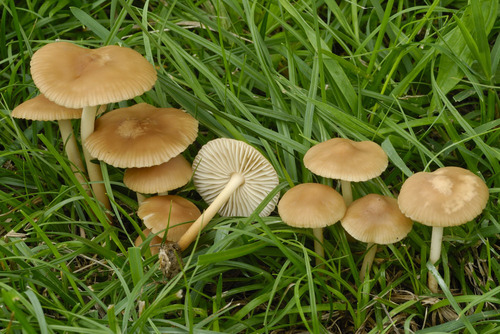
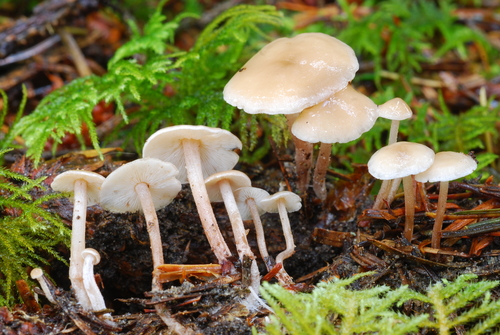
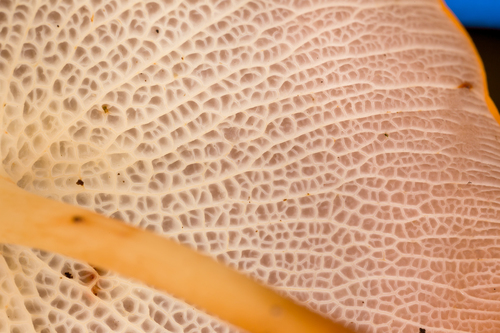
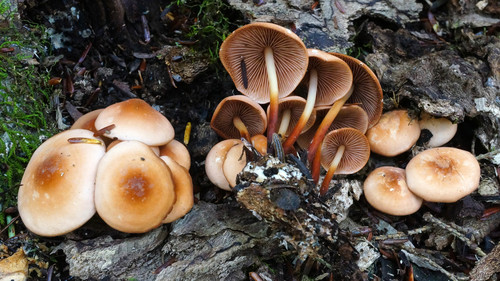
Marasmius cohaerens (Pers.) Cooke & Quél. has a matt or slightly felted cap between 1 cm and 3.5 cm across. Cap colour ranges from pale brown, yellow brown to chocolate brown, and may sometimes have a faint pink tinge. With age, the cap shape changes from campanulate to flat. No ring or other veil remnant is present on the fruiting body. The stem is 5 to 9 cm long, and up to 0.5 cm in diameter. Its colour shifts from dark brown at the base to whitish at the top, with an ochraceous to reddish tone in the middle section, and it has a distinctive shiny, horny consistency. The gills are adnate to almost free, fairly widely spaced, and cream to brownish in colour, with a darker brown edge. Tiny hairs visible on the gill edge when viewed with a hand lens. This species has a mild taste and very faint odour. Its spores are ellipsoid to almond-shaped, measuring approximately 8-10.5 μm by 4–5.5 μm. It has broadly club-shaped cheilocystidia with finger-like protrusions at their distal end; this cell type is called "broom cells of the siccus type", a characteristic also seen in Marasmius siccus. This saprobic mushroom grows singly or in small groups on humus and leaf litter. It is most often found in beech forests or other forests dominated by deciduous trees, and only occurs occasionally in coniferous forests. It is widely distributed, fairly common in Europe and eastern Asia. It also occurs in North America, where it is rare, and additional varieties have been described there; the European variety is M. cohaerens var. cohaerens.