About Marah macrocarpa (Greene) Greene
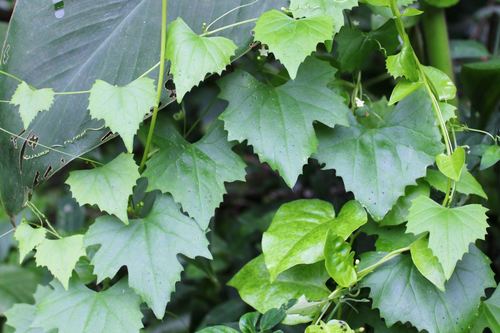
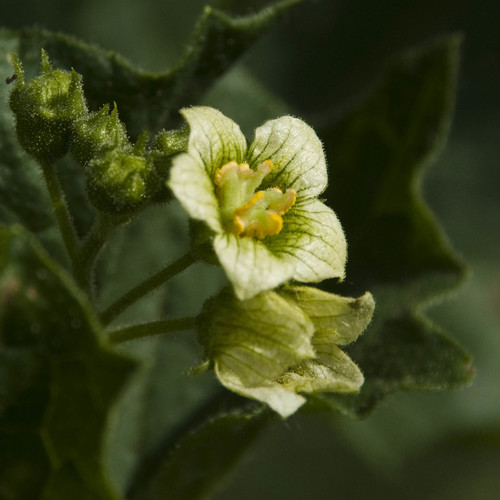
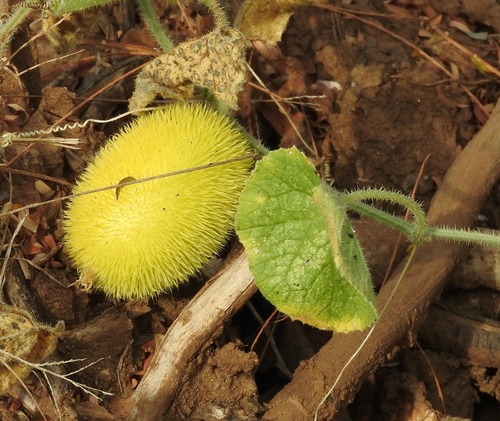
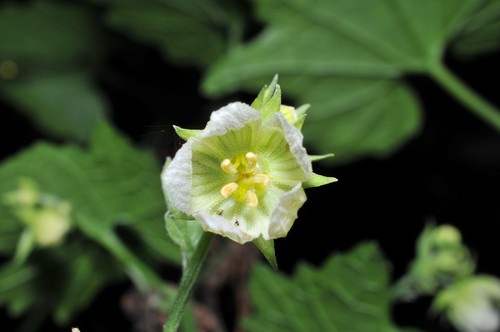
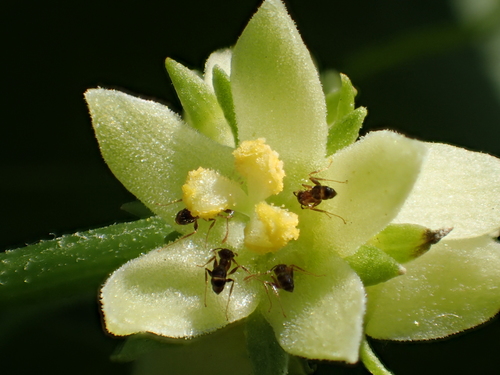
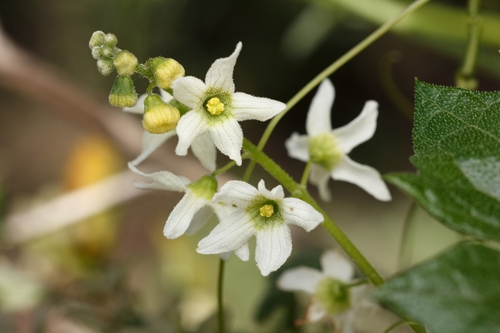
Marah macrocarpa (Greene) Greene has the most densely hairy shoots, stems, and leaves of all Marah species native to California, which aligns with it growing in the driest climate across the range of these species. Its vines emerge in late winter in response to increased rainfall, and can climb or scramble up to 6 meters (20 feet) in length. The subspecies M. m. major, native to California's Channel Islands, is approximately twice as large in all its structures. As an example, leaves from mainland plants are 5 to 10 centimeters wide, while leaves from the Channel Islands subspecies measure 15 to 25 centimeters in width. Mainland seeds are 15 to 20 millimeters long, while insular seeds reach 28 to 33 millimeters in length. The vines grow from a large, hard tuberous root that can reach several meters in length and weigh more than 100 kilograms (220 pounds); weights as high as 500 pounds (227 kilograms) have been recorded. Vines develop leaves, and especially flowers and fruit, very quickly. Often, the first nodes of the fast-growing vines already hold both male and female flower heads. Its leaves typically have five lobes, and individual plants can show wide variation in both leaf size and lobe length. Flowers of Marah macrocarpa range in color from yellowish green to cream to white, and appear soon after the vine emerges. This species is monoecious: individual flowers are either male or female, but both sexes occur on the same plant. Male flowers grow in open clusters, while female flowers, which are distinguished by a swollen base, usually grow singly. The plant is self-fertile, meaning pollen from male flowers can fertilize female flowers on the same individual plant, and pollination is carried out by insects. The fruit of Marah macrocarpa is longer than it is wide, measuring 5–6 cm in diameter and 15–20 cm long. It is covered in prickles of variable density, which reach up to 1 cm long but do not have hooks. Unripe fruit are bright green, and ripen to yellow. The fruit swells as it ripens until it eventually ruptures to release its large seeds. Fruit begin developing in late winter and ripen by early summer. Seeds of Marah macrocarpa are large, hard, and very smooth. This species, also called Southern California manroot, has larger, longer seeds than all other manroot species except Marah horridus. Fruits usually contain four or more seeds. Seeds germinate in the cool, wet conditions of late winter, and follow an unusual germination process. The initial shoot emerges from the seed and grows downward into the soil. This shoot then splits: one part begins to swell and forms the tuber, while the second part grows back up to the surface and develops into the vine. Marah macrocarpa is native to Southern California in the United States and Baja California, Mexico. Its range extends from the Transverse Ranges and Channel Islands through the Peninsular Ranges into the Sonoran Desert. To the north, its distribution is bounded by the Santa Clara River, which also forms the southern boundary of Marah fabacea. It is found throughout Baja California and its adjacent Pacific islands, including Cedros Island. It grows alongside streams, in washes, and on slopes in chaparral and oak woodlands, at elevations up to 900 m (3,000 ft). It can tolerate a wide variety of soil types and acidities, but requires seasonally moist soil. Its vines can grow in conditions from full sun to partial shade. It emerges shortly after winter rains begin, grows until late spring, and dies back completely during the heat and dryness of summer. Ethnographic records note that the most common traditional use of Marah macrocarpa was to treat hair loss and scalp baldness. The Chumash, Kawaiisu, and Cahuilla peoples roasted the seeds and mashed them into an oily black salve, which was then applied to the head. Pharmacological research indicates that cucurbitacins found in Marah are structurally similar to the antiandrogen medication finasteride, and may have similar biological activity, which supports the traditional use of the plant for treating hair loss. The Kumeyaay, Luiseño, Kawaiisu, and Tongva peoples also used M. macrocarpa to relieve pain and inflammation, applying the black salve made from roasted seeds to areas of irritation or sores. The black salve was additionally used for body painting. All parts of the plant are toxic due to the presence of cucurbitacins and ribosome-inactivating proteins, so it was not traditionally eaten by Indigenous groups. In other regions, other Marah species were historically consumed during difficult conditions to carry out suicide or euthanasia.