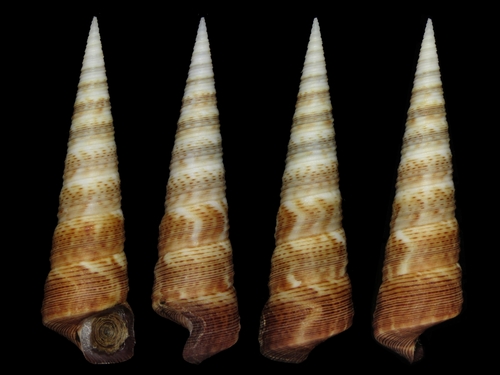
About Maoricolpus roseus (Quoy & Gaimard, 1834)
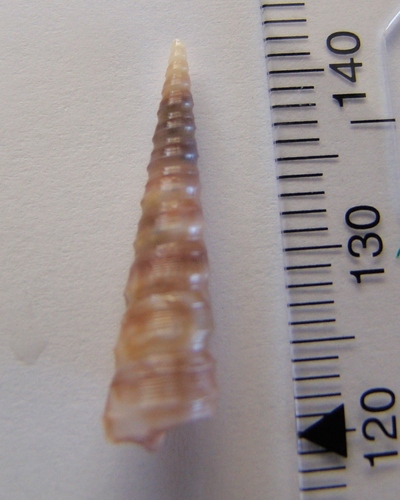
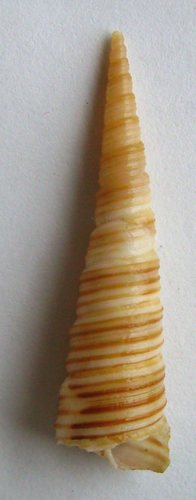
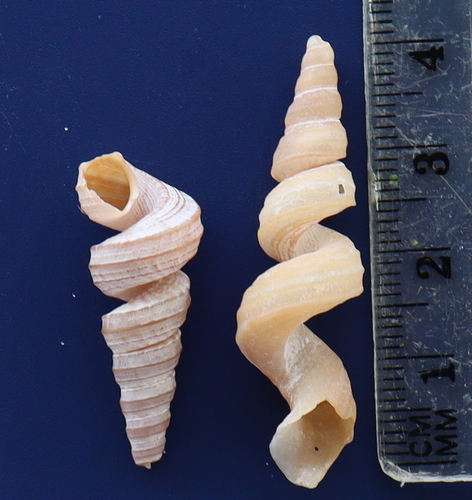
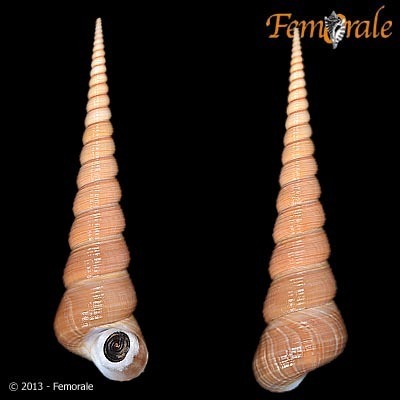
Maoricolpus roseus has a spiral cone-shaped shell that grows up to 87mm in length and 25mm in width. The shell is brownish-purple with a marbled tint. The shell's protoconch has three to four tiny round sections and no visible nucleus. The teleoconch of the shell has about 18 whorls, which form a shape with two angles and a slightly indented middle. The shell texture features three thick ridges: the middle ridge appears first, followed by the lower ridge, then the upper ridge. The shell is covered with both very fine and coarse lines. The base of the shell is flat, with many strong lines and growth marks.
Maoricolpus roseus is native to New Zealand, and also inhabits large areas of Australian waters. It can be found off the coast of New South Wales, the eastern coast of Victoria, Tasmania, and throughout New Zealand. Its tolerance to a range of different temperatures and depths allows its distribution to extend along the Australian coast. Specimens have been collected from Australian locations including Botany Bay in 1999 and D’Entrecasteaux Channel in 1935. Around New Zealand, it is found along most coastlines, with recorded locations including Otago Harbour and Tauranga.
This species is most often found in the benthic zone of the ocean. It occurs frequently in crevices of rock walls and sheltered pockets on more exposed reefs, and can also be found on soft sediment such as silt and gravel. It tolerates a range of temperatures: adult M. roseus can survive minimum temperatures of 8.4 °C and maximum temperatures of 20 °C. It can survive at depths up to 200 m, and also lives in low intertidal zones.
Maoricolpus roseus can undergo either direct or indirect embryonic development. In direct development, the veliger stage takes place inside the egg capsule. Indirect development involves a veliger larva that spends a longer time in the water column, which is indicated by the species' multispiral protoconch. Adults hold onto egg capsules until just before or just after the eggs hatch. A 1969 study of M. roseus in Otago found that each adult stored between 100 and 150 egg capsules, each containing 120 embryos. However, only 7 to 8 embryos per capsule develop into veligers, with the remainder being abortive.
It takes M. roseus over a year to reach maturity, with the fastest growth occurring in the first two years of life. Some planktonic veligers of M. roseus can begin shell coiling and double in size after two weeks. Growth rates are positively correlated with the abundance of planktonic microalgae. The average lifespan of M. roseus is around 2 to 3 years, though isotope analysis suggests maximum lifespans of 6 to 7 years. Male M. roseus gonads contain active sperm from December to March, while female gonads are enlarged from November to January. In New Zealand, no egg capsules are found in March, indicating that larvae hatch between late summer and autumn.