About Mantis religiosa (Linne, 1758)
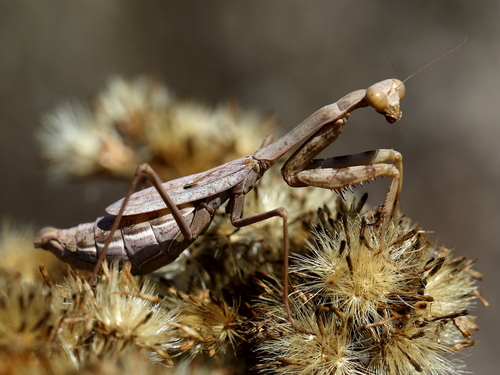
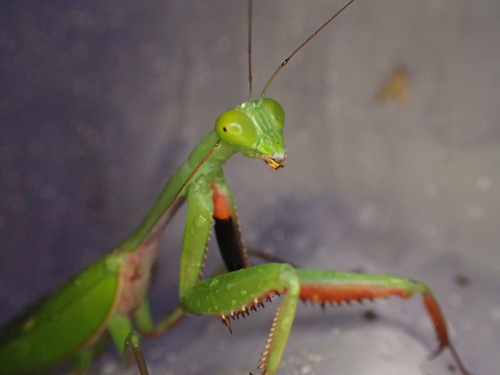
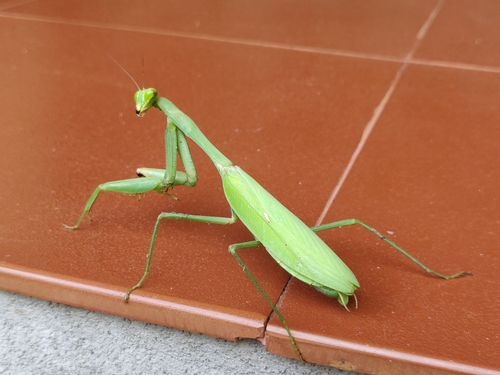
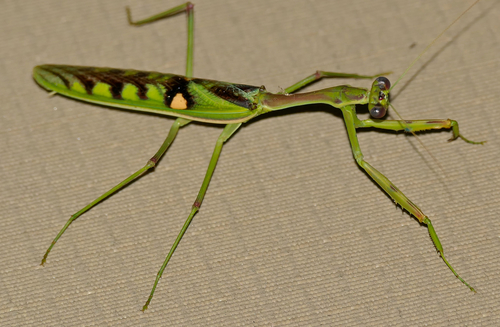
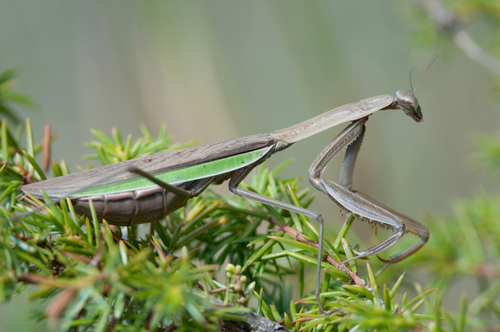
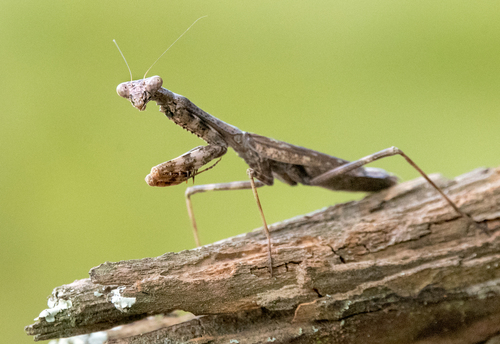
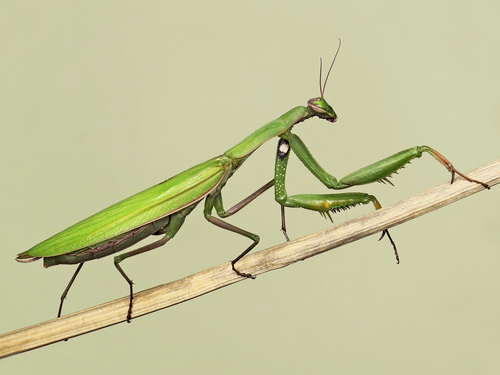
The European mantis, Mantis religiosa, is a large hemimetabolic insect belonging to Mantidae, the largest family of the order Mantodea (mantises). Its common name praying mantis comes from the distinctive posture of its first pair of legs when the mantis is at rest, which resembles a praying position. Both males and females have elongated bodies with two pairs of wings. The most striking features of this species (and all mantodeans) are a highly mobile triangular head with large compound eyes, and its first pair of legs (called raptorial legs) that are heavily modified to efficiently capture and hold fast-moving or flying prey. In Germany, M. religiosa is classified as endangered on the 1998 German Red List, and it cannot be legally caught or kept as a pet. Globally, the IUCN assesses this species as least concern. M. religiosa is native to and found across Europe, Asia, and Africa, and has been introduced to and established in North America. Germany hosts two confirmed stable populations, located in Rhineland-Palatinate and Baden-Württemberg. In recent years, there have been increasing reports of M. religiosa populations in Northern Europe, including Latvia and Estonia. While the species is absent from the British Isles, it lives and has been recorded breeding on the Channel Islands, with a particularly large abundant population on Jersey. This suggests the species may be able to expand its range northward into Great Britain. Despite being an introduced species in North America, it is the official state insect of Connecticut. The sexual behavior of praying mantises in general is unusual, so it has drawn scientific interest over the past century, and the differences between mantis species are well documented. For M. religiosa, courtship and mating follow two distinct stages: preliminary courtship starts when the two individuals make first visual contact, and ends when they make first physical contact. Copulation begins with physical contact and ends once the spermatophore is deposited. M. religiosa individuals become sexually mature just a few days after their final molt into adulthood, at which point they begin seeking out members of the opposite sex. Males are most attracted to females in midday, when temperatures are hottest. Researchers theorize this is because female pheromones are most volatile in heat, and males, as thermophilic insects, are most active at these temperatures. Sexually mature males approach mature females when they spot them, but males face risks during this approach due to females’ larger size and physical dominance. When a female spots a male, she is very likely to attack and kill him (a behavior known as sexual cannibalism). Because of this, M. religiosa males approach females very slowly and cautiously. After spotting a female, the male typically freezes and turns his head to look directly at her. Since the foveae in his eyes face forward, he gains the most accurate, detailed view of her and can track every movement she makes. He then approaches from behind, and stops moving whenever the female turns her head or moves. Mantises are very good at detecting moving objects, but almost cannot see stationary objects. Males use this stop-and-go tactic to stalk closer to the female, a process that often takes multiple hours. Depending on their surroundings, males sometimes perform a gentle rocking behavior thought to mimic surrounding leaves, helping them blend into the background. Studies found that males that rocked did not have a higher chance of being detected and attacked, which supports this concealment hypothesis. No courtship displays from either males or females have been observed in the wild or in captivity. In fact, males succeed in approaching not through displays, but through the absence of displays. Once the male is close enough to the female, he opens his wings slightly to help make his jump onto her back easier. Right after landing, he grips her with his raptorial legs, and his tibiae fit into grooves on either side of the female's mesothorax, in front of her wing bases. Once the male is secured in this position, copulation begins. The genitals, located at the tip of the abdomen in both sexes, have different structures: males have a pair of asymmetrical claspers, while females have an ovipositor. The ovipositor of M. religiosa is relatively short compared to that of other insects, and is partially covered by the edges of the last sternum. The male’s abdomen curves and twists 90 degrees around the female’s abdomen to insert his claspers between the female’s ovipositor and sternum. The male’s abdomen then contracts in a peristaltic pattern. The pair stays in this position for four to five hours before the spermatophore is deposited inside the female and the claspers are withdrawn. The male then releases his grip on the female, drops to the ground, and moves away to get out of the female’s reach for his own safety. After moving approximately 50 cm away, he stops and freezes for around four minutes before finally leaving. This behavior is thought to be necessary rest after the effort of mating, performed while at a safe distance from the female.