About Mantella baroni Boulenger, 1888
At maturity, Mantella baroni measures 28–32 mm in length. This makes it one of the largest species in the 16-species Mantella genus; only some individuals of Mantella viridis grow larger than it. Most related adult Mantella species typically range from 18–31 mm in body length. Like most Mantella frogs, this species shows sexual dimorphism: females of this species are 28–32 mm long, slightly larger than males, which measure 24–28 mm. This size difference becomes noticeable after the frogs reach 10–12 months of age.
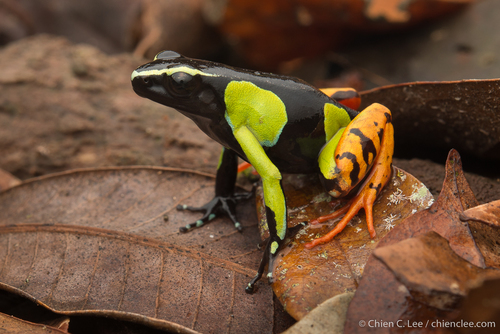
Most individual M. baroni have unique traits that set them apart from other Mantella species: a light rostral line above the eyes, and orange tiger-like markings with irregular black stripes on the hind limbs. However, this species has a wide range of existing phenotypes: forelimb color can vary from light green to bright orange and yellow. Because of this variation, M. baroni is sometimes misidentified or imported into the international pet trade as Mantella cowanii.
The forelimbs and femurs of M. baroni are yellow to greenish, and this color extends up the flanks to form a large, rounded flank blotch. This pattern matches the common appearance of Mantella madagascariensis, the painted mantella. Both species have these flank blotches that contrast with a black dorsum and striking orange-and-black legs, making it hard for distributors, vendors, herpetologists, breeders, collectors, and pet owners to correctly identify the species. The simplest way to tell the two species apart is that painted mantellas have a sky-blue, horseshoe-shaped marking on the throat, while Baron's mantellas lack flashmarks on the lower hindlimbs. Because of their similar looks, Baron's mantella is sometimes informally called "painted mantella" even though painted mantella is a separate species.
As visible in photos of the species, M. baroni has prominent aposematic features on its forelimbs, hindlimbs, and rostral line. Similar aposematic features, including bright coloration, stark color contrasts, and unusual patterning, are present across all 16 Mantella species to differing degrees: some Mantella species have weaker toxicity and primarily use bright coloration for mimicry. Although M. baroni and other Mantella species resemble small poison dart frogs from Latin America, which also use aposematism to signal toxicity to potential predators, the two groups are only distant taxonomic relatives. Their shared similar traits are an example of convergent evolution.
Like all members of the Mantellidae family, M. baroni is endemic to Madagascar. The Mantellidae family is estimated to have colonized Madagascar 76–87 million years ago, evolving in island isolation and undergoing adaptive radiation across the island that increased its geographic range and number of species. Mantellidae are phylogenetically related to Asian frogs, so the family likely arrived in Madagascar via a dispersal event from Asia. M. baroni is one of roughly 220 endemic frog species native only to Madagascar, 15 of which belong to the Mantella genus.
M. baroni has a moderately large, elongated geographic range in east-central Madagascar, located inland from the east coast and stretching from Fierenana in the north southward to Andringitra. Its natural habitats are subtropical or tropical moist lowland forest, subtropical or tropical moist montane forest, rivers, and degraded former forest. It typically lives at elevations between 600 and 1200 meters above sea level. The IUCN classified M. baroni as a Least Concern species in 2016 due to its relatively wide distribution, but its current population trend remains unknown. The species may be threatened by multiple sources of habitat loss, including human-driven encroachment from commercialization and industrialization, timber and logging operations, and agriculture. It is listed on CITES Appendix II.
For activity and reproduction, male M. baroni produce intense sequences of short, single-click calls during the day to claim territory or attract females for mating. A single female can lay up to 130 unpigmented eggs per clutch, and females almost always lay clutches near a water source. Rainwater washes newly hatched tadpoles into the water source after the eggs hatch.