About Mantella aurantiaca Mocquard, 1900
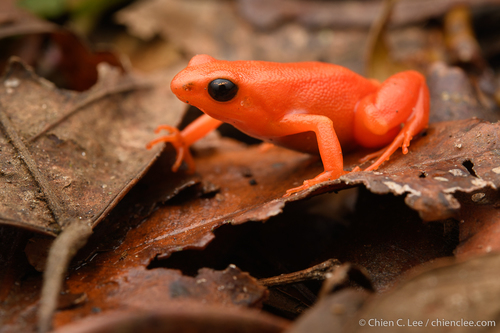
Description: The golden mantella (Mantella aurantiaca Mocquard, 1900) is a small frog with a uniform yellow, orange, or red body, measuring 20 to 26 mm in length. Red flash marks are visible on its inner leg, and it has a small but visible tympanum. Its bright skin coloration warns predators that the frog is poisonous. The bright coloration of the golden mantella is thought to be an example of aposematism, which functions to warn predators of the frog's poisonous nature. Ecology and behaviour: Golden mantellas have highly seasonal behaviour, and are largely inactive during the winter months from May to October. They are commonly active during the day in summer, and live in groups that typically have twice as many males as females. When rains come and temperatures rise, the frogs emerge from hiding and use small lentic wetlands for breeding. Males often call from concealed spots near water, and their call is a repeated, rather pleasant clicking sound. Unlike frogs that use typical amplexus for breeding, golden mantellas engage in what is called virtual amplexus, where the male only positions himself over the female's back. Eggs are laid on land, in moist leaf litter near water. When rains arrive, the developed tadpoles are washed off the land into nearby water to develop further. Golden mantellas eat small invertebrates; in the wild, their diet is mainly made up of mites, ants, flies, and collembolans. The frogs get their skin toxins from their diet, and these toxins include pumiliotoxin, allopumiliotoxin, homopumiliotoxin alkaloids, pyrrolizidines, indolizidines and quinolizidines. Despite being poisonous, the snake Thamnosophis lateralis and a skink from the genus Zonosaurus have been observed preying on this species at Torotorofotsy Wetland.