About Manouria emys (Schlegel & Müller, 1844)
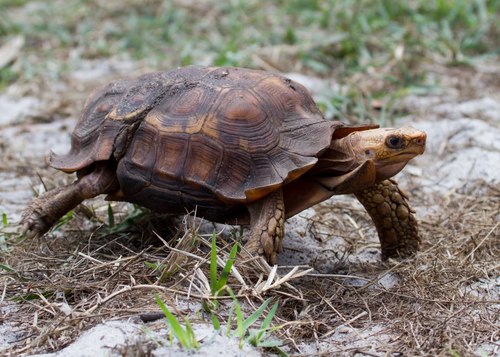
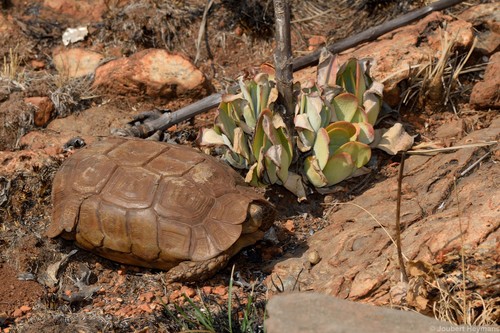
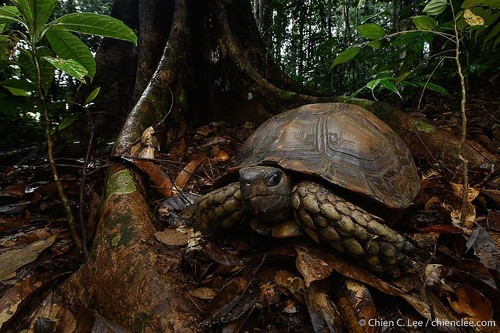
Manouria emys is the largest tortoise native to mainland Asia. The largest wild adult individuals of the northern subspecies, M. e. phayrei, can reach 25 kg (55 lb), and individuals in captivity often grow much larger. This species has a broad, flattened upper shell (carapace) and a large lower shell (plastron), with distinct features on its head, limbs, and skin that distinguish it from other tortoise species. The carapace is significantly flattened, with a depth less than half its length. Both the anterior and posterior margins of the carapace are upturned and strongly toothed (serrated). A nuchal neck shield is present, along with two supracaudal shields located above the tail. Dorsal shell shields have concentric grooves and are often concave. Vertebral shields are much broader than they are long, and at least as broad as the side costal plates. The plastron is large; the throat gular region is slightly extended and typically indented notched. The rear hind lobe of the plastron is deeply notched. Pectoral shields may be widely separated, or connected by a short median seam (suture). The armpit axillary shield is very small, while the groin inguinal shield is large. The head is moderate in size, with two large prefrontal shields and one large frontal shield. The beak is not hooked. The jaws are weakly toothed (feebly denticulated), and there is a strong median raised ridge on the inner alveolar surface of the upper jaw. The front surfaces of the forelimbs have large, bony, pointed, overlapping bumps (tubercles) arranged in four or five longitudinal rows. The hind limbs have large bony tubercles on their sole plantar surface, with larger conical, spur-like tubercles on the heel, and a cluster of even larger conical tubercles on each side of the back of the thighs. Adult Manouria emys are dark brown or blackish. Juveniles have a yellowish-brown carapace marked with dark brown patterns. This species is distributed across multiple Asian countries: Bangladesh, Cambodia, India, Indonesia, Malaysia, Myanmar, Thailand, and Vietnam. Manouria emys is the only tortoise species that lays its eggs above ground in a nest constructed by the female from leaf litter. The female uses both her front and rear legs to gather material for the nest, and lays up to 50 eggs deep within the finished nest. She then stays on or near the nest to guard it, and will chase away predators and other intruders. Preliminary research on Temperature-Dependent Sex Determination (TSD) in the southern subspecies M. e. emys identified an estimated pivotal temperature of 29.29°C. Incubation temperatures above this pivotal temperature produce a high proportion of female hatchlings, while temperatures below it produce a high proportion of male hatchlings. Incubation duration also correlates with temperature: higher temperatures lead to shorter incubation times, and lower temperatures lead to longer incubation times. Incubation times for this species range from 60 to 90 days.