About Manorina melanophrys (Latham, 1801)
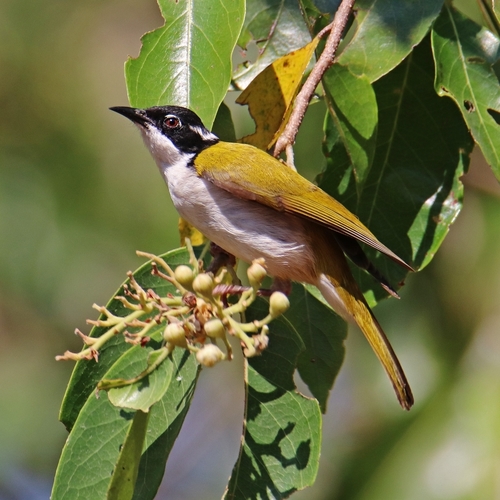
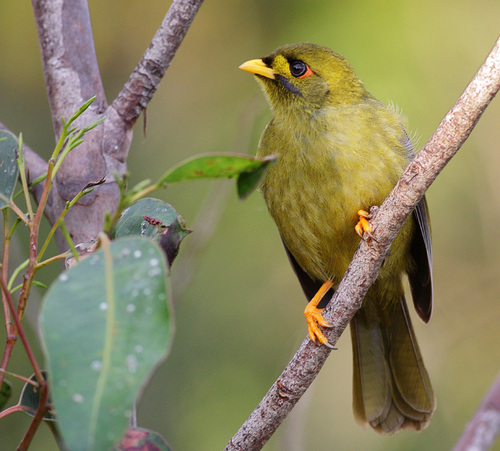
Bell miners (Manorina melanophrys) are the smallest species in their genus. Unlike the other three predominantly grey miner species, they have olive-green plumage, which is darker on the wings and yellower on the belly. They are medium-bodied honeyeaters, slightly smaller and stockier than Lewin's honeyeater (Meliphaga lewinii). Their weight ranges from 25 g to 35 g, with an average of 29 g. They measure 17.5–20 cm in total length (average 18.5 cm) and have a wingspan of 22–30 cm (average 26.5 cm). They share the characteristic slightly downturned yellow bill of all miners. Their legs are bright orange, and they have a bare red-orange patch behind the eye. Their crown and lores are black, while the feathers in front of the eye are yellow. A dark streak runs downward from the corner of the bill, giving the bird a slight frowning appearance. They have brown eyes and yellow mouths. Both sexes look similar overall, though males are usually slightly larger. Sex can be determined by measuring wing length, tail length, and culmen depth, or by identifying female-specific calls, but there is no simple reliable way to tell sexes apart in the field without careful observation of behaviour and calls. Juveniles are more brown-toned than adults, with overall duller, less bright coloration. Young birds do not have the bare skin patch behind the eye; the patch first develops as pale grey, changes to pale yellow, then darkens to pale orange, before reaching the adult bright red-orange color as the bird matures. Nestlings hatch naked, and grow a light brown down around two days after hatching. Bell miners are more often heard than seen, because they typically forage high in the canopy and their olive-green plumage blends in with surrounding leaves. They maintain a repeated "ping" contact call while foraging throughout the day. At the Royal Botanic Gardens in Melbourne, bell miners often come low enough to be easily seen and photographed. Bell miners are distributed from near Gympie in Queensland, south along the coastal plain and ranges, to the Melbourne area in Victoria. They prefer the margins of wet or dry sclerophyll forest and thick woodlands, and often settle near a stream or other permanent water source. This preference restricts their range to higher-rainfall coastal areas, which are often adjacent to but not inside rainforest. Unlike the closely related noisy miner, bell miners prefer denser habitats with a thick understory (under 5 m tall), but a sparse midstory (5–15 m tall) and sparse canopy (over 15 m tall). In undisturbed areas, bell miners choose habitats with an understory of shrubs, ferns, sedges, and rainforest vines. They have been recorded expanding their range into disturbed habitats that have a thick undergrowth of the invasive weed lantana. Measured population densities of bell miners range from 14 to 38 birds per hectare. They are selective about their preferred habitat, and reasonably small disturbances to the undergrowth, such as fire or lantana removal, can cause an entire colony to move to a new territory.