About Manorina melanocephala (Latham, 1801)
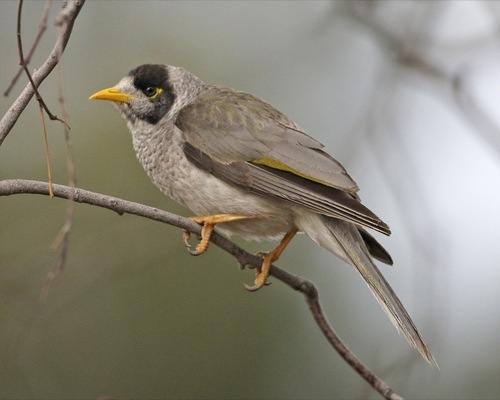
The noisy miner (Manorina melanocephala) is a bird of the honeyeater family Meliphagidae, endemic to eastern and southeastern Australia. This species is primarily grey, with a black head, orange-yellow beak and feet, a distinct yellow patch behind the eye, and white tips on the tail feathers. The Tasmanian subspecies has a more intense yellow panel in the wing and a broader white tail tip. Males, females, and juveniles have similar appearances, though young birds are brownish-grey. As its common name suggests, the noisy miner is a vocal species with a large repertoire of songs, calls, scoldings, and alarms, and produces almost constant vocalizations, especially from young birds. It is one of four species in the genus Manorina, and is itself divided into four subspecies. The Tasmanian subspecies M. m. leachi was separated long ago, and mainland populations were further split into additional subspecies in 1999. The noisy miner occurs across a broad arc extending from Far North Queensland through New South Wales and Victoria to Tasmania, southeastern South Australia, and out to far north-west Queensland. It primarily lives in dry, open eucalypt forests with no understory shrubs. This includes forests dominated by spotted gum, box, and ironbark, as well as degraded woodland where the understory has been cleared, such as recently burned areas, farming and grazing areas, roadside reserves, and suburban parks and gardens that have trees and grass but no dense shrubbery. Noisy miner population density has increased significantly across much of its range, particularly in human-dominated habitats. While the popularity of nectar-producing garden plants such as large-flowered grevilleas was once thought to contribute to this population growth, studies now show the noisy miner has primarily benefited from landscaping practices that create open areas dominated by eucalypts. Noisy miners are gregarious and territorial; they forage, bathe, roost, breed, and defend territory communally, forming colonies that can contain several hundred birds. Each bird has an 'activity space', and birds with overlapping activity spaces form stable associations called 'coteries', which are the most stable units within the colony. The birds also form temporary flocks called 'coalitions' for specific activities such as mobbing a predator. Group cohesion is supported by both vocalizations and ritualised displays, which are categorised as flight displays, postural displays, and facial displays. The noisy miner is a notably aggressive bird; chasing, pecking, fighting, scolding, and mobbing occur throughout the day, targeting both intruders and other colony members. The noisy miner forages in tree canopies, on trunks and branches, and on the ground, and mainly feeds on nectar, fruit, and insects. It spends most of its time gleaning eucalypt foliage, and can meet most of its nutritional needs from manna, honeydew, and lerp gathered from this foliage. The noisy miner does not use a stereotyped courtship display, but copulation is a frenzied communal event. It breeds year-round, building a deep cup-shaped nest and laying two to four eggs. Only the female incubates the eggs, though up to twenty male helpers care for nestlings and fledglings. Noisy miners use a range of strategies to increase breeding success, including producing multiple broods and group mobbing of predators. The noisy miner's population increase has been linked to reduced avian diversity in human-affected landscapes. Due to its territoriality, translocation is unlikely to resolve issues of overabundance, and culling has been proposed, though the noisy miner is currently a protected species across Australia. Size variation in the noisy miner across its range follows Bergmann's rule: birds tend to be larger in colder climates. Adults from central-eastern and northern Queensland generally have little to no olive-yellow edging on the back and wing feathers, and a wider white fringe on hind-neck and back feathers, giving Queensland populations more distinctive scalloping than other populations. Wing length generally increases with latitude, though M. m. leachi has measurably shorter wings than the nominate race; one study comparing populations north of 30° S and south of the Murray River found no significant difference in wing length. The subspecies leachi also has finer scalloping on the hind-neck than the nominate race, a more intense yellow tinge to the wing panels, and a slightly broader off-white tip to the tail. The far north Queensland subspecies titaniota has a shorter tail, paler crown, larger yellow skin-patch, and paler upper parts without the yellow-olive colouring of the nominate race. The subspecies lepidota, found in western New South Wales, is smaller than the nominate race, with a black crown and darker, more mottled upperparts. The noisy miner is endemic to eastern and southeastern Australia, occupying a broad arc from scattered populations in Far North Queensland, through widespread and common populations in New South Wales (from the coast to a line from Angledool to Balranald), through Victoria into southeastern South Australia, and eastern Tasmania. Its range in South Australia has expanded steadily since it was first recorded near Adelaide in the early 1890s. It is sedentary across its entire range. Colonies aggressively defend their territory, which has led to significant reductions in avian diversity in areas occupied by noisy miners, with smaller species excluded entirely. The noisy miner primarily inhabits dry, open eucalypt forest without understory shrubs. It is commonly found in open sclerophyll forests, including those on coastal dunes or granite outcrops; forests dominated by spotted gum on mountain ridges and exposed slopes; box and ironbark forests on the foothills of the Great Dividing Range; mixed forests of eucalypts and cypress (Callitris); forests dominated by yapunya, mulga, gidgee, brigalow or emu bush; in stands of belah and scattered clumps of boree; on the edges of river red gum woodlands, including swamp woodlands bordering floodplains, and areas dominated by exotic species such as European ash and willow. It regularly lives in degraded forest patches where the understory has been cleared, including recently burned areas, and modified habitats such as lightly-timbered farming and grazing areas, roadside reserves, bushland remnants in towns and cities, and suburban parks and gardens with trees and grass but no dense shrubbery. The noisy miner has benefited from thinning of woodland on rural properties, heavy grazing that removes understory, woodland fragmentation that increases the proportion of edge habitat, and urban landscaping that increases open eucalypt environments. It has been called a 'reverse keystone' species, because it colonises an ever-expanding range of human-dominated habitats and aggressively excludes smaller bird species from urban environments; this phenomenon is also observed in rural areas. A field study across the South West Slopes of New South Wales found that the presence of noisy miners corresponded with fewer insectivorous birds such as fantails, whistlers, the restless flycatcher (Myiagra inquieta), and other honeyeater species, and this decrease was most pronounced in sites with better access to water and nutrients. While it was once hypothesised that the spread of large-flowered grevillea cultivars contributed to noisy miner abundance, recent research identifies the spread of lightly treed, open areas and the presence of eucalypt species as the most significant factors driving population increases. Large-flowered grevillea hybrids such as Grevillea 'Robyn Gordon' can benefit the noisy miner: an abundance of resources is usually dominated by larger, aggressive honeyeaters, and a continuous nectar source could give an advantage to this non-migratory species. A field study in box-ironbark country in central Victoria found that noisy miner numbers correlated with the occurrence of yellow gum (Eucalyptus leucoxylon), which reliably produces flowers and nectar each year. Overall, noisy miner abundance is primarily determined by habitat structure. While the noisy miner's overall range has not expanded significantly, population density within that range has increased substantially. High densities of noisy miners are regularly recorded in forests with thick understory in southern Queensland, 20 kilometres or more from the forest/agricultural land edge. Many of these sites have extensive road networks for forest management, and picnic areas and walking tracks for recreational use, and these cleared spaces contribute to noisy miner abundance in these forests. Higher road densities correspond to higher noisy miner population levels. Field work in Victoria found that noisy miners infiltrate between 150 and 300 metres into remnant woodland from the edges, with greater penetration in less densely forested areas. This means that around 36 hectares of woodland habitat is needed to maintain areas free of noisy miners. Revegetation projects restoring buloke woodland, a she-oak species critical to the survival of the red-tailed black cockatoo (Calyptorynchus banksii), often interplant buloke with a fast-growing eucalypt nurse species. Noisy miner populations are more likely to occur in buloke woodlands where eucalypts have been planted at densities of up to 16 per hectare. The presence of noisy miners is accompanied by substantial changes to the number and types of other birds found in the woodland.