About Manorina flavigula (Gould, 1840)
The yellow-throated miner (Manorina flavigula) is a medium-sized honeyeater that is very similar in color and shape to its close relatives, the noisy miner and the black-eared miner. Adults reach a total length of 22 to 28 centimetres (8.7–11.0 in), with a wing length of 12–13.8 cm (4.7–5.4 in), an average bill length of 25 mm (0.9 in), and a body weight between 50 g (1.8 oz) and 61 g (2.2 oz).
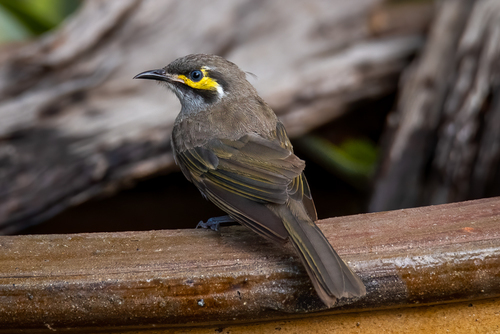
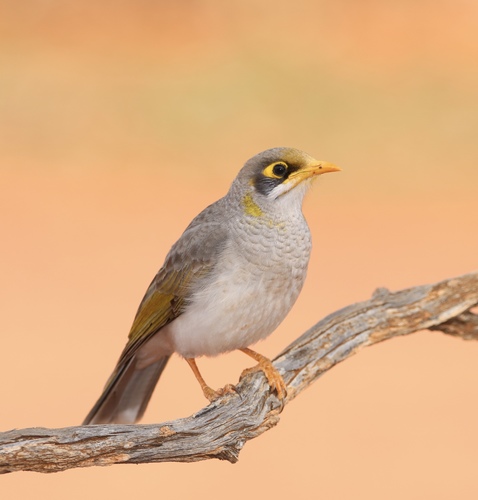
Like the closely related noisy and black-eared miners, the yellow-throated miner has a dark grey dorsal surface with medium grey patterning on the feathers. Its wings are dark grey with differing levels of yellow highlighting. The ventral feathers range from light grey to white, with light grey scalloping on the chest. The feathers surrounding the eye are black, while the beak and bare skin patch around the eye are bright yellow; the iris is brown, and the legs are also yellow, though their shade and brightness can vary.
Fledgling yellow-throated miners have undefined, fluffy light grey chests that lack scalloping. Immature birds can be identified when handled by their retained juvenile flight feathers (remiges and rectrices), which are more brownish in color.
The yellow-throated miner can be distinguished from the other two miner species by its distinct clean white rump; noisy and black-eared miners have continuous grey colouring from the back onto the rump. The white rump is clearly visible when the yellow-throated miner flies away, so this feature is often used for identification in areas where two miner species share range overlap.
Yellow-throated miners have varying amounts of yellow highlighting above and below the beak, on the forehead and chin, and along the sides of the throat. This differs from noisy miners, which have white colouring above the beak, no yellow highlighting on the forehead or neck, and may only have a small amount of yellow on the chin. Compared to the yellow-throated miner's paler lower jaw feathering relative to the throat, pure black-eared miners have darker lower jaw feathering relative to the throat. Hybrids between yellow-throated and black-eared miners show a range of rump and lower jaw colour shades. Different subspecies of yellow-throated miner have small variations in color and size; M. f. obscura is darker, while M. f. lutea is yellower.
Of all species in the Manorina genus, the yellow-throated miner has the widest distribution. It occurs across most of Australia, with the exception of areas east of the Great Dividing Range, Cape York Peninsula, the very north-eastern Northern Territory, and small patches of the driest regions in Central Australia. Different subspecies occupy distinct ranges: M. f. wayensis has the largest range, extending across central Western Australia through to western Queensland. M. f. flavigula is the easternmost subspecies, covering most of Queensland except Cape York and the coast from south-east Queensland southwards, and extends south through New South Wales into inland Victoria. M. f. lutea ranges across the northern parts of Western Australia and the Northern Territory. M. f. obscura occurs in south-western Western Australia. M. f. melvillenis is found in the very northern part of the Northern Territory.
Yellow-throated miners live primarily in arid and semi-arid regions, but also extend into temperate, subtropical, and tropical areas. They inhabit woodlands and scrublands, including acacia, eucalyptus, mallee, and casuarina vegetation. Similar to noisy miners, they favour habitat edges and adapt well to disturbed habitats; they can be found in regrowth, along roads, and next to cleared land. They prefer areas with some undergrowth and will recolonize restored habitat, but are rarely found in dense growth such as mature mallee. Though they prefer some tree cover, yellow-throated miners will venture further into open areas such as pastures than noisy miners will.