About Mannophryne trinitatis (Garman, 1888)
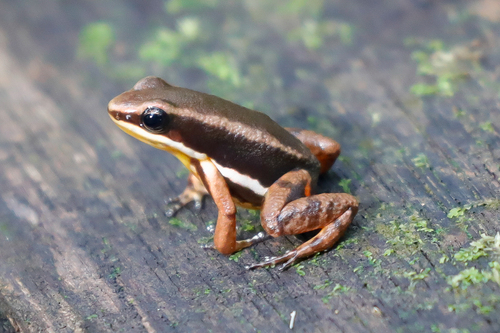
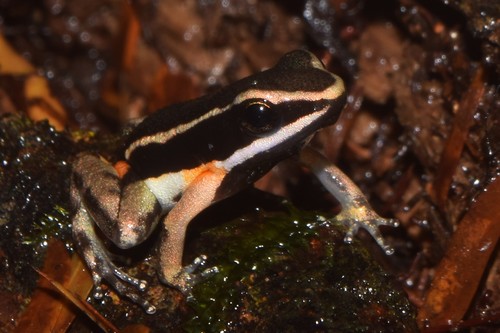
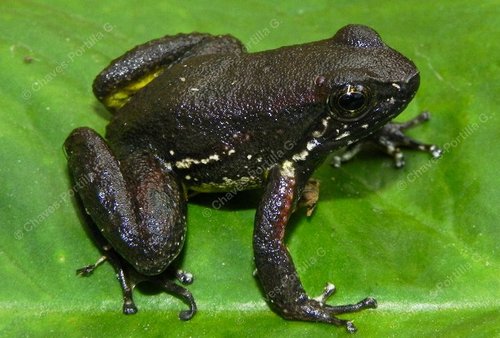
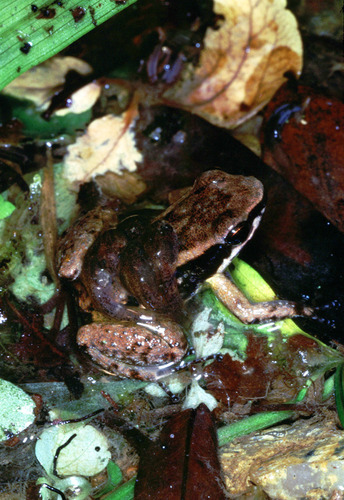
Adult Mannophryne trinitatis, commonly called the Trinidad poison frog, are a relatively small, diurnal species. Their dorsal surface is dark brown, and their flanks are mottled. This species is sexually dimorphic: adult males have grey throats, with an average snout-vent length of 25 mm, while females have bright yellow throats, with an average snout-vent length of 28 mm. When adult males perform mate-calling to attract females, they can change their skin color from pale brown to jet black. Newly metamorphosed individuals reach around 37 mm in length, while tadpoles measure between 14 mm and 16 mm at hatching. This species has a well-defined, solidly pigmented collar and a solid brown dorsum. It also has well-defined pale dorsolateral stripes, dark pigmentation around the outer edge of its soles and palms, a well-defined pale inguinal stripe, band-like clusters of melanophores along the front of the arms, and dark pigmentation on the metatarsal and subarticular tubercles of the toes. The Trinidad poison frog is found only on the Paria Peninsula of northern Venezuela, and in the Northern and Central Ranges of Trinidad, West Indies. It inhabits areas from sea level up to very high elevations, and prefers habitats around rocky streams in valleys, mountain slopes, or undisturbed moist montane forests. These streams are typically narrow, shallow, with slow-moving clear water, and contain deeper pools where frogs deposit and raise their tadpoles. If there are many predators in the original stream, adults will sometimes transport their tadpoles to other pools, such as phytotelmata. Trinidad poison frogs use two forms of territorial defense. The first occurs in nonreproductive areas, where frogs defend access to resources including food, water, and shelter. The second occurs in large reproductive areas, where frogs defend their space against calling conspecific rivals during the breeding season. Adult females engage in territorial defense more frequently than males. Adult females use aggressive behaviors including visual threat displays, wrestling, and chasing to defend territories against other frogs. During threat displays, females display their bright yellow throats to intruders. In contrast, adult males defend their territories against both predators and other male intruders by producing advertisement calls from their calling sites. This defense both deters competitors and attracts females as potential mates. Reproductive traits of the Trinidad poison frog, including intraovarian clutch size and tadpole size, vary based on the population's biogeography. In Trinidad, clutch sizes range from 6 to 13 eggs for populations in the Northern Range, and from 12 to 26 eggs for populations in Tamana Cave in the Central Range hills. Adult males court females from a distance by producing advertisement calls. They also perform throat displays and toe-tip jumping. As they vocalize, their skin changes color from pale brown to jet black. When a nearby female detects a male's call or notices his skin color change, she leaves her own territory, approaches the calling male, and engages in amplexus. The pair then moves to an oviposition site such as a rock crevice or wet leaf near a stream.