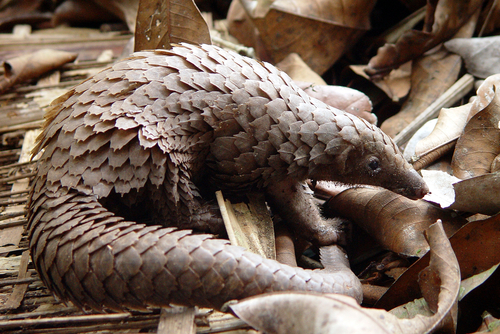
About Manis tricuspis Rafinesque, 1821
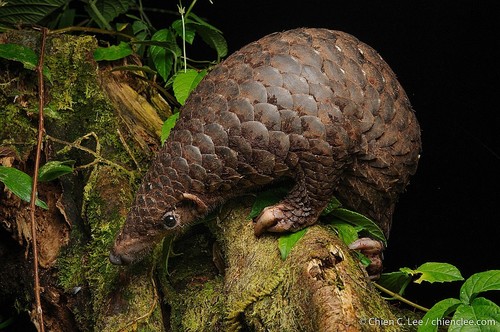
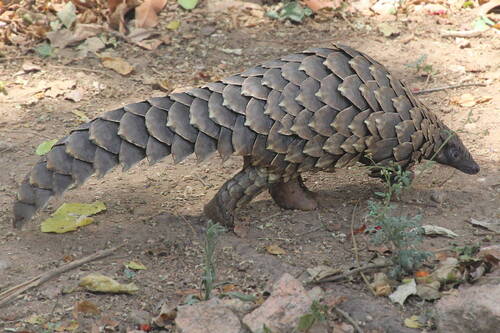
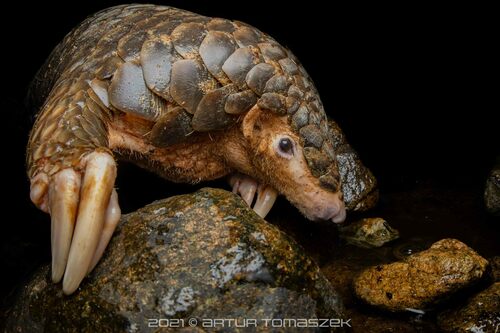
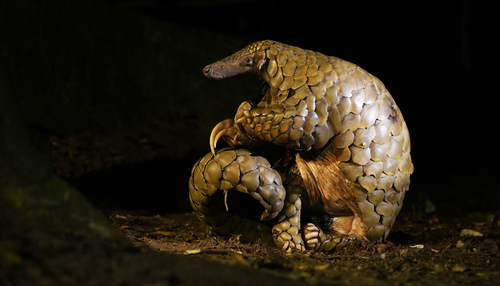
Phataginus tricuspis (also referenced by the scientific name Manis tricuspis Rafinesque, 1821) is a relatively small species of pangolin, also commonly called the white-bellied pangolin. Its combined head and body length measures 33–43 cm (13–17 in), and its tail measures 49–62 cm (19–24 in). Each of its scales, which range in color from dark brown to brownish yellow, has three points — this feature gives the species its specific name tricuspis. The name Phataginus tricuspis translates from Greek to "number by order". These scales cover the pangolin's entire body, with the exception of the face, underbelly, and inner sides of the legs. Like human fingernails, the scales are made of keratin, and are anchored at their base to the pangolin's skin. This species has a small head and an elongated snout. Its feet are short, and each foot has five long curved claws. The white-bellied pangolin's range extends from Guinea through Sierra Leone and most of West Africa into Central Africa, reaching as far east as extreme southwestern Kenya and northwestern Tanzania. To the south, its range extends to northern Angola and northwestern Zambia. Individuals have been found on the Atlantic island of Bioko, but no confirmed records of the species exist for Senegal, Gambia, or Guinea-Bissau. The white-bellied pangolin is semiarboreal and generally nocturnal. It occurs in lowland tropical moist forests, including both primary and secondary forests, as well as in savanna/forest mosaic landscapes. It likely has some ability to adapt to habitat modification such as commercial plantations, as it favors cultivated and fallow land where it is not aggressively hunted — for example, abandoned or little-used oil palm trees growing within secondary growth. For this species, female territories are solitary and small, covering less than 10 acres (4 ha), and female territories rarely overlap. Males have larger territories, reaching up to 60 acres (24 ha), that overlap the territories of multiple females; this overlapping allows for encounters between males and females. Pangolins signal their availability to mates through markings from feces and urine, as well as by spreading scent produced by their anal glands. Encounters between males and females are brief unless the female is in estrus, at which point mating occurs. Gestation lasts 150 days, and births typically produce only one young. Newborn pangolins cannot walk, so they are carried on their mother's tail. Young are weaned after three months, but stay with their mother for a total of five months. At birth, a newborn's scales are soft, but begin to harden after a few days. The white-bellied pangolin is widely and often intensively exploited by humans for bushmeat and traditional medicine, and it is the most common pangolin species found in African bushmeat markets. Conservationists estimate that this species underwent a population decline of 20–25% between 1993 and 2008, a period spanning three pangolin generations, with the decline driven primarily by bushmeat hunting. They confirm that the species continues to be harvested at unsustainable levels across parts of its range. Its global conservation status has been successively upgraded over time, changing from "Least Concern" in 1996 to "Endangered" by 2019.