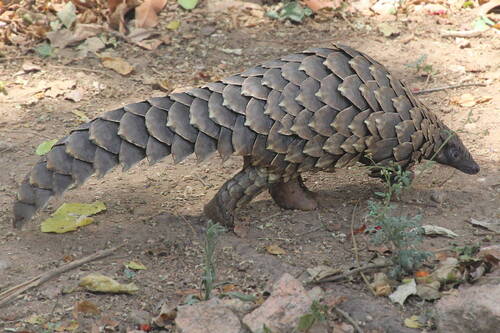
About Manis temminckii Smuts, 1832
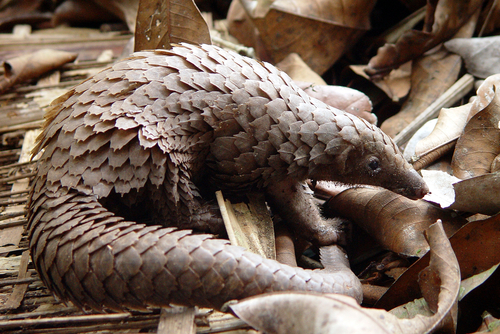
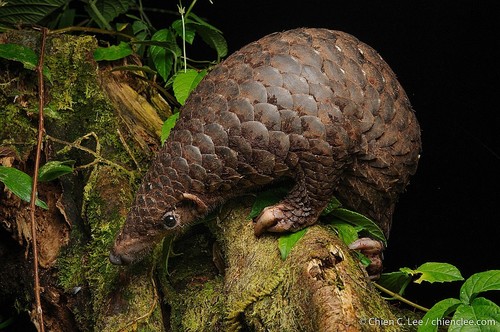
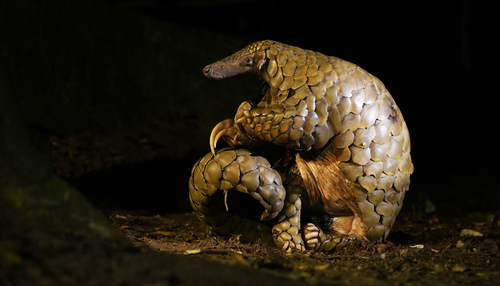
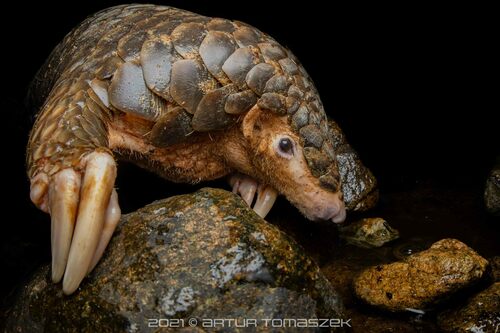
This entry covers the ground pangolin, scientifically named Manis temminckii Smuts, 1832. Almost the entire body of a pangolin is covered in overlapping protective scales, which account for roughly 20% of the animal’s total body weight. These scales are made of keratin, the same material that forms human hair and fingernails, and give pangolins an appearance similar to a pinecone or artichoke. The underside of a pangolin has no scales, and instead is covered in sparse fur. When a pangolin feels threatened, it typically rolls into a complete ball to protect its vulnerable belly. Excluding the tail, pangolins measure 30 to 90 cm (12 to 35 in) long, and weigh 5 to 27 kg (11 to 60 lb). Across all eight living pangolin species, the tail length of adult individuals ranges from about 26 to 70 cm (10 to 28 in). Mature adult pangolins are colored light brown, olive, or dark brown, while young pangolins are pale brown or pink. Ground pangolins walk on their hind legs, and occasionally use their forelegs and tail to maintain balance. Each hind foot has five toes. Their forelimbs have three long, curved central claws, plus two smaller claws on the first and fifth digits. The muscular forelimbs and large central claws are adapted to break into ant and termite colonies, and to excavate burrows. Because of the size and shape of these claws, pangolins must balance on the outer edges of their fore feet and tuck their claws in to avoid damaging them. Pangolins have long, broad tails and small, conical heads, with jaws that have no teeth. To replace chewing, the pangolin stomach is muscular, and contains keratinous spines that project into the stomach’s interior, along with small stones to mash and grind prey. This works similarly to a bird’s gizzard. Pangolins also have long, muscular tongues that they use to reach and lap up ants and termites from narrow cavities. Their tongues are so long that they are actually longer than the pangolin’s entire body. The tongue attaches in the lower body cavity, near the pelvis and the last pair of ribs, and can retract to rest inside the chest cavity when not in use. Pangolins have reduced external ear pinnae, resulting in poor hearing, and they also have poor vision, though they do have a strong sense of smell. All African pangolin species are native to 15 African countries spread across southern, central, and east Africa. Manis temminckii is the only pangolin species found in southern and eastern Africa, and it prefers savannah woodland with moderate amounts of scrub at low elevations. The total lifespan of wild pangolins is unknown, but the maximum observed lifespan for pangolins kept in captivity is 20 years. Pangolins are sexually dimorphic: males are 10–50% heavier than females. No defined year-round mating season has been confirmed, but pangolins generally mate during summer and autumn. For ground pangolins and other African pangolin species, the gestation period lasts up to 139 days. Females of African pangolin species usually give birth to only one offspring per litter, though litters of three have been recorded in Asian pangolin species. Newborn pangolins have soft, pale scales that begin to harden by their second day of life. At birth, young pangolins are usually about 15 cm (6 in) long and weigh around 340.19 g (12 oz). Mothers nurse their young for 3 to 4 months, though young pangolins start eating termites after only one month. Pangolins reach sexual maturity at 2 years old, at which point they leave their mothers and begin living solitary lives.