About Manis pentadactyla Linnaeus, 1758
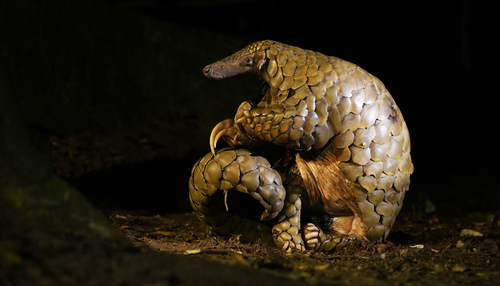
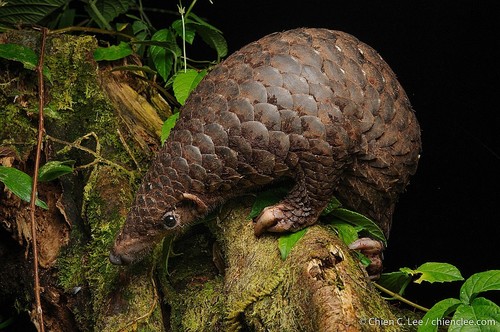
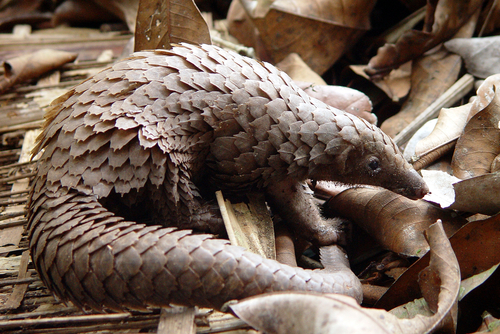
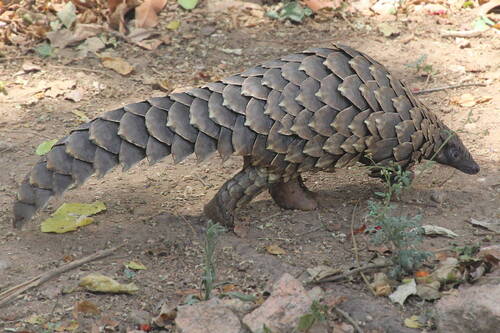
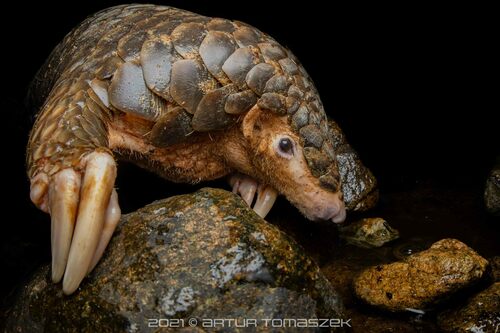
The Chinese pangolin (Manis pentadactyla Linnaeus, 1758) looks like a scaly anteater, with typically grayish-blue scales. Its head and body length ranges from 40 to 58 cm (16 to 23 in), while its tail measures 25 to 38 cm (9.8 to 15.0 in). Mature Chinese pangolins weigh between 2 and 7 kilograms (4.4 to 15.4 lb). This species has 18 rows of overlapping scales that grow alongside hair, a combination that is rare among mammals. It has a small, narrow mouth and a small, pointed head, and its claws grow inward as the animal ages. Female Chinese pangolins give birth to only one offspring at a time. Newborn pangolins weigh around 93 g (3.3 oz) and measure about 45 cm (18 in) in length. Breeding occurs in April and May, when the weather becomes warmer. Young are born with soft scales that harden two days after birth. Even though newborn pangolins can walk on their first day of life, the mother carries her young on her back or tail. If the mother senses a threat, she uses her tail to quickly fold her baby onto her belly. Observations have recorded male pangolins allowing females and their young to share the male's burrow. The Chinese pangolin is native to southern Nepal, northeast India, Bhutan, Bangladesh, Myanmar, northern Indochina, and southern China, including the island of Hainan and most of Taiwan. It has been recorded at elevations up to 3,000 m (9,800 ft). Historically, its range covered all provinces south of the Yangtze River, and also extended north of the Yangtze River into southern Sichuan, northeast Chongqing, northwest Hubei, and southwest Henan Provinces. Today, confirmed populations in mainland China are found in Yunnan, Hainan, Guangxi, Guangdong, Hunan, Chongqing, Fujian, Jiangxi, Zhejiang, and Anhui provinces. It lives in primary and secondary tropical forests, bamboo forests, limestone forests, broadleaf forests, coniferous forests, agricultural fields, and grasslands. The Chinese pangolin is a fairly secretive, nocturnal animal that moves slowly. Its hard scales act as protection from predators, and when threatened, it curls up into a ball in a behavior called volvation.