About Manicina areolata (Linnaeus, 1758)
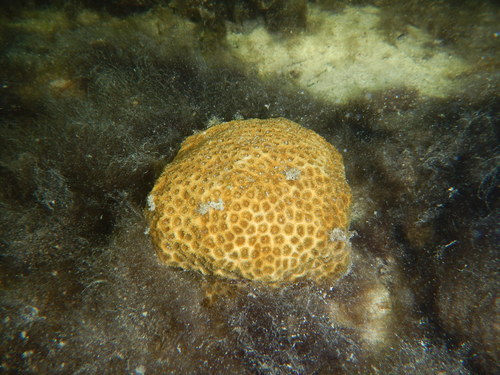
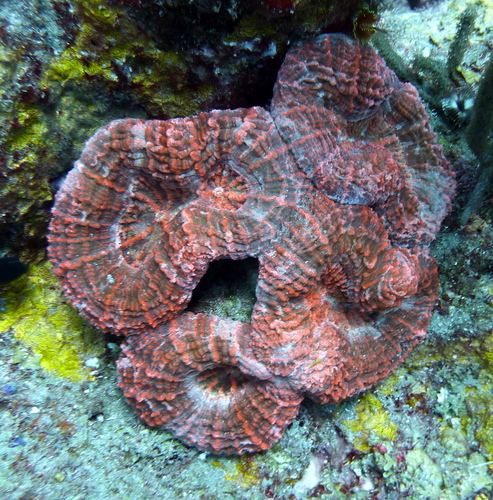
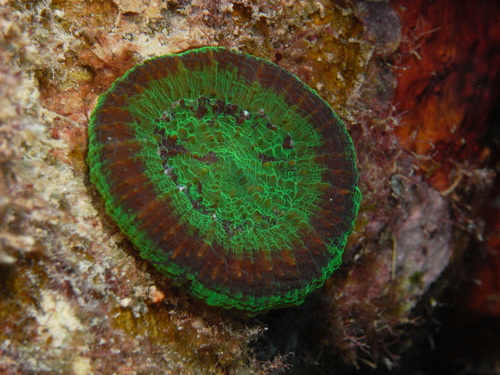
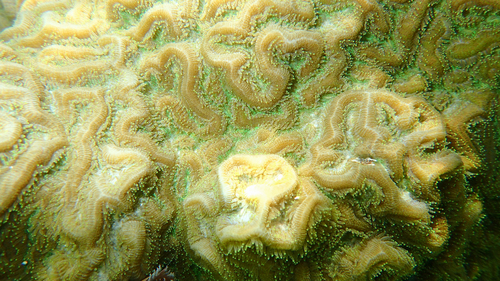
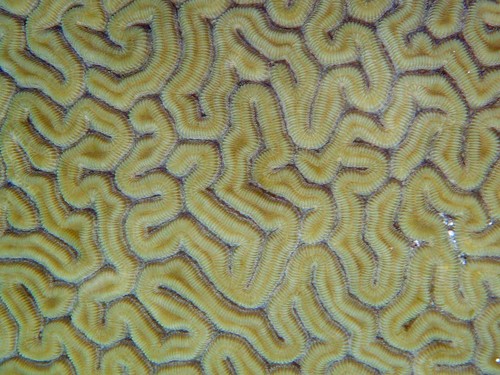
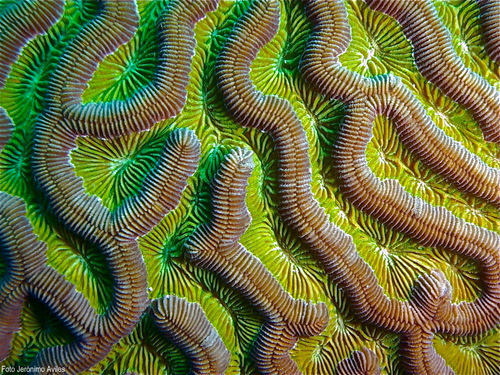
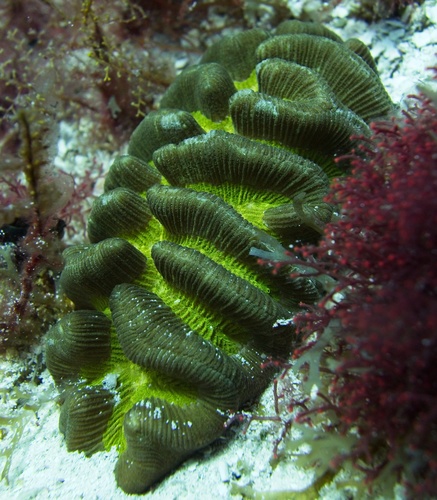
Manicina areolata is a colonial coral. Its budding is intracalicular, taking place within the whorl of tentacles of an individual polyp. Corallites are arranged in a meandering pattern, meaning there are a series of connected centers grouped into broad valleys that are typically 10 to 15 mm (0.4 to 0.6 in) wide. This arrangement gives the colony a surface texture that resembles a human brain. The polyps share one long oral disc, with tentacles arranged around the rim of the disc. Colonies are small, most often under 10 cm (4 in) in diameter. Manicina areolata develops two completely distinct growth forms: some individuals grow as small, solid hemispherical heads, while others grow as small, cone-shaped structures that do not attach to the seabed. The coral’s surface is made up of long meandering walls separated by wide valleys. Polyps sit inside stony cups called corallites located within these valleys. Fine transverse ridges called septa extend from the corallites in several series up to the top of the walls on either side of the valley. Often, the entire coral is formed from a single long, convoluted valley, sometimes with smaller side valleys branching off. When multiple separate valleys are present, the intervening walls have grooves running along their upper edges. The overall colour of this coral ranges from yellowish-brown to tan or dark brown, and the valleys and walls often display contrasting colours. Polyps only extend their bodies at night, and their oral surfaces are often green. Manicina areolata is native to the tropical and subtropical West Atlantic Ocean. Its range covers the southern half of the Gulf of Mexico, the Caribbean Sea, southern Florida, the Bahamas, and Bermuda. It grows on soft sediments, cobble, or rubble, on both fore-reef and back-reef slopes, and in sea grass meadows. It usually occurs at depths shallower than 10 m (33 ft), with a maximum lower depth limit of around 60 m (200 ft). The massive attached growth form is found on reefs attached to rocks, while the unattached growth form occurs on areas of broken coral fragments, and on sandy or muddy substrates including lagoons and turtle grass (Thalassia testudinum) meadows. The unattached cone-shaped form of Manicina areolata can reorient itself to an upright position if it gets overturned by fish, currents, or wave action. The polyps have pleats and muscles in their mesentries that allow them to extend further out from their corallites than small-polyp corals can. This ability lets the polyps inflate their body cavity with water, swelling up to dislodge accumulated sediment, and even turn the entire colony back over if needed. To overturn itself, the coral inflates its interior with water, then expels jets of water from one side to make the whole structure tip back into an upright position. This is a slow process, and it becomes more difficult as the coral grows larger. This difficulty is likely the reason this coral rarely grows to more than 10 cm (4 in) in diameter. This coral can also remove sediment that threatens to bury it by producing mucus, then shedding the mucus along with any adhered sediment as a single layer. The tissues of this coral host symbiotic unicellular algae called zooxanthellae. Manicina areolata is a hermaphrodite, and it produces gametes around the full moon in May and June. Fertilization happens internally, and larvae are brooded inside the colony for two weeks. All mature larvae are released simultaneously on the night of the new moon. After release, larvae may drift as plankton or settle immediately on the seabed. Other corals that occupy the same habitat and often occur alongside Manicina areolata (rose coral) are the free-living corals Porites divaricata, Cladocora arbuscula, and several species of Oculina.