About Manacus vitellinus (Gould, 1843)
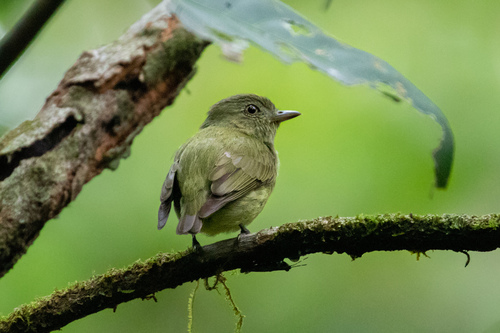
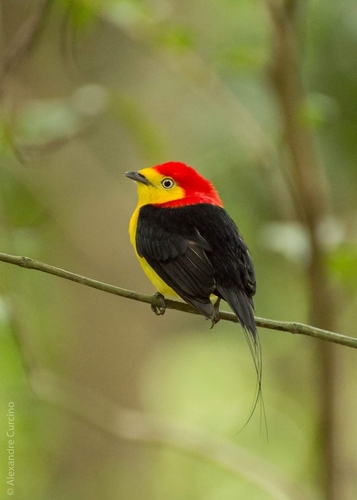
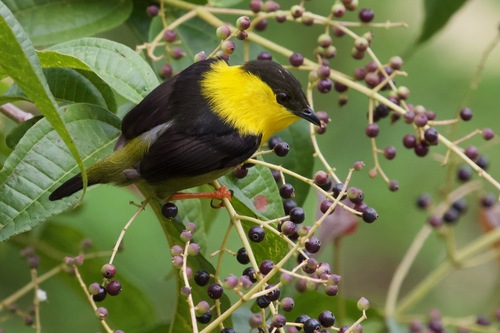
The golden-collared manakin, Manacus vitellinus, is approximately 10 to 12 cm (3.9 to 4.7 in) long and weighs around 15 to 24 g (0.53 to 0.85 oz). This species is sexually dimorphic, and males are larger than females. Adult males of the nominate subspecies M. v. vitellinus have jet black plumage on their crown, back, wings, and tail. Their chin, throat, and breast are a deep, glossy golden-yellow, which wraps around the nape to form the namesake golden collar. The chin and throat feathers are long and can be extended forward. Their lower breast, flanks, belly, and undertail coverts are olive green, with a yellow-olive tint on the belly. Adult females are mostly olive green overall. Their lower breast and belly have a paler yellow-olive wash, and their wings and tail are dusky, with olive edges on each feather. Other subspecies differ from the nominate and from each other in the following ways: M. v. amitinus is larger than the nominate with a longer tail; the male’s collar is a slightly more lemon-yellow, and green plumage is darker in both sexes, with less yellow wash on the female. For M. v. milleri, males have a paler lemon yellow collar and more yellow on the belly than the nominate, while females have paler green underparts with more yellow on the belly than the nominate. For M. v. viridiventris, the male’s collar matches the nominate or is slightly more lemony; both sexes have a darker olive belly with less yellow, and females are darker olive overall. All subspecies of both sexes have a mouse brown to dark brown iris, a black bill, and legs and feet that range from variably bright orange to dull scarlet. The subspecies of the golden-collared manakin are distributed across the following regions: M. v. vitellinus occurs on the Caribbean slope of Panama from Bocas del Toro Province to Colombia, and on the Pacific slope from Veraguas Province to Colombia; in Colombia, it extends east into northern Antioquia Department and south to central Chocó Department. M. v. amitinus is found on Isla Escudo de Veraguas, off the coast of Bocas del Toro Province, Panama. M. v. milleri is found in northern Colombia, from Antioquia Department east into Córdoba Department. M. v. viridiventris is found in Colombia’s Western Andes, from Chocó Department south to Cauca and Valle del Cauca departments. The golden-collared manakin lives in evergreen forest and mature secondary forest in the lowlands and foothills of the tropical zone. It typically avoids the deep interior of forests and is more common along forest edges, watercourses, and regenerating clearings. Its elevational range extends from sea level up to 1,200 m (3,900 ft).