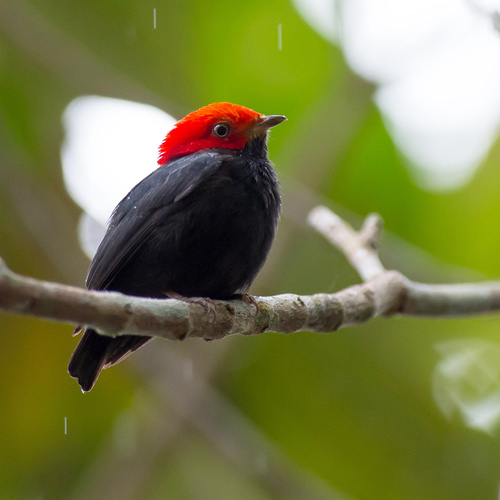
About Manacus manacus (Linnaeus, 1766)
Like other manakins, the white-bearded manakin is a compact, brightly coloured forest bird, typically 10.7 centimetres (4.2 in) long and weighing 16.5 grams (0.58 oz). The adult male has a black crown, upper back, wings and tail, and all other plumage is white, plus orange legs. Females and young males are olive-green, and resemble female golden-headed manakins, but they also have orange legs. The race endemic to Trinidad, M. m. trinitatis, is larger than mainland birds, and the female of this race has yellower underparts. Apart from a buzzing display song, the white-bearded manakin has a number of other calls, including a trilled musical peeerr. In South America, two thirds of the white-bearded manakin's range lies across the combined Amazon Basin, the Guianas, and the Orinoco River drainage of Venezuela, along with eastern Colombia. Three disjunct populations also occur: one in Pacific coastal Ecuador and southwestern Colombia; a second in coastal and inland western Venezuela and northwestern Colombia; and the largest disjunct population in southeastern Brazil, extending south to inland regions bordering Paraguay, and northeast from Paraná state to coastal Pernambuco. The only area of the Amazon Basin that does not host this species is the 2200 km Purus River region in southwestern Amazonas state. These manakins eat fruit alongside some insects and spiders. Male white-bearded manakins perform an interesting breeding display at a communal lek. Each male clears a patch of forest floor down to bare earth, and perches on a bare stick. The display consists of rapid leaps between sticks and the ground, accompanied by a loud wing snap, whirring wings, and a chee-poo call. Groups of up to 70 birds may display together, with the largest leks found in Trinidad. The female builds a shallow cup nest low in a tree, and lays two brown-mottled white eggs. Incubation is done entirely by the female and lasts about 18–19 days, and young take a further 13–15 days to reach fledging. Young are fed mainly on regurgitated fruit, with some insects added to their diet.