About Manacus candei (Parzudaki, 1841)
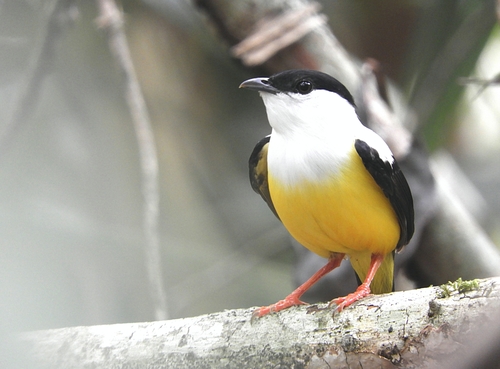
The white-collared manakin (Manacus candei), like its close relatives, is a compact, short-tailed bird with a heavy hooked bill, orange legs, and brightly colored plumage in males. It is typically 11 cm long and weighs 18.5 g. Adult males have black crowns, wings, tails, and a black band across the midback. The rest of the head, neck, breast, and upper back are white, the rump is olive-green, and the belly is bright yellow. Males have heavily modified wings: the five outer primaries are very narrow for their outer half, while the inner primaries are thickened and bowed. This wing modification is only shared with male orange-collared and golden-collared manakins. The male's call is a rolled preew. As with other manakins, the modified wings are used to produce a loud snap similar to a breaking twig, plus various rustling and whiffling noises. Females and young males are olive-green with a yellow belly. They are very similar to female orange-collared manakins, but the two species have no overlapping range. This species is named after Admiral Antoine Marie Ferdinand de Maussion de Candé, an explorer of South America. It occurs in the lowlands and foothills of the Caribbean slope up to 700 m elevation; it is replaced on the Pacific slopes of Costa Rica and Panama by the closely related orange-collared manakin (M. aurantiacus) and golden-collared manakin (M. vitellinus). It hybridizes extensively with the golden-collared manakin in a limited area of Bocas del Toro Province, Panama. Male hybrids have a lemon yellow collar, and were once considered a distinct species called the almirante manakin (Manacus×cerritus), as documented by Brumfield et al. (2001) and McDonald et al. (2001). The white-collared manakin lives in thickets at the edges of moist forest, tall second growth, and old cacao plantations. Like other manakins, this species performs an unusual breeding display at a communal lek. Each male clears a patch of forest floor up to 120 cm across down to bare earth, then leaps back and forth between thin upright bare sticks while producing a loud wing snap. When a female is present, males jump together, crossing each other above the cleared display court. Males also erect their throat feathers to form a beard. The female lays two brown-speckled white eggs in a shallow cup nest built 1–3 m high in a horizontal tree fork. Nest building, incubation (which lasts 18–21 days), and care of the young are all done by the female alone, as manakins do not form stable breeding pairs. The white-collared manakin feeds low in trees on fruit and some insects, plucking both from foliage while in flight.