About Mammillaria vetula Mart.
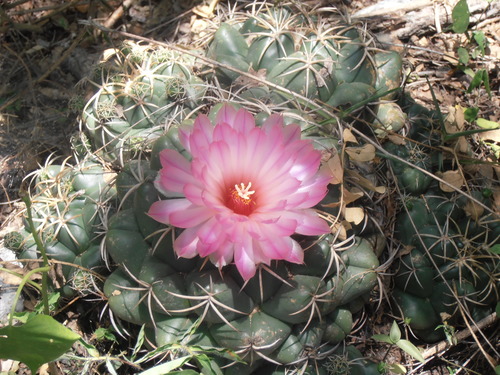
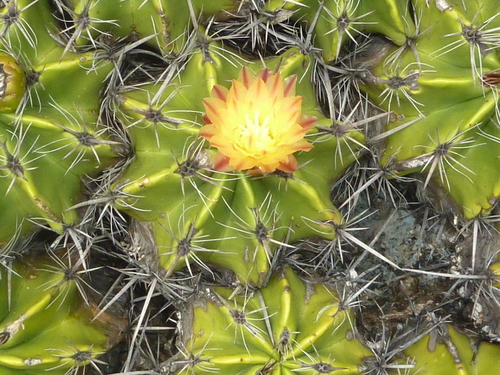
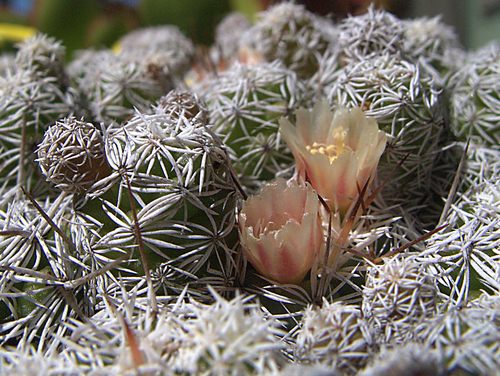
Mammillaria vetula Mart. is a succulent subshrub that grows in clustered formations of globose to short-cylindric, bluish-green stems. Its stem axils may be either naked or slightly woolly. The nominate subspecies, Mammillaria vetula subsp. vetula, has white radial spines: young plants produce 25 to 40, while mature plants grow up to 50. This subspecies typically has 1 to 2 central spines, though some specimens collected in Hidalgo have been observed with 5 to 9. Its central spines are reddish-brown and measure around 10 mm long. The flowers of M. vetula are funnel-shaped and lemon-yellow, around 15 mm in both length and width, with stigmas that are white, and occasionally orange-yellow. Its fruits are dull pink, and its seeds are black. Mammillaria vetula subsp. gracilis is a prolific grower that produces offsets which detach easily. Its stems are cylindrical, reaching up to 13 cm long and 1 to 3 cm wide, and it has naked axils. This subspecies has 11 to 16 bristle-like, chalky white radial spines that are 3 to 8 mm long; smaller variants sometimes have brown-tipped spines. Central spines are either absent, or mature plants may grow up to 5, which are 10 to 12 mm long, sturdier than radial spines, and either white or dark brown. Its flowers are 12 mm in both length and width, pale yellow with a pinkish or brownish midstripe. Its fruits are small, red or pinkish-white, with black seeds. A smaller-stemmed form with brown spines also exists; it is sometimes labeled as M. fragilis or M. gracilis var. pulchella, but botanist David Hunt classifies it as a cultivar. Mammillaria vetula grows primarily in desert and dry shrubland habitats. The nominate subspecies occurs in the Mexican states of Hidalgo, Guanajuato, and Querétaro, at altitudes between 1,600 and 3,350 meters. At its highest altitude growing sites, it is often covered by snow and ice. Documented specific locations for the nominate subspecies include San José del Oro, La Encarnación, Sierra de Jalapa, and Vizarrón. Mammillaria vetula subsp. gracilis is found in Hidalgo and Querétaro, growing at altitudes between 1,200 and 1,850 meters. Documented locations include Puente de Dios, San Onofre, Tolantongo, Barranca Xilitla, San Pedro Gilo, Ixmiquilpan, and Metztitlan. The type specimen of this subspecies was collected from leaf litter under shrubs growing on limestone rocks. Within cultivation, Mammillaria vetula includes both the rarest and the most common mammillaria grown. After the 1970s or 1980s, the nominate subspecies, M. vetula subsp. vetula, declined in popularity. Cacti nurseryman John Pilbeam speculates that it was replaced by showier species due to its plain spination and inconspicuous flowers. When grown in full sun, plants develop the best spination and produce the best blooms, and Pilbeam considers full-sun grown plants to be a worthy addition to any collection. Because M. vetula subsp. gracilis breaks apart into propagable pieces at the slightest touch and grows without issues in cultivation, Pilbeam estimates it is probably the most commonly grown mammillaria. He notes that it is frequently offered at general plant sale events, except paradoxically at cactus-focused events, where offering it is seen as ignominious. Mammillaria vetula are tough plants, but they require good drainage and grow best in sandy soil that is allowed to dry out completely between waterings. To encourage spring blooming, plants need a winter rest period in a cold location with no watering. They can be grown as houseplants, in rock gardens, or in xeriscapes. Registered cultivars of Mammillaria vetula include 'Oruga Blanca', 'Roi Baudouin I', and 'Snow Cap'.