About Mammillaria prolifera (Mill.) Haw.
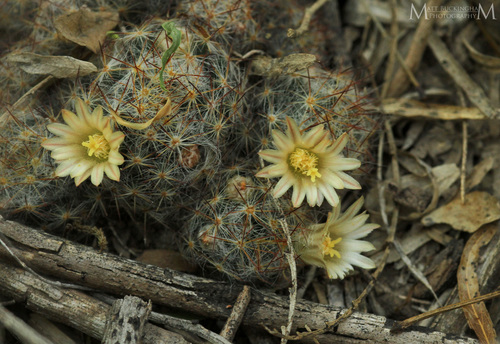
Mammillaria prolifera (Mill.) Haw. is a succulent subshrub. It was first described by Miller as a "roundish prolific Cactus, with oval tubercles closely joined, having long white beards" and "tufts of white down on the knobs, and also between them at every joint, which makes the whole plant appear as if it was covered with fine cotton". This original description was based on plants brought to London by William Houston, which were likely collected from Cuba. This species is now recognized to be highly variable. It usually grows in dense clusters, with each individual stem being round to slightly elongated, reaching around 9 cm tall and 4.5 cm wide. The stem surface is covered in small, cylindrical bumps called tubercles, each about 1 cm long; the bases of the tubercles are either bare, or bear fine white hairs that can be as long as the tubercles, or longer. This species has fibrous roots. Its edible fruit is cylindrical, 8–20 mm long and 4–5 mm wide, only the outer walls of the fruit are juicy, and the dried flower structure remains attached to the ripe fruit. The recognized subspecies differ primarily in spine shape and spine count. Mammillaria prolifera subsp. prolifera may grow in clusters or remain as a single simple stem. It has a rounded to short cylindrical shape, growing up to 6–7 cm wide. The axils (spaces between tubercles) are filled with short wool and white bristles. This subspecies produces around 60 or more radial spines, which are white, bristle-like to fine hair-like, straight or twisted, and 6–15 mm long. It has between 6 and 11 central spines that are needle-like, with one central spine thicker and longer than the others. These spines are slightly fuzzy, glassy white to pale straw-yellow at the base, with darker tips, and measure 4–7 mm long. Its flowers are cream yellow with a reddish brown midstripe, approximately 15 mm long and 15 mm wide. Its fruit is orange-red, and may persist on the plant until it blooms again the following year. The seeds are black. Mammillaria prolifera subsp. arachnoidea differs from the other subspecies primarily in its smaller stem size and an overall softer appearance. It has 4–5 extremely thin central spines that are almost indistinguishable from its radial spines; the radial spines of this subspecies resemble a cobweb. Its flowers have a narrow funnel shape. Mammillaria prolifera subsp. texana is distinguished by its greyish coloration. It forms dense clusters along its entire stem. Its individual stems are 5–7 cm in diameter, and grow into low, almost flat clumps. The bristles in its axils are white. Each areole has over 50 thin, needle-like white radial spines that are 5–9 mm long. Each areole usually holds 8–12 needle-like central spines, which are 4–7 mm long, white, and somewhat sturdier than the radial spines, with brown tips. All spines of this subspecies are straight and smooth. Its flowers, which are about 20 mm long and 15 mm wide, have white edges and a brownish pink midstripe. Flowers appear throughout spring, and are followed by red fruit and black seeds. This subspecies produces fruit especially freely. An unnamed yellow-spined form of this subspecies exists, with pale yellow radial spines, honey yellow central spines, and creamy yellow to pale yellow flowers. Mammillaria prolifera is native to Texas (United States), northeastern Mexican states, Cuba, and Hispaniola. It grows primarily in tropical biomes that experience seasonal droughts. Mammillaria prolifera subsp. prolifera is found in Cuba, the Dominican Republic, and Haiti, typically at elevations between 30 m and 50 m above sea level. Britton and Rose recorded its presence at Guantanamo Bay Naval Base, where it grows in low, dry thickets, described as "quite inconspicuous but abundant". Confirmed locations for this subspecies include Port-au-Prince and Ganthier in Haiti, and Guayubin in the Dominican Republic. Mammillaria prolifera subsp. arachnoidea has been collected in the Mexican states of Hidalgo and Tamaulipas. In Hidalgo, it occurs in the canyon of the Moctezuma River, east of Jacala; in Tamaulipas, it is found 8 km west of Antiguo Morelos, growing on rocks adjacent to Federal Highway 8, at 300 m above sea level. The distribution of Mammillaria prolifera subsp. texana ranges from the U.S. state of Texas to the Mexican states of Coahuila, Nuevo León, Querétaro, San Luis Potosí, and Tamaulipas, at elevations of 400–2250 m above sea level. In Texas, it occurs at 0–600 m elevation in Tamaulipan thorn scrub, oak-juniper woodlands, gravel, limestone crevices, plant litter under vegetation, cliffs, hills, valleys, and plains. It grows along the entire length of the Rio Grande and along Texas' Gulf Coast to the area around Rockport, never growing more than a few miles inland from the coast. On the Gulf coastal flat plains, it thrives in rich, deep lowland soils near thickets, or among clumps of coastal grasses. Near Eagle Pass, its range leaves the Rio Grande, and it grows on the rocky hilltops of the Edwards Escarpment, wedged into limestone crevices, often growing in very little soil and shaded by rock outcrops. Its northern range extends almost to Bandera and Rocksprings, where winters become too cold for it to survive. The unnamed yellow-spined form can be found growing alone or alongside the brown-spined form of the same subspecies, and the two forms do not appear to interbreed. Ecologist Den Weniger, who observed the two forms in the wild, suggests they may be different phenotypes of the same variable population. Mammillaria prolifera is one of the best known, easiest to grow, and most commonly cultivated species in the genus Mammillaria. Cacti nurseryman and journalist John Pilbeam notes that its commonness means it is "almost looked down upon by the connoisseurs". It is valued for its attractively dense tufts of spines, and for its ability to produce flowers and fruit at the same time, in greater abundance than any other Mammillaria species. Like Mammillaria vetula subsp. gracilis, Mammillaria prolifera is easy to propagate and distribute; Pilbeam estimates that most cactus enthusiasts first become interested in the Mammillaria genus after growing these two species. The most commonly cultivated subspecies is Mammillaria prolifera subsp. texana. According to Pilbeam, Mammillaria prolifera subsp. arachnoidea is more difficult to grow than the other two subspecies.