About Mammillaria glassii R.A.Foster
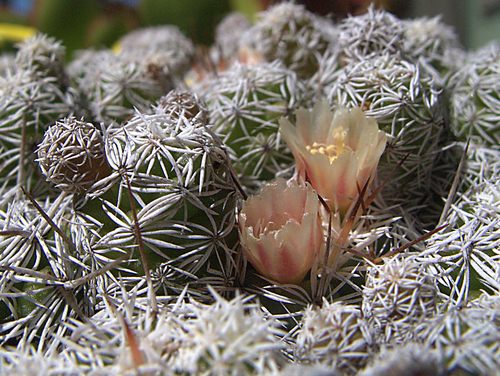
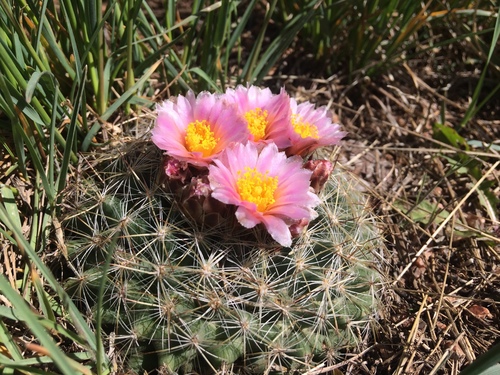
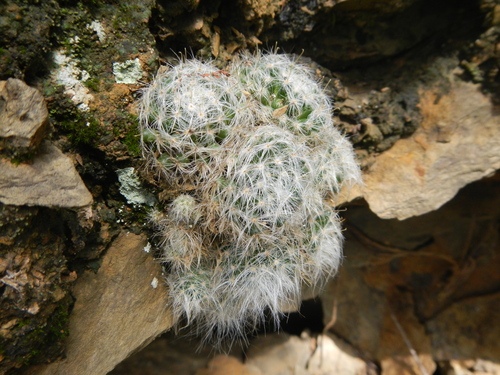
Mammillaria glassii R.A.Foster is a succulent subshrub that forms clusters of rounded stems. Its entire body is completely hidden by a dense covering of spines and bristly white axillary hairs, and it has a sparse root system. Its fruits are edible; unripe fruits are green, and they turn pinkish when mature, and contain black seeds. For Mammillaria glassii subsp. glassii, stems start 3 cm tall and wide, eventually growing into cylindrical shapes up to 10 cm tall. Each areole has 20 to 30 axillary hairs that can grow up to 25 mm long. It produces 50 to 60 fine, white, interwoven radial spines, each 10 to 15 mm long. It has one straight or hooked golden-amber central spine, plus 6 to 8 pale amber sub-central spines that are difficult to tell apart from the radial spines. Its pale pink flowers grow up to 14 mm long and 3.5 mm wide, and only open fully in bright sunlight. Mammillaria glassii subsp. ascensionis differs from the nominate subspecies by its larger stems, which are 2 to 10 cm in diameter, fewer axillary hairs, a more rounded stem top, slightly woolly areoles, and longer central spines. Most distinctively, this subspecies has much larger flowers that are 18 to 22 mm wide, with flower color ranging from pale shell-pink (seen in the former varieties ascensionis and siberiensis) to deep pink (in the former variety nominis-dulcis). Mammillaria glassii is endemic to Mexico, where it typically grows on steeply sloped rocks, often in partial or even full shade. The nominate subspecies has been recorded in the Mexican states of Coahuila, Nuevo León, and Tamaulipas, growing at elevations between 1,450 and 2,250 meters. M. glassii subsp. ascensionis occurs at altitudes of 2,400 to 2,750 meters in Nuevo León, where it grows in moss, on limestone, and in crevices of steep cliffs, only receiving sunlight in the late afternoon. The former variety siberiensis, which is now classified within this subspecies, gets its name from the village near where it was first discovered. When this species was first discovered, it caused excitement among cactus enthusiasts. M. glassii subsp. glassii was the first subspecies brought into cultivation, valued for its dense white spination and attractive flowers. It was soon surpassed in popularity by M. glassii subsp. ascensionis, which has larger, showier flowers. All variants of this species are easy to cultivate, but require growing conditions with sharp drainage. They grow best in shallow pots placed in locations with ample sunlight.