About Mammillaria bocasana Poselg.
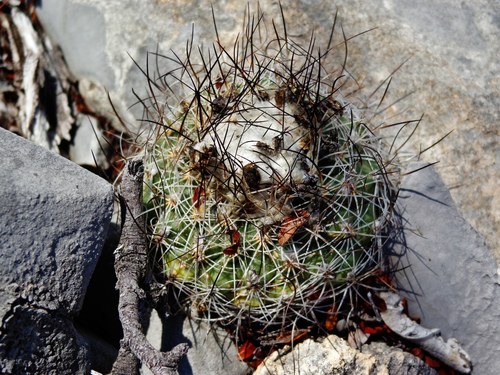
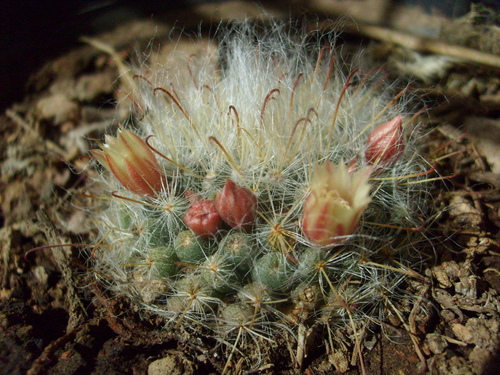
Mammillaria bocasana Poselg. is a cactus that typically grows in a hemispherical shape. It produces white, hair-like spines that fully cover its radial spines and hooked central spines. In spring and summer, it produces multiple cream-colored flowers. After flowering, it develops a red cylindrical fruit that holds reddish-brown seeds with a partially lateral hilum. This species has a variable form, with many recognized varieties and subspecies. In its natural range, this cactus grows in north-central Mexico, at elevations between 1650 and 2300 meters above sea level. It grows on canyon walls, in volcanic rock, and in semi-desert environments, and is often found growing underneath native shrubs. It has been classified as Least Concern on the IUCN Red List of Threatened Species since 2009. In cultivation, Mammillaria bocasana can be propagated from seed. As the plant matures, it produces offsets that eventually form large mounds. This cactus is prone to rot, and can tolerate brief exposure to temperatures as low as -7°C (20°F). It has been awarded the Royal Horticultural Society's Award of Garden Merit.