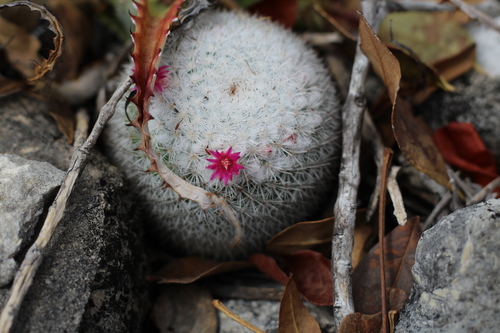
About Mammillaria albilanata Backeb.
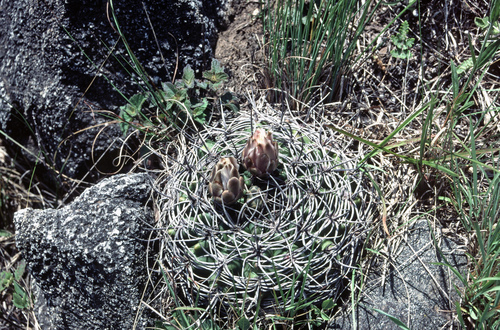
Mammillaria albilanata Backeb. is a species of cactus that is endemic to Mexico. This species is divided into four currently recognized subspecies: Mammillaria albilanata subsp. albilanata, Mammillaria albilanata subsp. oaxacana, Mammillaria albilanata subsp. reppenhagenii, and Mammillaria albilanata subsp. tegelbergiana. The species as a whole occurs across the Mexican states of Chiapas, Colima, Guerrero, Oaxaca, and Puebla. This cactus most commonly grows as a solitary, short, cylindrical plant, though it may form clusters when grown in cultivation. Mature individuals can reach up to 15 centimeters in height and 8 centimeters in width. Its flowers are small and colorful, with color ranging from carmine red to purplish pink. After flowering, it produces red fruits that contain brown seeds. The species grows in a variety of habitats including rocky crevices and open areas, at altitudes between 500 and 2,400 meters, with elevation ranges varying by subspecies.
The type subspecies, Mammillaria albilanata subsp. albilanata, is native to Guerrero, where it occurs at altitudes from 500 to 2,200 meters. It grows primarily in an approximately 100-kilometer long mountainous area between the cities of Iguala and Chilpancingo. It grows well in varied terrains, including the humus-rich hilly regions of Zopilote Canyon. Additional recorded locations for this subspecies include Mexcala, sites above Xochipala, and Teloloapan. Mammillaria albilanata subsp. oaxacana is native to Oaxaca and Puebla, growing at altitudes between 700 and 2,400 meters. Recorded locations in Oaxaca include San Pedro Mártir Quiechapa, the area of San Sebastián Tecomaxtlahuaca/Santiago Juxtlahuaca, the area south of Guelatao, San Pedro Yolox, San Juan Quiotepec, San Juan del Estado, Mitla, Totolapan, Tlaxiaco, Yucunama, Huajuapan, Tamazulapan, Santo Domingo Tonalá, and Ocotepec. In Puebla, this subspecies occurs in areas around Acatlán de Osorio. Mammillaria albilanata subsp. reppenhagenii is the westernmost subspecies of the species. It is found in the coastal state of Colima in southwestern Mexico, growing at altitudes between 900 and 1,300 meters. Mammillaria albilanata subsp. tegelbergiana is native to Chiapas, occurring at elevations ranging from 700 to 2,200 meters. It thrives in open areas and limestone crevices, particularly along Highway 190 near Ocozocoautla de Espinosa, and in the Sierra Ecatepec region near Teopisca and San Cristóbal de las Casas.