About Malvaviscus arboreus Cav.
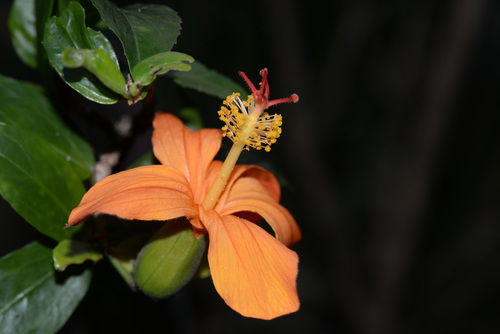
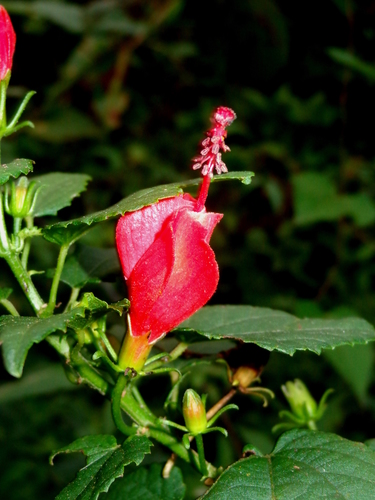
Malvaviscus arboreus Cav. is a flowering plant species in the hibiscus family Malvaceae, native to the southern United States, Mexico, Central America, and South America. Its specific epithet arboreus describes the tree-like growth form of mature individuals. This species is widely grown in cultivation today, and has many common English names: wax mallow, Turk's cap (mallow), Turk's turban, sleeping hibiscus, manzanilla, manzanita (de pollo), ladies teardrop, and Scotchman's purse. Many of these common names are also used for other, sometimes unrelated, plant species. Its flowers never fully open, and their structure helps attract butterflies and hummingbirds. The native range of Malvaviscus arboreus includes Mexico, Central America, and the Gulf Coast of the United States, where it grows as an understory shrub especially in coastal Texas and Louisiana. Where it occurs in Texas, it is a common understory shrub, and serves as an important food source for female and juvenile Ruby-throated Hummingbirds (Archilochus colubri) and Black-chinned Hummingbirds (A. alexandri). Each individual flower lives for two days, and produces more nectar on its first day. One documented location of M. arboreus is the coastal Petenes mangroves of the Yucatán region of Mexico, where it is a subdominant species within the local plant community. It is also the primary host plant for caterpillars of the Turk's-cap White-Skipper (Heliopetes macaira). Malvaviscus arboreus is commonly cultivated in both shady and sunny sites in butterfly and hummingbird gardens throughout the southern United States. It can be propagated from fresh seed, or from softwood cuttings. It typically blooms from May through November, and will continue blooming through mild winters.