About Malva sylvestris L.
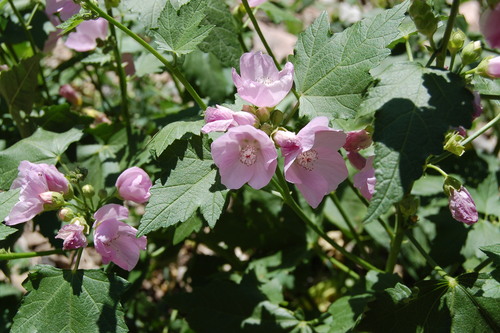
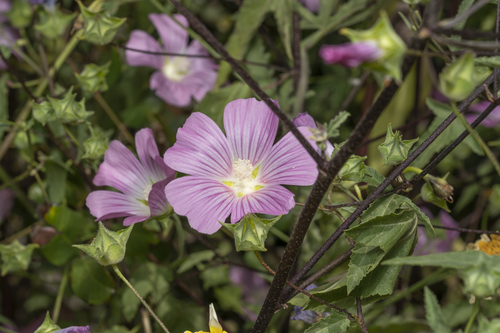
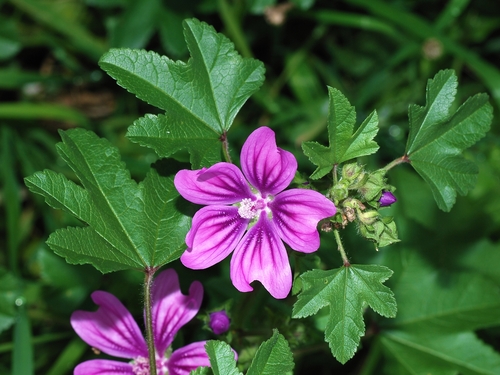
Common mallow (Malva sylvestris L.) is a herbaceous perennial plant. It has an erect or decumbent branched stem that can reach up to 1.5 metres (5 ft) tall. Minutely ridged stems are covered in fine soft hairs, which sometimes have a slightly bulbous base. Its leaves grow in an alternate arrangement, with a petiole up to 20 centimetres (8 in) long. The leaves are simple but palmate, reaching up to 7 cm long by 10 cm wide, and bear stellate hairs (multiple strands radiating from a single common center), with prominent veins on their underside. Its flowers are reddish-purple with dark stripes, arranged in axillary clusters of 2 to 4 along the main stem, where the flowers at the base of the stem open first. Each flower has 5 petals, each up to 2 cm (3⁄4 in) long, and 5 sepals 3–6 mm long; the sepals are fused in their lower half, and have broadly triangular lobes. There is also an epicalyx (or false calyx) with oblong segments, which are two-thirds as long as the calyx lobes, measuring 2–3 mm long by 1.5 mm wide. Malva sylvestris grows self-seeding on waste and rough ground, beside roads and railways, throughout lowland England, Wales and the Channel Islands, Siberia, with scattered populations elsewhere. A major growing region for this species is northeast and central Iran. It is also found in North Africa; it grows as a biennial in the Mediterranean region, and as a perennial in all other areas where it occurs. It has been introduced to and become naturalised as an invasive species in eastern Australia, the United States, Canada, and Mexico. It is often cultivated as an ornamental plant for its attractive flowers, which are produced over a long period through the summer. Numerous named cultivars have been selected for cultivation: 'Annita', 'Aurora', 'Bardsey Blue', 'Blue Fountain', 'Brave Heart', 'Cottenham Blue', 'Gibbortello', 'Harry Hay', 'Highnam', 'Inky Stripe', 'Knockout', 'Magic Hollyhock', 'Mest', 'Mystic Merlin', 'Perry's Blue', 'Purple Satin', 'Richard Perry', 'Tournai', 'Windsor Castle', 'Zebrina' (soft lavender-purple striped with deep maroon veins) and 'Zebrina Zebra Magis'. The young leaves and shoots of Malva sylvestris are edible, and can be eaten either raw or cooked. This species has a long history of traditional use as a wild food plant across the world, from the Mediterranean and Middle East (including Palestine and Italy) to the Caucasus. In Morocco, Tunisia and Palestine, Malva leaves are steamed with garlic and tomatoes, and served as an appetizer or salad. In Egypt, the leaves are used to make a stew-like winter vegetable dish called khobeiza, which is similar to Molokheia. In 1931, Maud Grieve wrote that the medicinal use of this mallow species has been largely superseded by marsh-mallow (Althaea officinalis), which has the same beneficial properties in a stronger form, but common mallow remains a popular folk remedy for country people where marsh-mallow cannot be found. Historically, the flowers were spread on doorways and woven into garlands or chaplets for May Day celebrations. Boiled young common mallow leaves were eaten as a vegetable across several parts of Europe in the 19th century. In herbalism, Malva sylvestris has long been used in traditional medicine. Like many other members of the mallow family Malvaceae, Malva sylvestris contains mucilage, especially in its fruit. The seeds are used internally as a demulcent, prepared as a decoction or herbal tea, while the leaves can be used in poultices as an emollient for external use. This species has also long been used to produce a natural yellow dye, and yellow-green dyes of varying shades can be obtained from both the plant and its seeds. A tincture made from the flowers can act as a sensitive test for alkalis. Malva sylvestris has additionally been used for veterinary purposes.