About Malva neglecta Wallr.
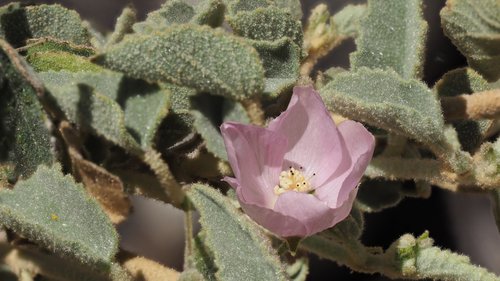
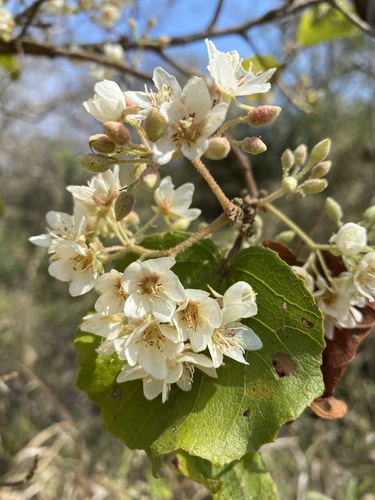
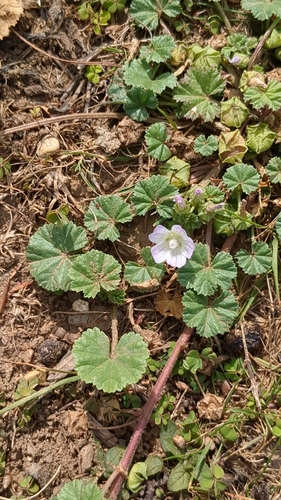
Dwarf mallow, scientifically named Malva neglecta Wallr., is a prostrate, downy herbaceous plant that grows to roughly 60 cm (24 in) tall. It produces a tough taproot. Its leaves are alternate, each attached to the stem via a long, strongly channeled petiole that can reach up to 12 cm (4.7 in), with narrowly triangular stipules. Most leaves are either reniform or have 5 to 7 shallow lobes. Basal leaves measure 3–7 cm (1.2–2.8 in) across. This species is typically a broadleaf winter annual, but it can also live as a biennial or perennial when growing conditions are favorable. Flowers grow on single stalks, arranged in clusters of 2 to 5 in leaf axils. Flower stalks are shorter than leaf stalks, so flowers are partially hidden by surrounding leaves. Its fruits are schizocarps that split into 10–12 smooth, hairy mericarps, also called nutlets. In addition to daily phototropic movements, Malva neglecta leaves also exhibit epinasty, geotropism, and sleeping behaviors. Leaves attached to the east side of the stem bend abaxially, while leaves on the west side bend adaxially; leaves on the north and south sides of the plant turn sideways. Overnight, leaves have been observed returning to the position they held in the morning. After this species was introduced to Canada, the common mallow form was found to be freezing tolerant: it retains the ability to carry out photosynthesis and respiration even after long exposure to subfreezing temperatures. Its native range is the Palearctic realm, covering specific regions and locations as follows: Macaronesia: Canary Islands; Northern Africa: Algeria, Morocco; Arabian Peninsula: Saudi Arabia; Western Asia: Afghanistan, Cyprus, Sinai, Iran, Iraq, Israel, Jordan, Lebanon, Palestinian Territories, Syria, Turkey; Caucasus: Armenia, Azerbaijan, Georgia; Soviet Middle Asia: Kazakhstan, Kyrgyzstan, Tajikistan, Turkmenistan, Uzbekistan; Mongolia: Mongolia; China: Xinjiang; Indian Subcontinent: India, Pakistan; Northern Europe: Denmark, Ireland, Norway, Sweden, United Kingdom; Middle Europe: Austria, Belgium, Czech Republic, Germany, Hungary, Netherlands, Poland, Slovakia, Switzerland; Southeastern Europe: Albania, Bosnia and Herzegovina, Bulgaria, Croatia, Greece, Italy, Montenegro, North Macedonia, Sardinia, Serbia, Slovenia, Romania; Southwestern Europe: France, Portugal, Spain. Malva neglecta has six distinct age stages in its life cycle: seedlings, juveniles, immatures, virginals, young generatives, and middle-aged generatives. Seedling leaf blades are pubescent on their lower surface and along their edges. Juvenile plants grow a single solitary shoot, with rounded leaves that have wavy toothed margins. Immature plants develop kidney-shaped leaves with jagged edges. Virginile plants form rosettes holding 3 to 5 rounded heart-shaped leaves. Young generative plants produce solitary white or light pink flowers. Middle-aged plants show branching of their generative shoot. Young leaves and stems are green, while mature leaves and lower stems range in color from green to purple. Chemically, the plant contains 1-Octacosanol, ascorbic acid, choline, alkaloids, and saponin, and it has a measurable antioxidant content. It has a high nitrate content, comparable to that of arugula. Its flowers contain tannins.