About Malus domestica (Suckow) Borkh.
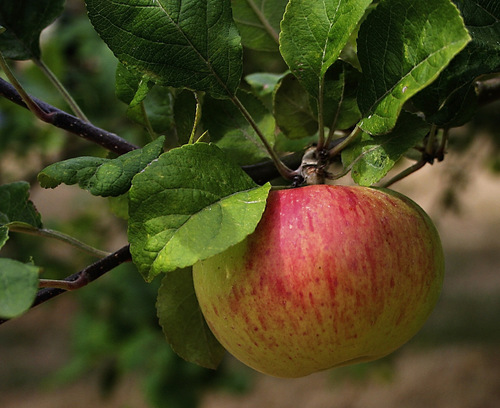
Malus domestica (Suckow) Borkh., the common apple tree, is a deciduous tree. In cultivation, it typically grows 2 to 4.5 metres (6 to 15 feet) tall; in the wild it can reach up to 15 m (49 ft), though wild specimens more commonly grow 2 to 10 m (6.5 to 33 ft). When cultivated, the tree's final size, shape, and branch density are controlled by the choice of rootstock and trimming practices. Naturally growing apple trees usually develop a rounded to erect crown with a dense leaf canopy. The bark of mature trunks is dark gray or gray-brown; young branches have a smooth texture and are reddish or dark brown. Young twigs are covered in fine downy hairs, and become hairless as they age. Buds are egg-shaped, dark red or purple, and measure 3 to 5 millimeters across, usually staying smaller than 4 mm. The edges of the bud scales are covered in dense fine hairs. When new leaves first emerge from buds, they are convolute, meaning their edges overlap one another. Mature leaves are simple, and can be oval (elliptic), medium or wide in width, ovate (somewhat egg-shaped with the widest portion near the base), or oblong (with sides that are more parallel rather than curved), all ending in a narrow pointed tip. Leaf edges have broadly angled teeth and do not form lobes. The upper surface of leaves is glabrescent, becoming almost hairless as it matures, while the underside is densely covered in fine hairs. Leaves grow in an alternating arrangement along branches, attached by short petioles that are 1 to 3.5 cm (1⁄2 to 1+1⁄2 in) long. Blossoms form in spring at the same time that leaves bud out, growing on spurs and some long shoots. When flower buds first open, petals are rose-pink; they fade to white or light pink once fully open. Each flower is 3 to 4 centimeters (1 to 1+1⁄2 inches) in diameter. These five-petaled flowers grow in cymes (a type of inflorescence) that hold 3 to 7 flowers total. The central flower of the inflorescence is called the "king bloom"; it opens earlier than the other flowers and can develop a larger fruit than the rest. Open apple blossoms are damaged by even brief exposure to temperatures of −2 °C (28 °F) or colder, though overwintering wood and buds can survive temperatures as low as −40 °C (−40 °F). Apples are self-incompatible, meaning they require cross-pollination from another cultivar to develop fruit. Each growing season during flowering, apple growers typically use managed pollinators to move pollen; honey bees are the most commonly used pollinator. Orchard mason bees are also used as supplemental pollinators in commercial apple orchards. Bumblebee queens are sometimes present in orchards, but they do not usually occur in large enough numbers to act as significant pollinators for commercial production. Apple cultivars are sometimes classified by the day of peak bloom within the average 30-day blossom period, and compatible pollinizer cultivars are chosen to have at least a 6-day overlap in bloom time. Depending on climate, there are 4 to 7 distinct pollination groups for cultivated apples, with example groups and typical bloom timing in England as follows: Group A – Early flowering, 1 to 3 May (example cultivars 'Gravenstein', 'Red Astrachan'); Group B – 4 to 7 May (example cultivars 'Idared', 'McIntosh'); Group C – Mid-season flowering, 8 to 11 May (example cultivars 'Granny Smith', 'Cox's Orange Pippin'); Group D – Mid/late season flowering, 12 to 15 May (example cultivars 'Golden Delicious', 'Calville blanc d'hiver'); Group E – Late flowering, 16 to 18 May (example cultivars 'Braeburn', 'Reinette d'Orléans'); Group F – 19 to 23 May (example cultivar 'Suntan'); Group H – 24 to 28 May (example cultivar 'Court-Pendu Gris', also called Court-Pendu plat). A given cultivar can be pollinated by a compatible cultivar from the same group or an immediately adjacent group (for example, A can pollinate A or B, but not A with C or D).