About Malurus splendens (Quoy & Gaimard, 1830)
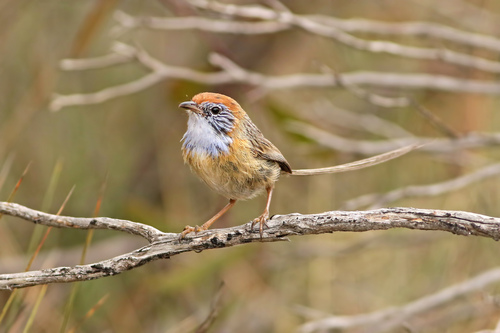
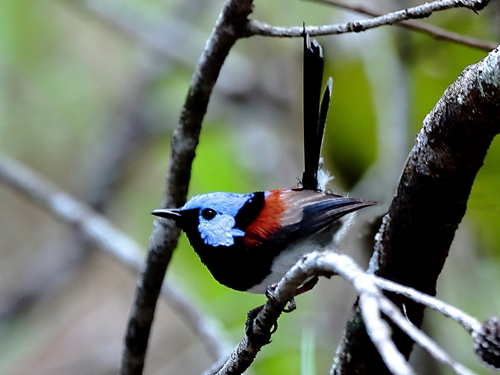
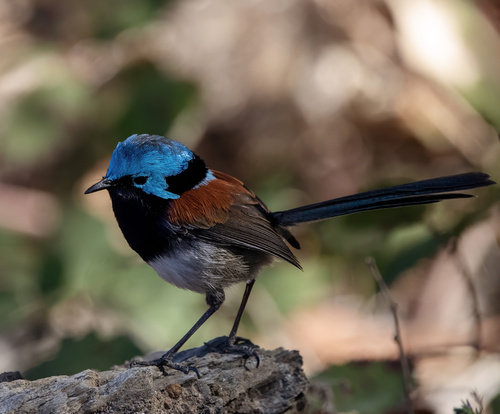
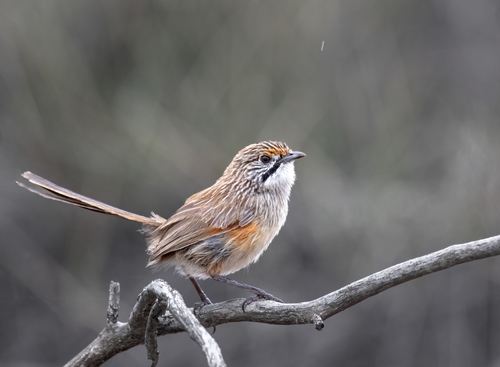
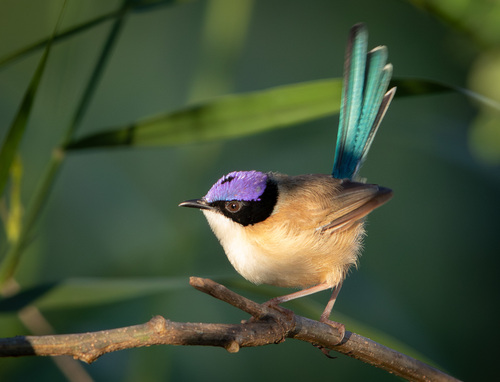
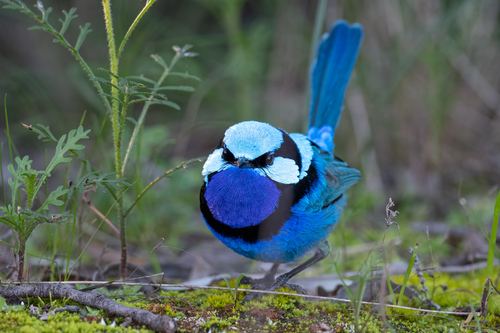
The splendid fairywren (Malurus splendens) is a small, long-tailed bird that measures 14 cm (5.5 in) in total length. This species shows a high degree of sexual dimorphism in plumage. Breeding males have distinct markings: a bright blue forehead and ear coverts, a violet throat, and deeper rich blue coloring across the back, wings, chest, and tail, paired with a black bill, black eye band, and black chest band. The blue plumage of breeding males is commonly called nuptial plumage. Non-breeding males are predominantly brown, with blue markings in the wings and a bluish tail. Females have similar overall coloration to non-breeding males, but differ by having a chestnut bill and chestnut eye-patch. Immature males moult into breeding plumage for their first breeding season after hatching, though this initial moult is often incomplete, leaving residual brownish plumage, and may take another one to two years to fully complete. Both sexes moult in autumn after the breeding season finishes; after this moult, males take on eclipse non-breeding plumage. They moult again back into nuptial plumage during winter or spring. A small number of older males retain their blue breeding plumage all year, moulting directly from one year's nuptial plumage to the next. The blue plumage of breeding males, especially the feathers of the ear coverts, is highly iridescent. This iridescence comes from the flattened, twisted surface of the feather barbules. The blue plumage also strongly reflects ultraviolet light, so it may be even more visible to other fairywrens, whose colour vision can detect this part of the light spectrum. The main advertising call of the splendid fairywren is described as a gushing reel; this call is harsher and louder than the calls of other fairywren species, and varies between individual birds. A soft single 'trrt' sound is used as a contact call by members of a foraging group, while the species' alarm call is a sharp 'tsit'. When encountering cuckoos or other intruders, splendid fairywrens may respond with a threat posture and a churring threat call. Females produce a purring call while brooding eggs or young. The splendid fairywren is widely distributed across the arid and semi-arid zones of Australia. Its typical habitat is dry, shrubby country, including mulga and mallee vegetation in the drier parts of the country, and forested areas in southwest Australia. The western subspecies M. s. splendens and the eastern black-backed fairywren (subspecies M. s. melanotus) are mostly sedentary, while the turquoise fairywren (subspecies M. s. musgravei) is thought to be partially nomadic. Unlike the related eastern superb fairywren, the splendid fairywren has not adapted well to landscapes modified by human settlement, and has disappeared from some urbanised areas. Commercial forestry plantations of pine (Pinus spp.) and eucalypts are also unsuitable habitats for the species, as these plantations lack sufficient undergrowth. Like all fairywrens, the splendid fairywren is an active, restless forager. It forages most often on open ground near shelter, but also searches for food through lower foliage. It moves through its habitat in a series of quick jaunty hops and bounces, with its large proportional tail helping it maintain balance; the tail is usually held upright and is rarely still. The species' short, rounded wings provide good initial lift for short flights, but are not suited for long-distance travel. Even so, splendid fairywrens are stronger fliers than most other fairywren species. In spring and summer, birds are active in short bursts throughout the day, and sing while foraging. Insects are abundant and easy to catch at this time of year, so birds can rest between foraging outings. Members of a social group often shelter and rest together during the hottest part of the day. In winter, food is much harder to find, so the birds must forage continuously throughout the day. Groups of two to eight splendid fairywrens stay within a shared territory and defend it year-round. Average territory size is 4.4 ha (11 acres) in woodland-heath areas; territories get smaller as vegetation density increases, and get larger as the number of males in the group increases. Each group is made up of one socially monogamous breeding pair, plus one or more helper birds of either sex that hatched within the territory, though helpers are not always the genetic offspring of the main pair. Splendid fairywrens are sexually promiscuous: both breeding partners mate with other individuals outside the pair bond, and even help raise young produced by these extra-pair matings. Over one-third of all offspring are the result of extra-pair matings. Helper birds assist the breeding pair by defending the territory, and by feeding and rearing the group's young. All members of a group roost side-by-side in dense vegetation cover, and also engage in mutual preening. Major nest predators of the splendid fairywren include native Australian birds: Australian magpies (Gymnorhina tibicen), butcherbirds (Cracticus spp.), laughing kookaburras (Dacelo novaeguineae), currawongs (Strepera spp.), crows and ravens (Corvus spp.), and shrike-thrushes (Colluricincla spp.). It also faces predation from introduced mammals: the red fox (Vulpes vulpes), domestic cat (Felis catus), and black rat (Rattus rattus). Like other fairywren species, splendid fairywrens may use a 'rodent-run' display to distract predators from nests that contain young birds. During this display, the bird lowers its head, neck, and tail, holds its wings out, fluffs up its feathers, runs rapidly, and gives a continuous alarm call.