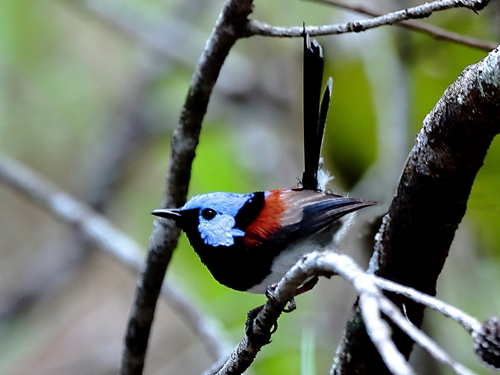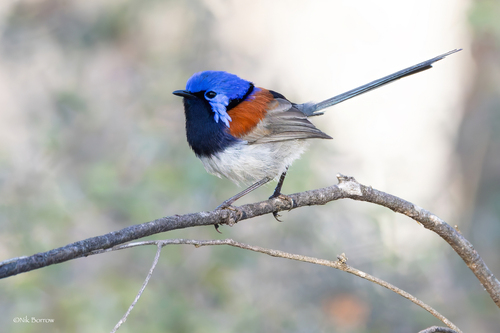
About Malurus pulcherrimus Gould, 1844
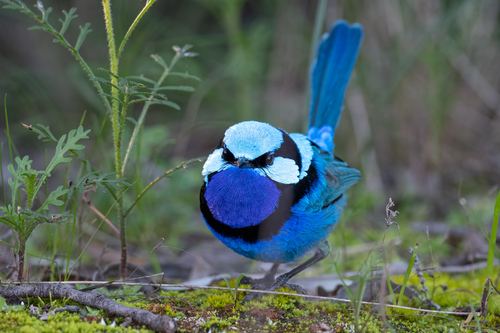
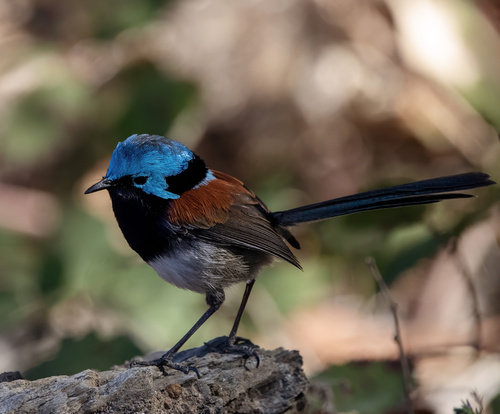
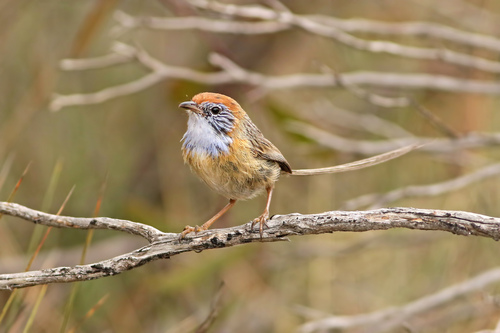
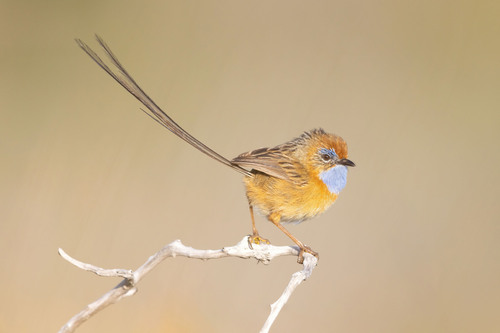
This species, the blue-breasted fairwren (Malurus pulcherrimus Gould, 1844), has distinct vocalizations. Its contact call is a soft, short, reed-like trill. The alarm call consists of characteristic short churring notes for the genus Malurus, which are repeatedly given out and then taken up by all members of the group. Among Australasian wrens, males of this species have the least distinctive song: a soft whirring, buzzing trill, typically sung from a sheltered spot deep inside the foliage of shrubby vegetation. Its range covers inland south-western Western Australia and the Eyre Peninsula of South Australia. Scientists originally believed the species only occurred in Western Australia, before it was discovered in the more eastern Eyre Peninsula region, where it was misidentified for a period as one of the many forms of variegated wren. The species' distribution is unusual, with a 300-kilometre gap in its range stretching from the head of the Great Australian Bight to where the species reappears on Eyre Peninsula. Malurus pulcherrimus is not a common species. It is naturally secretive, so it is not easy to observe. Imitating a wren distress call can draw females out into the open. Adult males are even shyer than females, and usually only spotted briefly as they move hidden through bushes.