About Malurus melanocephalus (Latham, 1802)
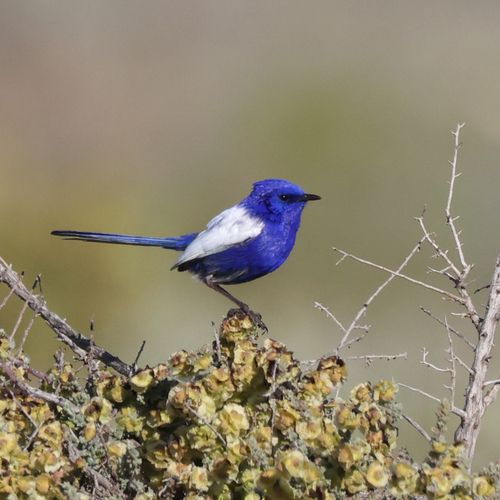
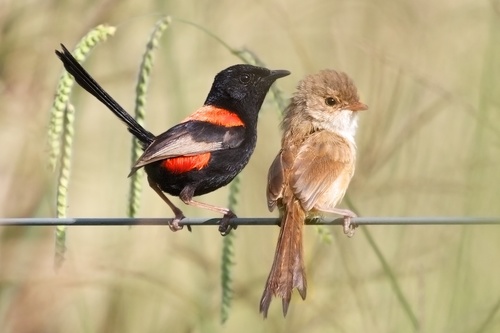
The red-backed fairywren, with the scientific name Malurus melanocephalus (Latham, 1802), is the smallest member of the genus Malurus. It measures 11.5 centimetres (4.5 in) long and weighs 5–10 g (0.18–0.35 oz), with an average weight of around 8 g (0.28 oz). Its tail is approximately 6 centimetres (2.4 in) long: breeding males have black tails, while non-breeding eclipse males, females, and juvenile birds have brown tails. The bill averages 8.6 mm (0.3 in) long, and is relatively long, narrow, pointed, and wider at the base. It is wider than it is deep, and its shape is similar to the bills of other birds that feed by probing or picking insects from their surroundings. Like other fairywrens, the red-backed fairywren displays marked sexual dimorphism. Males do not develop full breeding plumage until their fourth year, which is later than all other fairywrens except the closely related white-winged fairywren. Breeding-plumage males have a black head and body, a striking red back, and brown wings. At other times of year, males have a brown upper body and white underparts. Some males, mostly younger individuals, remain in non-breeding eclipse plumage while breeding. Females have a buff brown body and a yellowish spot under the eye, making them remarkably similar in appearance to non-breeding males. Female red-backed fairywrens differ from females of other fairywren species because they lack a blue tint in the tail. Geographically, this species follows Gloger's rule: female red-backed fairywrens have whiter bellies and paler brown upperparts when they live inland in sunnier climates. Juveniles of both sexes look very similar to females. The red-backed fairywren is endemic to Australia. Its range extends along rivers and the coast from Cape Keraudren in northern Western Australia, through the Kimberleys, Arnhem Land and the Gulf Country, into Cape York, with the Selwyn Range and upper reaches of the Flinders River marking its southern limit in the north. It is also found on the nearby offshore islands Groote Eylandt, Sir Edmund Pellew, Fraser, Melville and Bathurst Islands. Its range continues all the way down the east coast east of the Great Dividing Range to the Hunter River in New South Wales. The species prefers wet, grassy tropical or sub-tropical areas with tall grasses such as blady grass (Imperata cylindrica), Sorghum species, and Eulalia. It is not a true migrant, but it may be locally nomadic in response to vegetation changes, and may leave its territory after the breeding season. When fires occur, the species retreats to fire-resistant cover. It avoids arid habitats, and is replaced to the south of its range by the white-winged fairywren. The red-backed fairywren is diurnal: it becomes active at dawn, and is active in bursts throughout the rest of the day. When not foraging, multiple birds often shelter together. They roost side-by-side in dense cover and engage in mutual preening. Their usual form of locomotion is hopping, where both feet leave the ground and land simultaneously. However, individuals may run when performing the rodent-run display. A relatively long tail, which is usually held upright and rarely still, helps the bird maintain balance. Its short, rounded wings provide good initial lift and work well for short flights, but are not suited for long trips. The birds generally fly in a series of undulations, for a maximum distance of 20 or 30 m (66 or 98 ft). In dry tall grasslands in monsoonal areas, vegetation can change dramatically due to either fires or wet season growth, so red-backed fairywrens here are more nomadic and change territories more often than other fairywrens. In other areas such as coastal regions, they maintain more stable territories. Cooperative breeding is less common in this species than in other fairywrens; while helper birds have been reported occasionally, the red-backed fairywren has not been extensively studied. Both adult males and adult females may use the rodent-run display to distract predators from nests with young birds. During this display, the bird lowers its head, neck and tail, holds its wings out, fluffs its feathers, runs rapidly, and gives a continuous alarm call.