About Malurus leucopterus Dumont, 1824
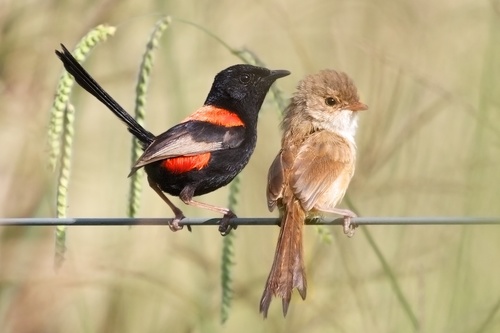
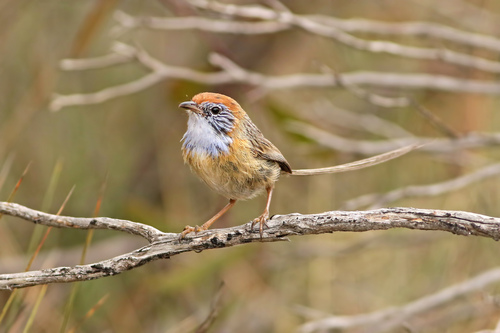
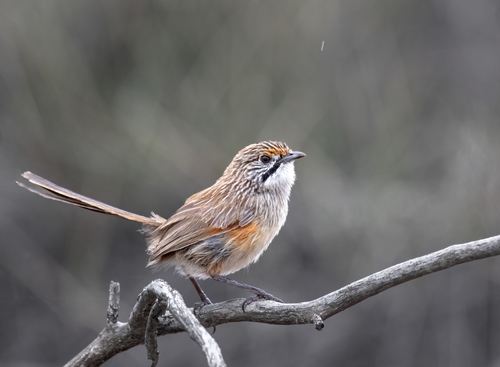
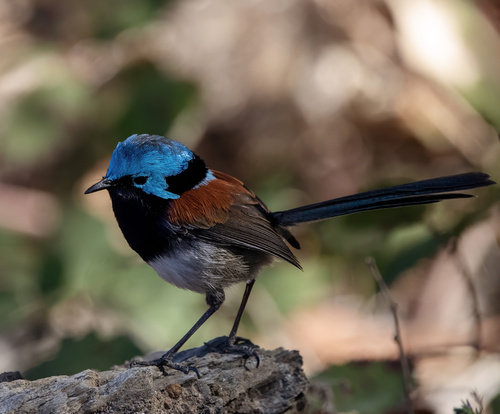
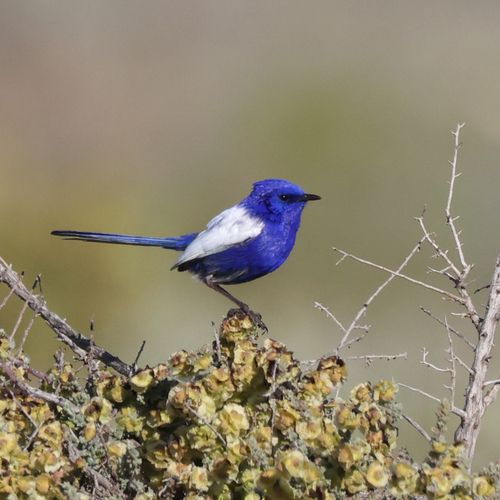
Measuring 11 to 13.5 centimetres (4.3 to 5.3 in) in length, the white-winged fairywren (Malurus leucopterus) is one of the two smallest species in the genus Malurus. Males typically weigh between 7.2 and 10.9 grams (0.25 and 0.38 oz), while females weigh between 6.8 and 11 grams (0.24 and 0.39 oz). The bill averages 8.5 mm (0.3 in) long in males and 8.4 mm (0.3 in) in females; it is relatively long, narrow, pointed, and wider at its base. Wider than it is deep, the bill matches the shape of other birds that feed by probing for or picking insects from their surroundings, and it is finer and more pointed in this species than in other fairywrens. Fully mature adults are sexually dimorphic: males are larger and differ in colour from females. The adult female has sandy-brown plumage, a very light blue tail, and a pinkish buff bill. A male in breeding plumage has a black bill, white wings and shoulders, and a body that is entirely cobalt blue or black, depending on the subspecies. These contrasting white feathers are particularly noticeable during flight and ground displays in the breeding season. A male in non-breeding eclipse plumage resembles the female, though it can be distinguished by its darker bill. Both sexes have long, slender, distinct tails held at an upward angle away from their bodies. Tail feathers measure around 6.25 centimetres (2.46 in) and have a white fringe that wears away over time. Nestlings, fledglings, and juveniles have brown plumage, pink-brown bills, and shorter tails than adults. Young males develop blue tail feathers and darker bills by late summer or autumn, following a spring or summer breeding season, while young females develop light blue tails. By the following spring, all males are fertile and have developed cloacal protuberances, which store sperm. In contrast, during the breeding season, fertile females develop oedematous brood patches, which are bare areas on their bellies. Males entering their second or third year may develop spotty blue and white plumage during the breeding season. By their fourth year, males have developed their full nuptial plumage: the scapulars, secondary wing coverts, and secondary flight feathers are white, while the rest of their bodies are a vibrant cobalt blue. All sexually mature males moult twice a year, once before the breeding season in winter or spring, and again after the breeding season in autumn; rarely, a male may moult directly from one nuptial plumage to another. The blue plumage of breeding males, particularly the ear-coverts, is highly iridescent due to the flattened and twisted surface of the barbules. This blue plumage also reflects ultraviolet light strongly, so it may be even more prominent to other fairywrens, whose colour vision extends into the ultraviolet part of the spectrum. The white-winged fairywren is well adapted to dry environments. The subspecies M. l. leuconotus is found throughout arid and semi-arid environments between latitudes 19 and 32°S in mainland Australia. Its range covers coastal Western Australia from around Port Hedland south to Perth, stretching eastwards to Mount Isa in Queensland, along the western parts of the Great Dividing Range through central Queensland and central western New South Wales, into the northwestern corner of Victoria and the Eyre Peninsula, and across the Nullarbor. This species commonly cohabits with other fairywren species, including the purple-backed fairy-wren (M. lamberti assimilis). White-winged fairywrens often inhabit heathlands or treeless shrublands dominated by saltbush (Atriplex) and small shrubs of the genus Maireana, or grasses such as tussock grass (Triodia) and cane-grass (Zygochloa). They also inhabit floodplain areas vegetated with lignum (Muehlenbeckia florulenta). M. l. leucopterus inhabits similar dry habitats on Dirk Hartog Island, and M. l. edouardi occupies the same type of habitats on Barrow Island. The red-backed fairywren replaces the white-winged fairywren to the north of its mainland Australian range. The usual form of locomotion for the white-winged fairywren is hopping, with both feet leaving the ground and landing at the same time. However, the birds may run when performing the rodent-run display. A proportionally large tail, usually held upright and rarely still, helps the bird maintain balance. Short, rounded wings provide good initial lift and are useful for short flights, but are not suited for long trips. White-winged fairywrens live in complex social groups. Clans consist of 2–4 birds, typically one brown or partially blue male and a breeding female. Nest helpers are birds raised in previous years that remain with the family group after fledging and assist in raising new young; these helpers may be males that have retained brown plumage, or females. Birds in a group roost side-by-side in dense cover and engage in mutual preening. Several subgroups live within one territory to make up a clan, which is led by one blue (or black) male that has full breeding plumage. While the blue male is dominant over all other brown and partially blue males within his clan, he only nests with one female and only contributes to raising her young. It is unclear whether he fathers any young from the other nests within his territory. Each clan has a defined territory that all members forage within and defend. Normally, territories measure 4 to 6 hectares (10 to 15 acres), and their size is usually correlated with rain and resource abundance in the region: smaller territories occur where insects and other resources are plentiful. Additionally, feeding territories are larger during the winter months, when the entire clan spends most of its time foraging together. White-winged fairywrens occupy much larger territories than other fairywren species. The wing-fluttering display, observed in this species, occurs in multiple contexts: it is performed by females responding (presumably acquiescing) to male courtship displays, by juveniles begging for food, by helpers to older birds, and by immature males to senior males. To perform this display, the fairywren lowers its head and tail, outstretches and quivers its wings, and holds its beak open silently. Both adult male and adult female white-winged fairywrens may use a rodent-run display to distract predators from nests that contain young. During this display, the bird lowers its head, neck and tail, holds its wings out, fluffs its feathers, runs rapidly, and gives a continuous alarm call.