About Malurus elegans Gould, 1837
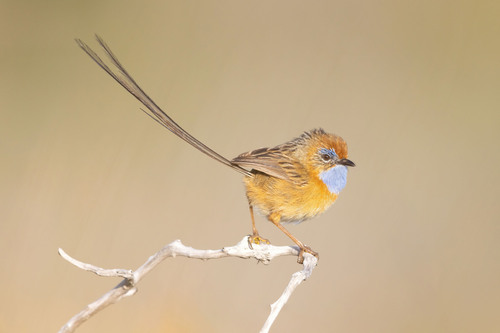
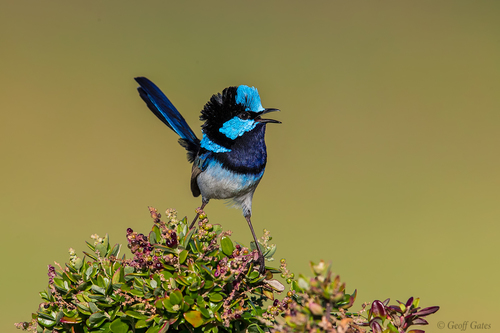
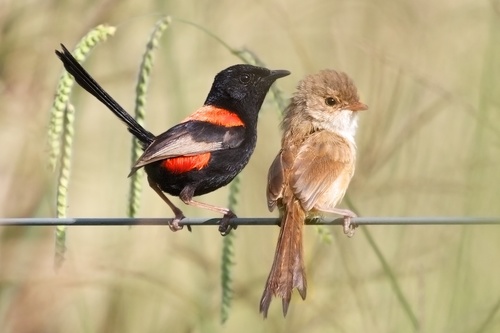
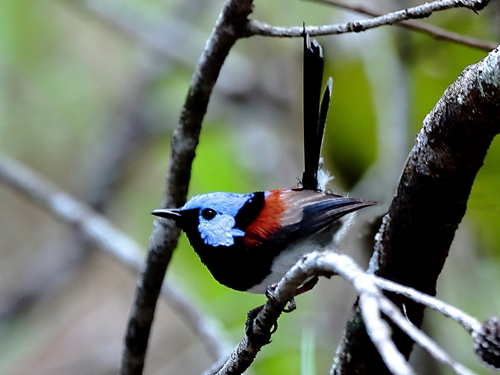
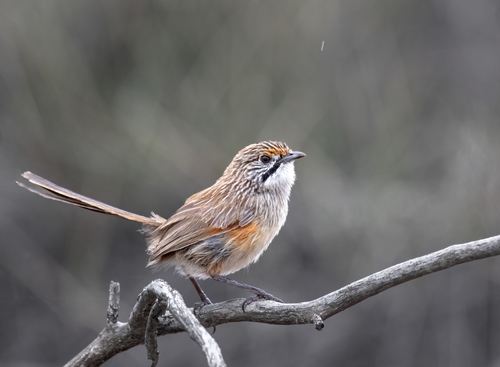
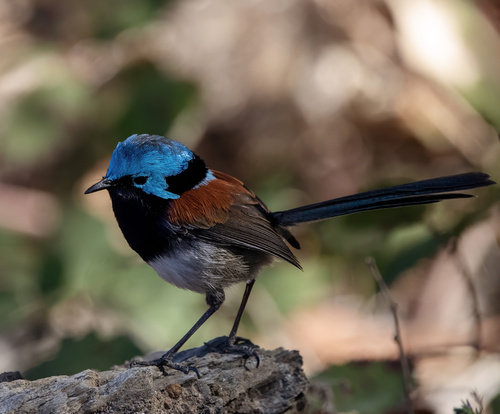
The red-winged fairywren (Malurus elegans Gould, 1837) measures 15 cm (6 in) in length and weighs 8–11 g (0.28–0.39 oz), making it the largest fairywren. Its average tail length is 7.5 cm (3.0 in), which is among the longest tails in its genus. The bill averages 10 mm (0.4 in) long in males and 9.3 mm (0.4 in) long in females; it is relatively long, narrow, pointed, wider at the base, and wider than it is deep. This bill shape matches that of other birds that feed by probing for or picking insects from their surroundings. Like other fairywrens, the red-winged fairywren shows strong sexual dimorphism. Breeding males have highly visible plumage in brilliant iridescent blue and chestnut that contrasts with black and grey-brown markings. The brightly coloured crown, ear tufts and upper back are prominent features used during breeding displays. A breeding plumage male has a silvery blue crown, ear coverts and upper back, a black throat and nape, bright red-brown shoulders, a long grey-brown tail and wings, and a greyish-white belly. Non-breeding males, females and juveniles are mostly grey-brown, though males may keep faint traces of blue and black plumage. All males have a black bill and black lores (the eye-ring and bare skin between the eyes and bill), while females have a black bill, rufous lores and a pale grey eye-ring. Immature males develop black lores by six weeks of age, and generally moult into an incomplete breeding plumage during their first breeding season after hatching. This incomplete plumage has a patchy, spotty appearance, with a mix of blue and grey feathers on the head, and black and grey feathers on the breast. Birds born early in the breeding season develop more full nuptial plumage initially than those born late. Most individuals finish their full nuptial moult by their second spring, though some may take an extra year. Multiple males in breeding plumage have been observed in the same group at the same time, but it is not known if or how this relates to dominance or breeding status. Both sexes moult in autumn after breeding, and males moult into an eclipse non-breeding plumage. They moult again into nuptial breeding plumage in winter or spring. Body feathers are replaced during both moults, while wing and tail feathers are only replaced during the spring moult. Wing and tail feathers may be replaced at any time if they become damaged or worn. The blue plumage of breeding males, particularly the blue ear-coverts, is highly iridescent because the barbules have flattened and twisted surfaces. This blue plumage also strongly reflects ultraviolet light, so it may be even more visible to other fairywrens, which have colour vision that extends into the ultraviolet spectrum. The red-winged fairywren lives in the wetter southwest corner of Western Australia, ranging from the Moore River north of Perth, south through the Margaret River region, and east to Albany. It is common across parts of its range, though there is some evidence of population decline caused by the draining of swampland. It inhabits the understorey of karri and jarrah forests. Older forests tend to be less favourable habitats, while red-winged fairywrens are attracted to disturbed areas created by logging. Populations disappear from an area after fire, and return within two years. Pine and eucalypt forestry plantations are generally unsuitable habitats, as they lack sufficient undergrowth. Within forest habitat, the red-winged fairywren prefers wetter gullies and riverside sword sedge. The northern edge of its range borders the range of the variegated fairywren, and the eastern edge borders the range of the blue-breasted fairywren. The two other species occupy drier scrub, while the red-winged fairywren is restricted to wetter forests. The absence of intermediate forms confirms all three taxa are separate species. BirdLife International has identified multiple sites as important for red-winged fairywren conservation: Araluen-Wungong, Jalbarragup, Mundaring-Kalamunda, North Dandalup, the Stirling Range, Two Peoples Bay and Mount Manypeaks. The red-winged fairywren usually moves by hopping, with both feet leaving the ground and landing at the same time, though it may run while performing the "rodent run display" described in other sources. A proportionally large tail helps it balance, and this tail is usually held upright and is rarely still. Its short, rounded wings provide good initial lift and work well for short flights, but not for long distance travel.