About Malurus cyaneus (Ellis, 1782)
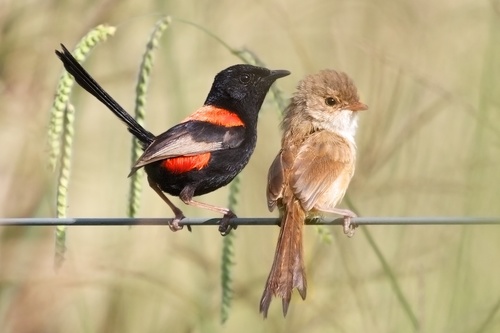
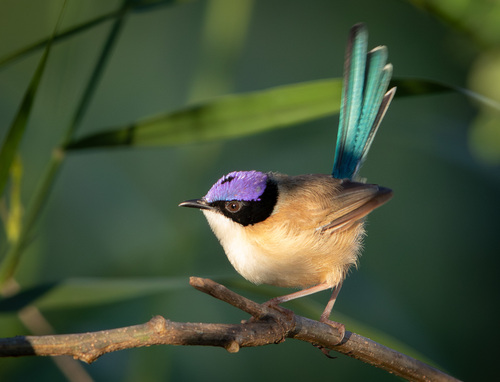
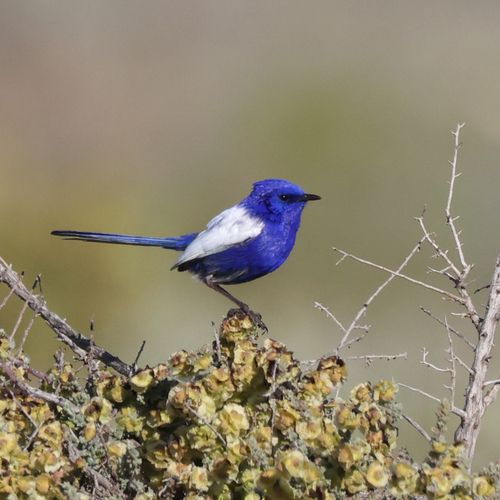
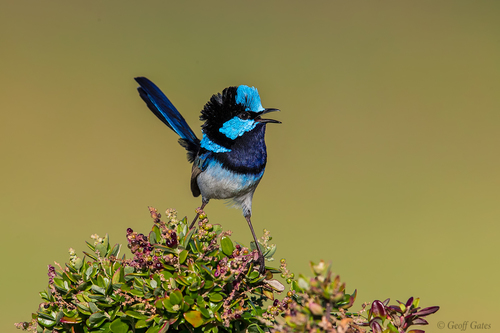
The superb fairywren (Malurus cyaneus) measures 14 cm (5+1⁄2 inches) long and weighs 8–13 g (0.28–0.46 oz), with males averaging slightly larger than females. Its average tail length is 5.9 cm (2+1⁄3 inches), which is among the shortest of any species in the Malurus genus. The bill is relatively long, narrow, pointed, and wider at its base, averaging 9 mm (0.4 inches) for the M. c. cyaneus subspecies and 8 mm (0.3 inches) for the M. c. cyanochlamys subspecies. The bill is wider than it is deep, matching the shape of bills of other birds that feed by probing for or picking insects from their surroundings. Like other fairywrens, the superb fairywren shows strong sexual dimorphism. Breeding males develop highly visible bright iridescent blue plumage that contrasts with black and grey-brown markings, and their brightly coloured crown and ear tufts are a prominent feature of breeding displays. A breeding male has a bright-blue forehead, ear coverts, mantle and tail, brown wings, and a black throat, eye band, breast and bill. Females, immature birds, and non-breeding males are plain fawn with a paler underbelly, and have either a fawn tail (for females and immatures) or a dull greyish blue tail (for non-breeding males). The bill is brown in females and juveniles, and turns black in males after their first winter. Immature males moult into breeding plumage for the first breeding season after hatching, though incomplete moulting sometimes leaves residual brownish plumage that can take one or two more years to fully replace. After breeding finishes in autumn, both sexes moult; males replace their breeding plumage with an eclipse non-breeding plumage. They moult again into nuptial breeding plumage in winter or spring. The blue plumage of breeding males, particularly the ear-coverts, is highly iridescent because the barbules have flattened, twisted surfaces. This blue plumage also reflects ultraviolet light strongly, so it may be even more visible to other fairywrens, which have colour vision that extends into the ultraviolet spectrum. The superb fairywren is common across most of the relatively wet, fertile south-eastern corner of Australia. Its range extends from south-eastern South Australia, including Kangaroo Island and Adelaide, and the tip of the Eyre Peninsula, through all of Victoria, Tasmania, coastal and sub-coastal New South Wales and Queensland, through the Brisbane area, and extends inland north to the Dawson River and west to Blackall. It is a common bird in the suburbs of Sydney, Melbourne and Canberra. It lives in wooded areas, generally locations with plenty of undergrowth, and has adapted to life in urban areas; it can be found in gardens and urban parks as long as native plant undergrowth is present nearby. Lantana (Lantana camara), a prolific weed in Australia, provides useful shelter in disturbed areas, as does the introduced invasive blackberry. Unlike other fairywrens, the superb fairywren appears to benefit from urban environments. One study conducted on the grounds of the Australian National University in Canberra found it has out-competed the introduced house sparrow. Colonies of superb fairywrens can even be found in Hyde Park and the Royal Botanic Gardens in central urban Sydney. The species is not found in dense forest or alpine environments, and pine or eucalypt forestry plantations are also unsuitable because they lack sufficient undergrowth.