About Malurus coronatus Gould, 1858
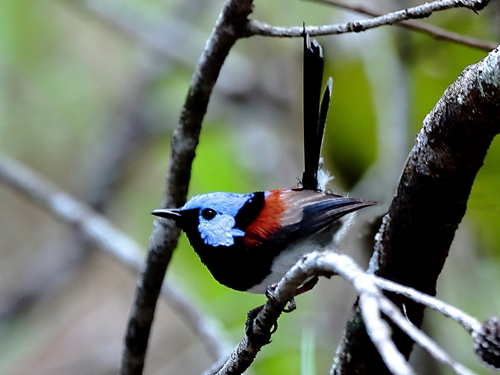
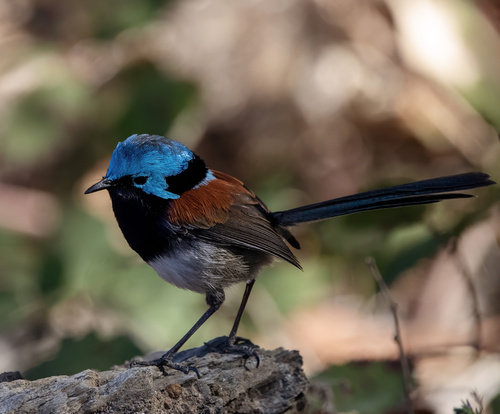
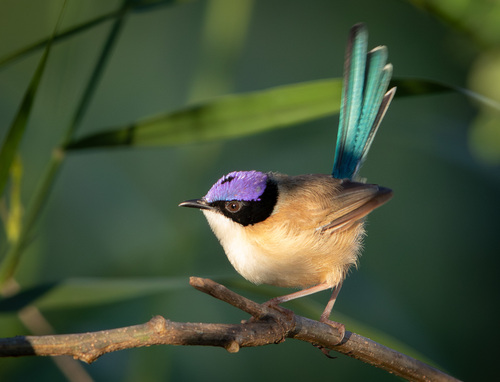
The purple-crowned fairywren (scientific name: Malurus coronatus Gould, 1858) is a small, sexually dimorphic bird. It measures approximately 14 cm (5.5 in) in length, has a wingspan of around 16 cm (6.3 in), and weighs between 9 and 13 g (0.32–0.46 oz). It can be distinguished from other North Australian fairywrens by its cheek patches and the deep blue color of its tail. Overall, its plumage is brown, with more greyish brown wings and a cream-buff belly. Its blue tail is long and held upright; all feathers except the central pair have broad white tips. The bird has a black bill, and brownish grey legs and feet. There are two subspecies, with slight geographic variation between them; only the difference in mantle color is noticeable in the field. For M. c. macgillivrayi, the crown and nape are slightly bluer, and the mantle and upper back have faint blue-grey shading. The slightly larger M. c. coronatus has a browner back, and a buff-colored rather than white breast and belly. This species is found across the wet-dry tropics of northern Australia, occurring in the Kimberley region of Western Australia, the Victoria River region of the Northern Territory, and the south-western sub-coastal region of the Gulf of Carpentaria in Queensland. Though its total distribution spans more than 1,500 km (930 mi), its range is limited by the quality and extent of riparian vegetation along waterways. A 300 km (190 mi) natural geographic barrier of unsuitable habitat separates the two subspecies. The western subspecies M. c. coronatus lives in the midsections of large river catchments that drain the Central Kimberley Plateau, and along sections of the Victoria River. The eastern subspecies M. c. macgillivrayi is found along most rivers that drain into the south-western and southern Gulf of Carpentaria, ranging from the Roper River in the Northern Territory to the Leichhardt and Flinders Rivers in Queensland. The purple-crowned fairywren is a specialist of riparian habitats, and lives in patches of dense vegetation that fringes rivers in northern Australia. Its preferred habitat lines permanent freshwater creeks and rivers, and features a well-developed mid-storey made up of dense shrubs such as Pandanus aquaticus and/or the freshwater mangrove Barringtonia acutangula (as seen in the Kimberley region), or 1.5–2 m (4 ft 11 in – 6 ft 7 in) tall dense thickets of river grass dominated by Chionachne cyanthopoda (as seen in the Victoria River District). A tall dense canopy of emergent trees, which the birds use as a temporary refuge during floods that submerge the mid-storey, is most often dominated by Eucalyptus camaldulensis, Melaleuca leucadendra, Melaleuca argentea, and Ficus species. Like all other species in the genus Malurus, the purple-crowned fairywren is a cooperative breeder. It lives in sedentary groups that maintain their territories, which are often arranged linearly along creeks and rivers, year-round. Unlike other members of the genus, which are highly promiscuous, purple-crowned fairywrens have high levels of fidelity and low rates of extra-pair paternity. Groups usually consist of one breeding pair, assisted by one to six offspring from previous broods. Helpers may stay with their parents for several years before they attempt to breed. Only the dominant pair in a group reproduces, and individuals can remain non-reproductive subordinates for multiple years. These subordinate helpers assist in raising offspring, which improves both group productivity and the survival of the breeding pair.