About Malurus assimilis North, 1901
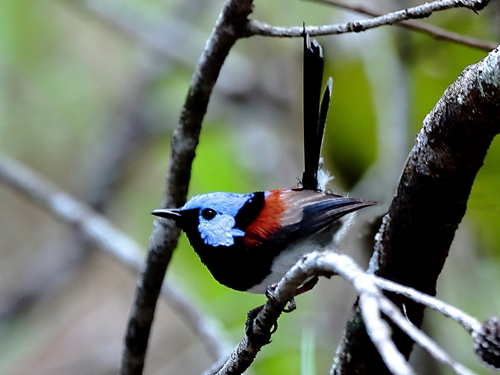
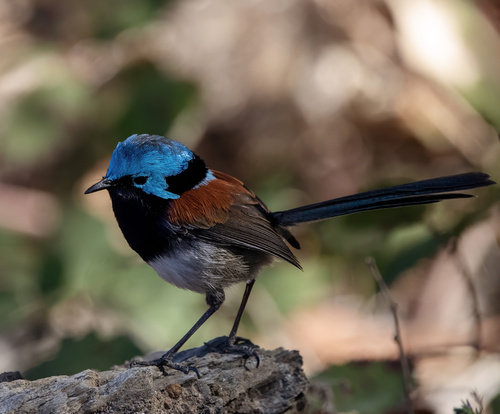
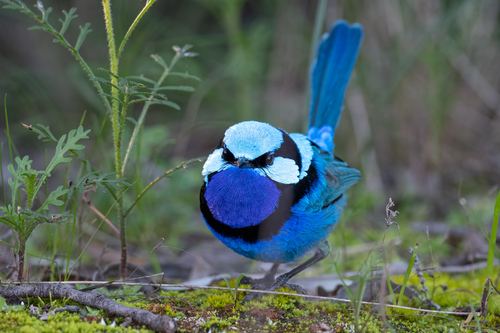
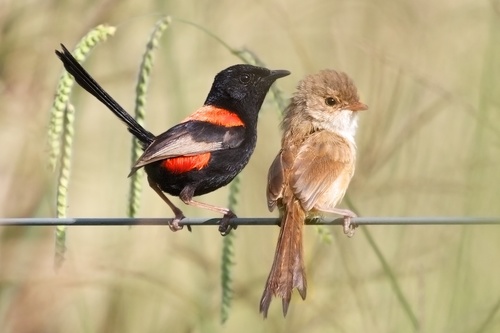
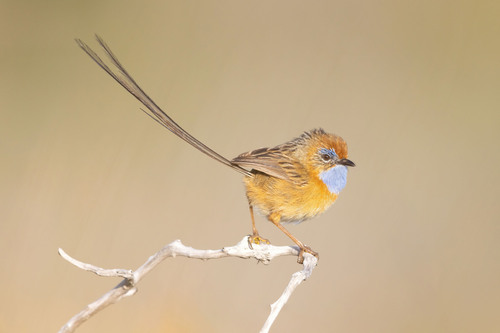
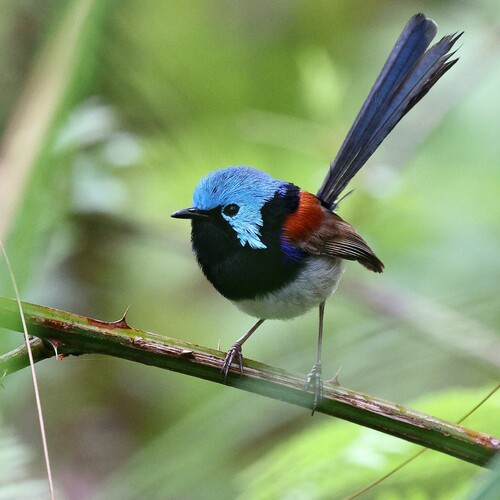
The purple-backed fairywren (Malurus assimilis) has an average length of 14.5 cm (5.5 in). Like other fairywrens, it displays strong sexual dimorphism. Breeding males grow highly visible, brilliant iridescent plumage in blue and chestnut that contrasts with black and grey-brown markings; their brightly coloured crown and ear tufts are featured prominently during breeding displays. In breeding plumage, males have striking bright blue ear coverts, a blue-purple crown and forehead, a black throat and nape, a blue-purple upper back, chestnut shoulders, and a bluish-grey tail. Their wings are drab brown and their belly is white. Across the range of the nominate subspecies M. a. assimilis, the plumage of both sexes becomes paler moving from east to west, with birds in northwestern Australia being the palest. Non-breeding males, females and juveniles of the nominate subspecies assimilis are predominantly grey-brown, while the same age and sex classes of subspecies rogersi and dulcis are mainly blue-grey. Males of all subspecies have a black bill and black lores (the eye-ring and bare skin between the eyes and bill). Females of subspecies assimilis and rogersi have a red-brown bill and bright rufous lores, while females of subspecies dulcis have white lores. Immature males develop black bills by six months of age, and moult into breeding plumage for the first breeding season after hatching. This first breeding plumage may be incomplete, with residual brownish plumage, and can take another one or two years to fully develop. Both sexes moult in autumn after breeding, after which males take on an eclipse non-breeding plumage. They moult again into nuptial breeding plumage in winter or spring. The blue plumage of breeding males, particularly the ear-coverts, is highly iridescent because the barbules have a flattened and twisted surface. This blue plumage also strongly reflects ultraviolet light, so it may be even more visible to other fairywrens, whose colour vision extends into the ultraviolet spectrum. The purple-backed fairywren is widely distributed across most of the Australian continent. It does not occur in southwestern Western Australia, where it is replaced by the red-backed and blue-breasted fairywrens, nor north of a line between Normanton and Townsville in northern Queensland, where it is replaced by the lovely fairywren. Early evidence suggested the nominate subspecies assimilis might be nomadic, but later more detailed fieldwork shows it is generally sedentary, with pairs maintaining territories year-round. There is little published information about the movement patterns of the other two subspecies. This species inhabits scrubland with plenty of dense vegetation cover. In inland and northern Australia, it prefers rocky outcrops and patches of Acacia, Eremophila or lignum. Fieldwork conducted in the Northern Territory found the species prefers open woodland dominated by thickets of lancewood (Acacia shirleyi) and bullwaddy (Macropteranthes kekwickii) over eucalyptus-dominated open woodland. It also occurs in chenopod scrubland alongside plants such as saltbush, bluebush, black rolypoly (Sclerolaena muricata), nitre goosefoot (Chenopodium nitrariaceum), and grass tussocks, with overstory plants such as black box (Eucalyptus largiflorens) and native cypress (Callitris). Clearing of native vegetation for agriculture in the Western Australian wheatbelt and the Murray-Mallee region of Victoria has had a negative impact on this species, as does cattle grazing that consumes saltbush.