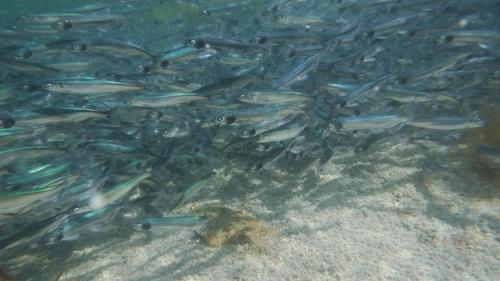
About Mallotus villosus (Müller, 1776)
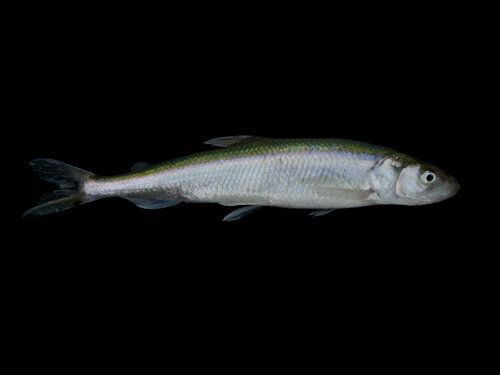
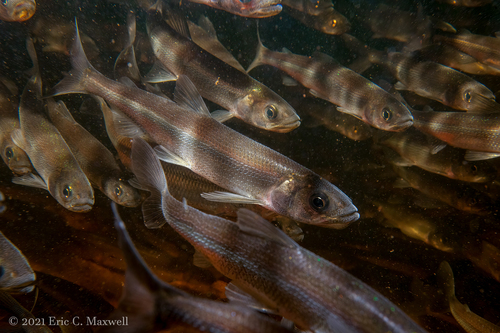
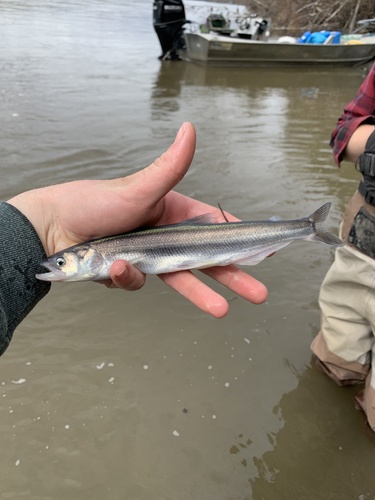
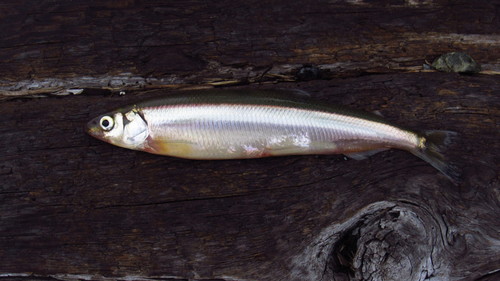
Capelin (also called caplin, scientific name Mallotus villosus) is a small forage fish belonging to the smelt family, found in the North Atlantic, North Pacific, and Arctic oceans. In summer, capelin graze on dense plankton swarms at the edge of the ice shelf. Larger capelin also eat large amounts of krill and other crustaceans. Capelin are preyed on by whales, seals, Atlantic cod, Atlantic mackerel, squid, and seabirds, especially during the spawning season when capelin migrate south. Capelin spawn on sand and gravel bottoms or sandy beaches when they are between two and six years old. For beach-spawning capelin, the post-spawning mortality rate is extremely high, and it is close to 100% for males. Mature males grow up to 20 cm (8 in) in length, while females can reach up to 25.2 cm (10 in) long. Capelin are olive-colored on their dorsal side, shading to silver on their sides. Males have a translucent ridge along each side of their bodies, and the ventral areas of males develop a reddish iridescence during spawning season. The closest known relative of capelin is the extinct fossil genus Enoplophthalmus, which lived in Europe during the early Oligocene and early Miocene epochs. As an r-selected species, capelin have high reproductive potential and a high intrinsic population growth rate. Their main spawning season starts in spring and can extend into summer. Most capelin are three or four years old when they spawn for the first time. Males migrate directly to the shallow spawning waters of fjords, while females stay in deeper water until they are fully mature. Once mature, females migrate to the spawning grounds to spawn, and this process usually occurs at night. In the North European Atlantic, capelin spawning typically takes place over sand or gravel at depths of 2 to 100 m (7–328 ft). In the North Pacific and waters off Newfoundland, most capelin spawn on beaches, jumping as far inland as possible, and some individuals become stranded in the process. While a small number of other fish species leave eggs in areas that dry out, or even leave eggs on plants above the water, mass jumping onto land to spawn is only shared by capelin, grunions, and grass puffers. In beach-spawning capelin populations, females leave the spawning grounds immediately after spawning, and can spawn again in later years if they survive. Males do not leave the spawning grounds, and may spawn more than once within a single spawning season. Even so, beach-spawning male capelin are considered semelparous, because they die soon after the spawning season ends. In ocean-spawning capelin populations, both males and females are semelparous, and die after spawning. This difference between populations shows capelin are physiologically capable of both iteroparous and semelparous reproductive strategies, depending on their spawning habitat. Studies of two Newfoundland capelin populations that spawn in different habitats found no evidence of genetic variation between beach and deep-water spawners, which supports the conclusion that the species is made up of facultative spawners. Capelin may choose their optimal spawning location based on abiotic factors including temperature range and sediment type. The greatest hatching success and highest offspring quality occurs when capelin eggs are incubated between 5 and 10 °C (41 and 50 °F), which supports the idea that individual capelin select spawning locations based on temperature—since temperature is one of the most variable factors between beach and deep-water spawning habitats. There is also evidence that temperature is not the only factor that influences spawning habitat selection. When both habitats fall within the optimal temperature range at the same time, capelin will spawn in both habitats. This may be an advantageous strategy that increases individual fitness. Capelin have been observed spawning on beaches when deep-water or subtidal habitat temperatures are lower than 2 °C (36 °F), and spawning in deep-water habitats when beach temperatures are consistently above 12 °C (54 °F).