About Malea ringens (Swainson, 1822)
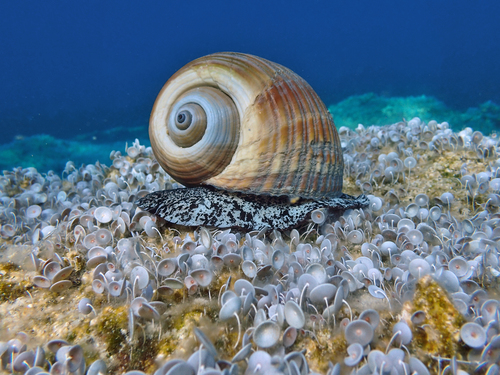
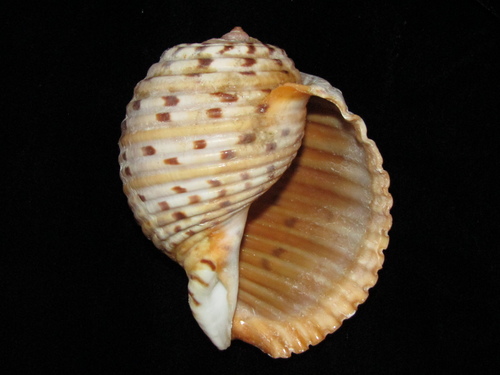
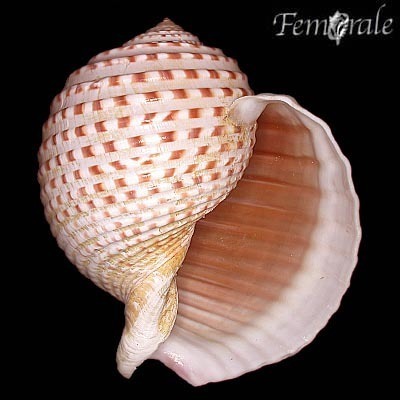
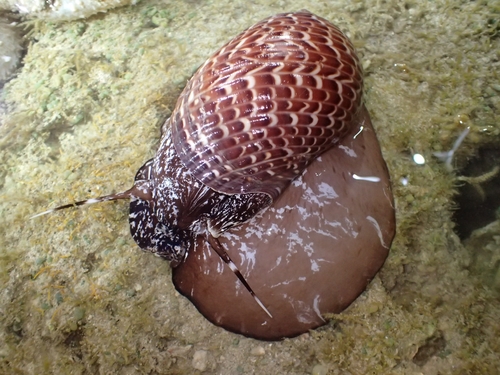
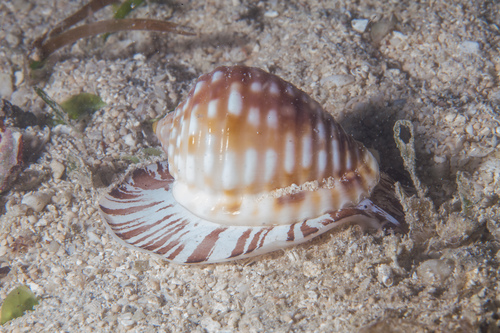
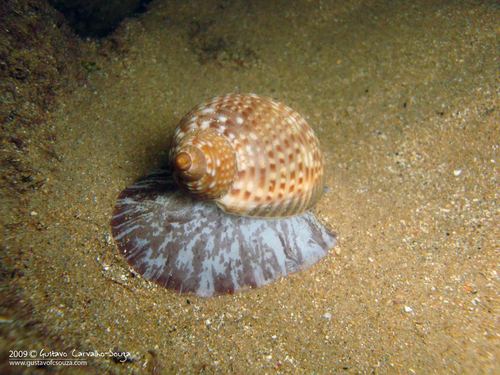
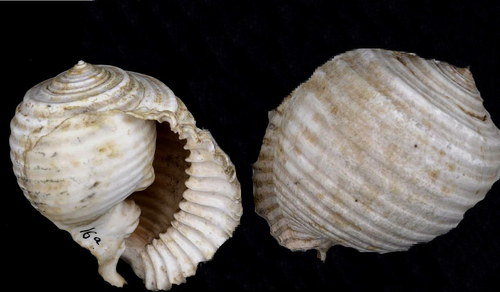
The shell of Malea ringens ranges in size from 60 mm to 270 mm, with an average diameter of approximately 100 mm. It is one of the largest shell species found in the Panamic region. Under the species' thin periostracum, the shells are primarily white and finely marked with yellow spots. The shell is quite thick, with an ovate-globose, ventricose shape. The pointed spire is made up of six whorls: the upper whorls are slightly convex, only minimally developed, and feature three or four clearly visible transverse striae marked with brown blotches. The body whorl is greatly inflated, and is entirely surrounded by 15 to 20 equal, depressed, slightly rounded ribs. These ribs are separated from one another by shallow furrows, which become wider between the first two or three upper ribs when intermediate ribs disappear. The longitudinal growth striae are numerous, very fine, and only faintly visible. The aperture is narrow, as it is significantly contracted by two protuberances located on the lower two-thirds of the columella. The outer lip is arched, flattened, and widened internally, with a broad longitudinal ridge on its outer surface. Along its full inner length, it has 16 to 18 very strongly prominent ridges or teeth. The outer lip's edge is undulated and denticulated. The inner lip is thin and diaphanous, spreading over the body of the shell and adhering to it, except towards the base where it becomes free and thicker. The columella is twisted, and has a very deep emargination; above this emargination sits a wide, thick, furrowed tubercle that appears suspended over the hollow. A second tubercle projects near the base, separated from the first tubercle by the cavity mentioned above. The columella has wrinkles and numerous brilliant white furrows that gradually decrease in size towards the base and above the emargination, which is turned outward like a gutter and is completely smooth. The exterior of the shell is whitish, lightly blended with a dull yellow shade. The interior of the shell is red. The periostracum is thin and yellowish. This species is distributed in the Pacific Ocean, ranging from Mexico to Peru, and is also found off the Galapagos Islands.