About Malcorus pectoralis A.Smith, 1829
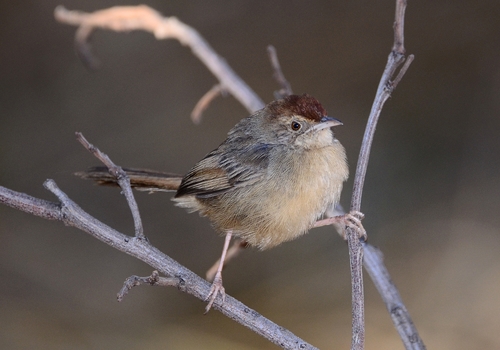
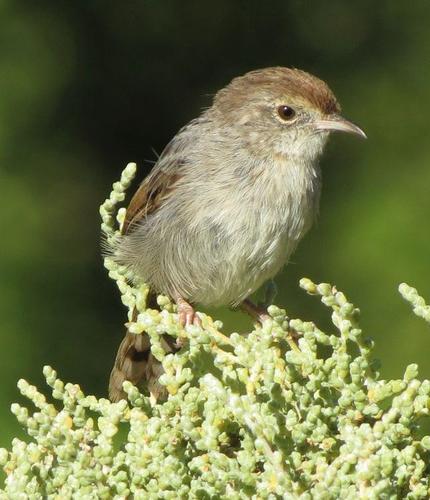
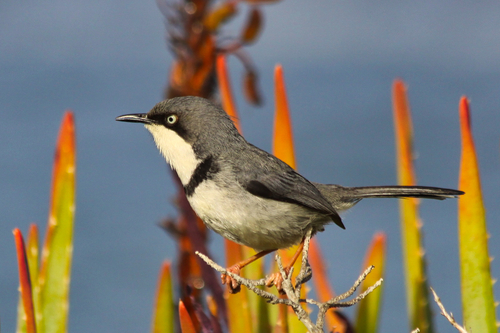
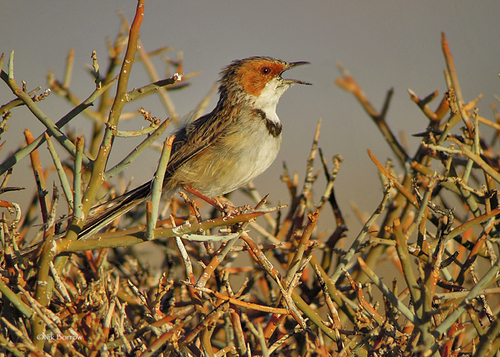
The rufous-eared warbler (scientific name Malcorus pectoralis A.Smith, 1829) is a small passerine bird named for its distinct rufous-coloured ear patches. Its head and the back of the neck are brown, streaked with dark red; the belly and front of the neck are greyish white, with a variable black breast-band that is absent from adult birds during winter. The mantle and back are mottled with greyish brown and blackish brown. It has reddish hazel eyes, pinkish legs, and a black bill 11–13 mm long. Its tail is long, thin, and often held upright over the body; it has 10 paired tail feathers total, with the outermost feathers up to 5.6 cm shorter than the central tail feathers. This species is small, measuring around 15 cm in total length: males weigh 10–12 g, while females weigh 9–11 g. Although the sexes look broadly similar, the rufous-eared warbler is one of the few Cisticolidae species that displays sexual dimorphism: females have paler ear patches and a narrower breast-band than males. Juveniles are paler overall, with a whiter belly and a narrower or completely absent breast-band. The subspecies M. p. ocularis is paler than the nominate form, with a more tawny face and whiter underparts. Subspecies M. p. etoshae is even paler than M. p. ocularis, with yellowish wing edges. This species is endemic and widely distributed across southern Africa, and is native to Botswana, Namibia, and South Africa. While its total global population size is not currently known, it is listed as Least Concern (LC) on the IUCN Red List because it has a large range. It is an arid-zone bird that lives in arid and semi-arid areas with scrubby bushes, as well as open grassland mixed with bushy vegetation on plains and slopes. It does not occur in Acacia karoo woodland or the core Namib desert, but it can be found along the Namib desert's edges in shrubs and drainage lines. It strongly favours low scrub Karoo habitats. The rufous-eared warbler is generally a resident species, but will occasionally move after rainfall events. Populations in arid areas do not experience large fluctuations during periods of low rainfall or drought, which indicates that individuals typically choose to stay in one place rather than move during unfavourable conditions. The rufous-eared warbler is predominantly insectivorous. Its recorded prey includes shield bugs, plant hoppers, beetles, termites, ants, moths, and spiders, and it also adds seeds, fruits, and insect larvae to its diet. It generally favours small beetles as its primary food source. Stomach content analyses have confirmed it feeds on termites, weevils, caterpillars, beetles, plant hoppers, coccids, bugs, ants, grasshoppers, spiders, and mites, as well as vegetation, fruit, and seeds from species in the Solanaceae, Asparagaceae, and Amaranthaceae families. It feeds mostly on the ground and in low shrubs, gleaning insects from foliage. It spends a large portion of its time on the ground, running between patches of cover. It often flies low between patches of scrubby vegetation, so it is sometimes mistaken for a rodent.