About Malayopython reticulatus (Schneider, 1801)
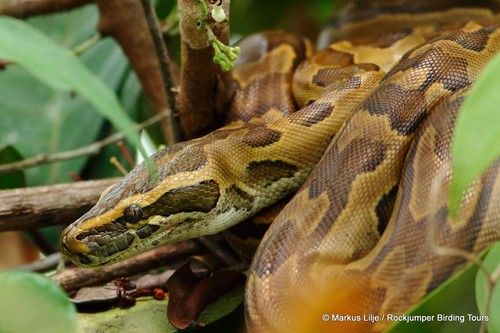
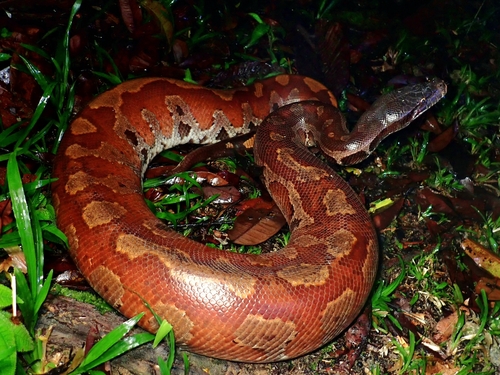
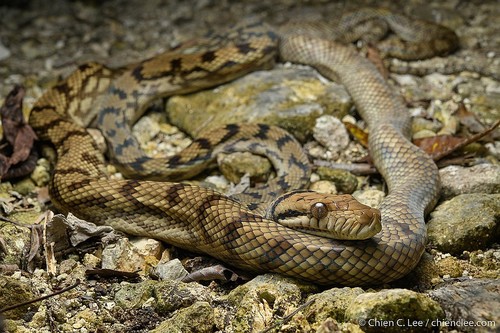
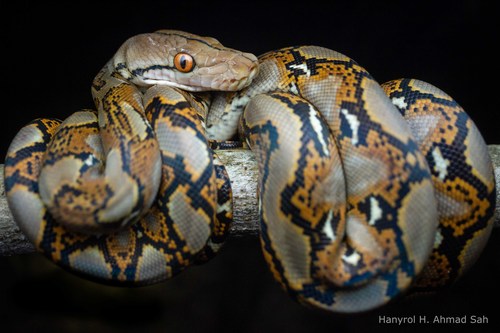
Malayopython reticulatus, commonly known as the reticulated python, has smooth dorsal scales arranged in 69–79 rows at midbody. Deep pits are present on four anterior upper labials, two or three anterior lower labials, and five or six posterior lower labials. It is the largest snake native to Asia. A study of over 1000 wild reticulated pythons in southern Sumatra estimated their length ranges from 1.5 to 6.5 m (4 ft 11 in to 21 ft 4 in) and their weight ranges from 1 to 75 kg (2 lb 3 oz to 165 lb 6 oz). Individuals over 6 m (19 ft 8 in) are rare, though the Guinness Book of World Records lists this species as the only extant snake that regularly exceeds this length. One of the largest scientifically measured specimens, collected from Balikpapan, East Kalimantan, Indonesia, measured 6.95 m (22 ft 10 in) and weighed 59 kg (130 lb 1 oz) under anesthesia after it had not eaten for nearly three months.
Colossus, a specimen held at the Highland Park Zoo (now the Pittsburgh Zoo and Aquarium) in Pittsburgh, Pennsylvania during the 1950s and early 1960s, was once widely accepted as the largest accurately measured snake ever recorded, with a peak reported length of 8.7 metres (28 ft 7 in) from a November 1956 measurement. It was later shown to be substantially shorter than originally reported. When Colossus died on 14 April 1964, its body was deposited at the Carnegie Museum of Natural History. Its skeleton was measured at 6.35 m (20 ft 10 in) total length, and its fresh hide measured 7.29 m (23 ft 11 in). Hides stretch during the skinning process, so they are often 20–40% or more longer than the original snake. Previous reports of Colossus's length combined partial measurements with estimations to account for kinks, as completely straightening a very large live python is virtually impossible. A 2012 journal article concluded from these issues that "Colossus was neither the longest snake nor the heaviest snake ever maintained in captivity." Because the specimen was too large to preserve with formaldehyde and stored in alcohol, it was prepared as a disarticulated skeleton. The hide was sent to a laboratory to be tanned, but it was either lost or destroyed; only the skull and selected vertebrae and ribs remain in the museum's collection today. There is also considerable confusion in existing literature over whether Colossus was male or female, and female reticulated pythons tend to be larger than males.
Numerous reports of larger reticulated pythons exist, but none have been measured by scientists or have specimens deposited in a museum, so these reports must be considered unproven and possibly erroneous. For many years, the New York Zoological Society (later renamed the Wildlife Conservation Society) has offered a large financial reward for a live, healthy snake 30 ft (9.14 m) or longer: the reward started at $1,000, was raised to $5,000, then to $15,000 in 1978, and reached $50,000 in 1980. No one has ever attempted to claim this reward.
The reticulated python is distributed across South and Southeast Asia, ranging from the Nicobar Islands, India, Bangladesh, Myanmar, Thailand, Laos, Cambodia, Vietnam, Malaysia, and Singapore, east through Indonesia and the Indo-Australian Archipelago including Sumatra, the Mentawai Islands, the Natuna Islands, Borneo, Sulawesi, Java, Lombok, Sumbawa, Sumba, Flores, Timor, Maluku, and the Tanimbar Islands, as well as the Philippines including Basilan, Bohol, Cebu, Leyte, Luzon, Mindanao, Mindoro, Negros, Palawan, Panay, Polillo, Samar, and Tawi-Tawi. The original species description did not include a type locality; Brongersma restricted the type locality to "Java" in 1972. Three subspecies have been proposed, but they are not recognized by the Integrated Taxonomic Information System. Color and size vary widely among the proposed subspecies, and each proposed subspecies has a distinct geographical range, so location is a good indicator for identifying these proposed subspecies.
This species inhabits rainforests, woodlands, and nearby grasslands. It is strongly associated with rivers, and is typically found in areas near streams and lakes. It is an excellent swimmer, and has even been reported far out at sea, which allowed it to colonize many small islands within its range. During the early 20th century, it was reported to be common even in busy areas of Bangkok, where it sometimes preyed on domestic animals. The reticulated python is oviparous. Adult females lay clutches of between 15 and 80 eggs. At an optimal incubation temperature of 31–32 °C (88–90 °F), eggs take an average of 88 days to hatch. Hatchlings are at least 0.61 m (2 ft) in length.