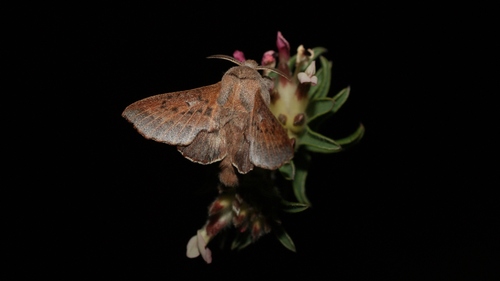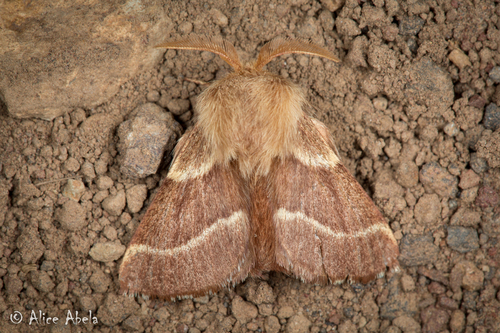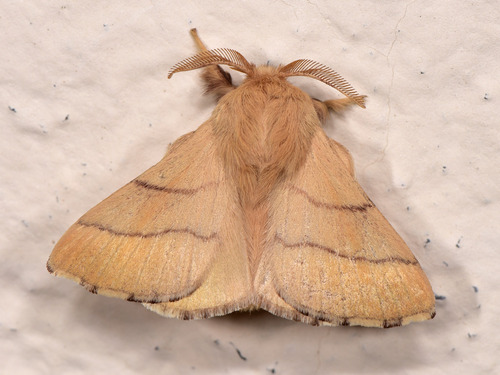
About Malacosoma neustria (Linnaeus, 1758)
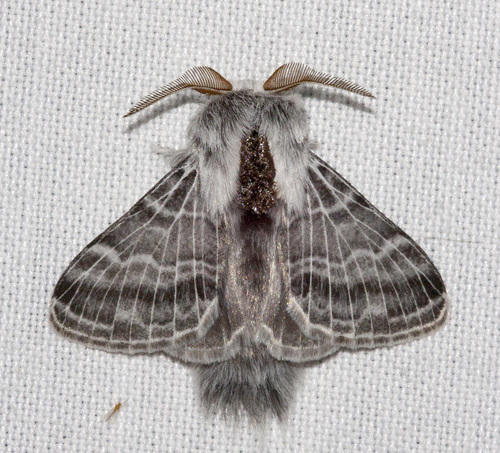
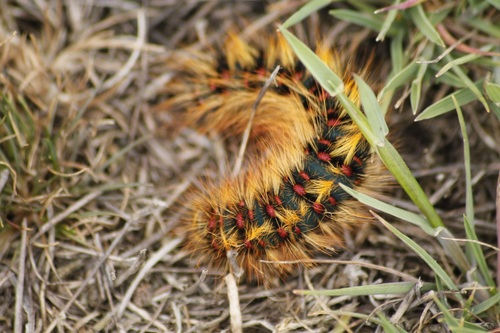
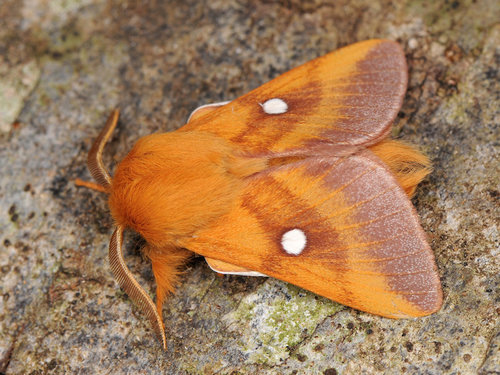
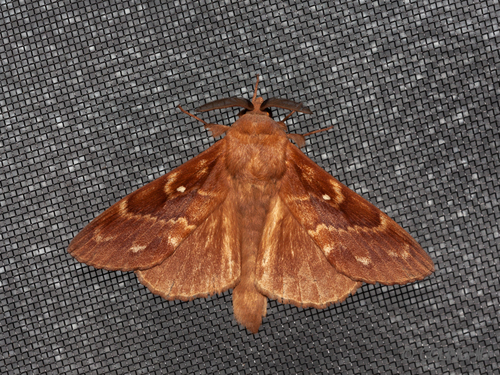
The lackey moth, with the scientific name Malacosoma neustria, is a moth species that belongs to the family Lasiocampidae. It was first formally described by Carl Linnaeus in the 10th edition of his work Systema Naturae, published in 1758. The species is common across southern Britain and central Europe, and is widely distributed overall across Europe, Asia, and North Africa. Members of the Malacosoma genus are known for their caterpillars, which are brightly coloured and construct silken tents to help regulate their body temperature. Malacosoma neustria caterpillars are brown, with blue, orange, and white stripes. Adult lackey moths are a fairly uniform brown colour. Larvae feed mainly on trees and shrubs while staying within their silken tents. Caterpillar food plants for this species include apple, pear, plum, willow, hornbeam, lime, and oak. This moth can be found in habitats including woodland edges, bushy grassland, coppices, hedgerows, and road verges. In the lackey moth life cycle, females lay eggs in ring-like bands during late summer, on twigs of their host trees. The eggs overwinter on these twigs before hatching. After hatching, the larvae are gregarious and weave a shared silken canopy of webbing. They feed on the tree's young foliage and moult several times as they grow. When they are ready to pupate, the larvae drop to the ground to undergo metamorphosis. Each individual forms a pupa that is sandwiched between leaves of plants growing under the host tree. In both Britain and Germany, adult lackey moths are active in flight from June to August.