About Malacosoma californica (Packard, 1864)
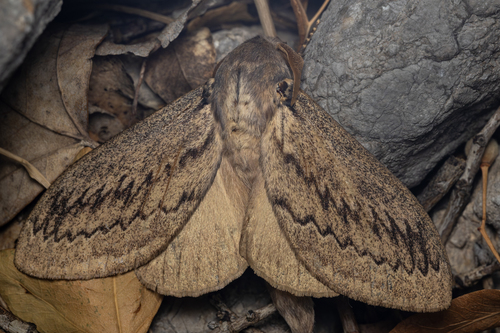
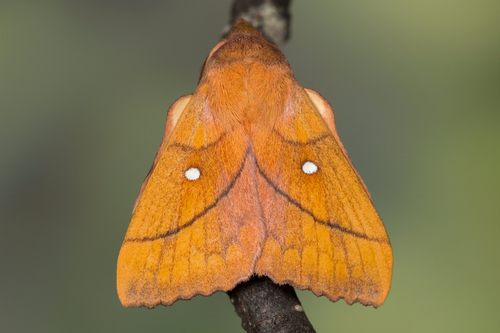
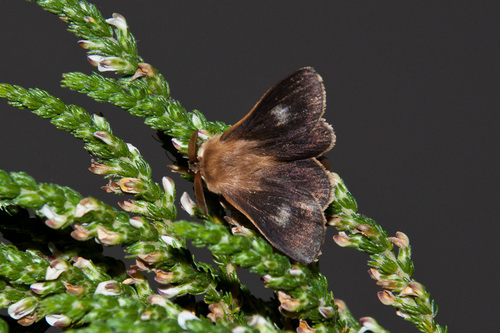
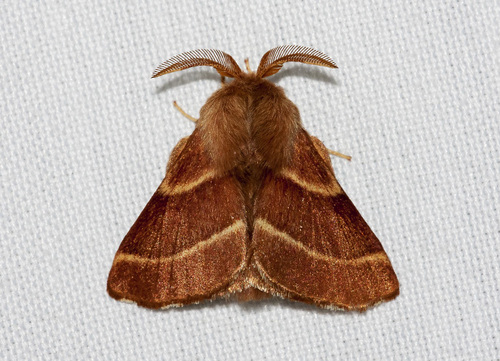
This species, Malacosoma californica, is commonly known as the Western Tent caterpillar. Mature pre-pupal Western Tent caterpillars reach 4 to 5 centimeters in length. Their bodies are black, grey, or white, with a single orange stripe that runs lengthwise along the body. Each body segment bears blue-white lines, and scattered setae project out from the caterpillar's body. Pupae measure 2 to 2.5 centimeters long, and range in color from reddish-brown to black. Pupae spin white silken cocoons that are dusted with a powder of white and yellow. Adult moths have a wingspan between 3.5 and 5 centimeters. Their bodies are brown, yellow, tan, or grey, and marked with two crossing lines that may be lighter or darker than the base color. For reproduction, adult moths mate during mid-summer. Males compete with one another to access females. Females are polyandrous, and lay a single clutch of eggs fertilized by multiple males. This clutch forms a continuous band of eggs that wraps completely around the circumference of a tree branch. A single egg band may hold hundreds of individual eggs. Western tent caterpillars have strong ecological interactions with their host plants. The timing of egg hatching is closely aligned with the bud-burst of host plants, to ensure early instar larvae can feed on new leaves. Despite this alignment, caterpillars may hatch anywhere from two weeks before to two weeks after host tree buds open. Climate change is predicted to cause phenological asynchrony between the western tent caterpillar and its host trees, which will lead to earlier larval emergence. This shift does not appear to have a significant effect on caterpillar larval fitness, because the larvae are able to resist starvation.