About Malacoptila panamensis Lafresnaye, 1847
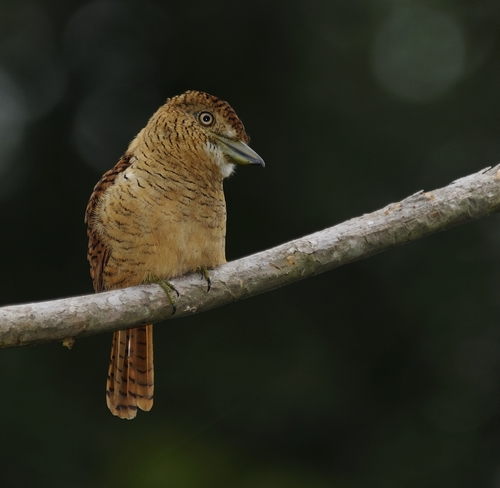
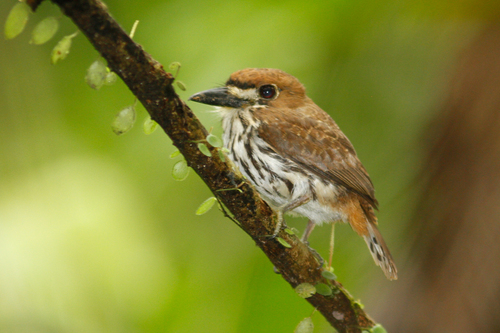
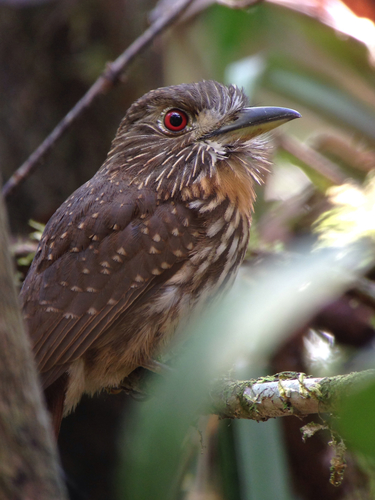
The white-whiskered puffbird (Malacoptila panamensis Lafresnaye, 1847) measures approximately 18 cm (7.1 in) long and has an average weight of around 43 g (1.5 oz). Unlike most puffbird species, male and female white-whiskered puffbirds have different plumage. Individuals of both sexes have bristles around the base of their large bill, plus white "whiskers" that are actually feather tufts. The upperparts of an adult male of the nominate subspecies range from brown to chestnut brown. The forecrown has narrow buff or tawny streaks, and most of the rest of the upperparts have buff or tawny spots. Its tail is chestnut brown. Its lores, supercilium, cheeks, and the sides of the neck are tawny. The throat and upper breast are tawny to tawny buff, while the rest of the underparts are buffy white with darker streaks on the breast and flanks. Adult females have less of a chestnut cast than males: their crown is grayer, and their upperparts are olive to brown. Most of their underparts are buff to cinnamon-buff with darker streaks, and their abdomen is white. Juveniles resemble adult females but have heavier streaking on the underparts. All subspecies are similar to the nominate subspecies, differing mainly in the shades of gray, brown, and rufous, and in the density of their streaking. Four subspecies of the white-whiskered puffbird have distinct ranges. M. p. inornata occurs on the Caribbean slope from southeastern Mexico, through Belize, Guatemala, Nicaragua and Costa Rica, into western Panama. M. p. panamensis occurs on the Pacific slope from southwestern Costa Rica, through Panama, into northwestern Colombia. M. p. magdalenae is found in the Magdalena River valley of west-central Colombia. M. p. poliopsis ranges from southwestern Colombia, through western Ecuador, into extreme northwestern Peru. This species mostly lives in dense primary evergreen forest, but it can also be found in secondary forest and in shorter vegetation along field edges. It typically stays fairly low to the ground, within 6 m (20 ft) of the surface. In terms of elevation range, it occurs from sea level up to 750 m (2,500 ft) in northern Central America, up to 900 m (3,000 ft) on Costa Rica's Caribbean slope and in Colombia, and up to 1,200 m (3,900 ft) on Costa Rica's Pacific slope.