About Malaconotus blanchoti Stephens, 1826
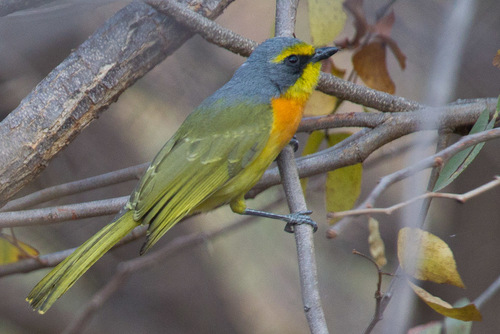
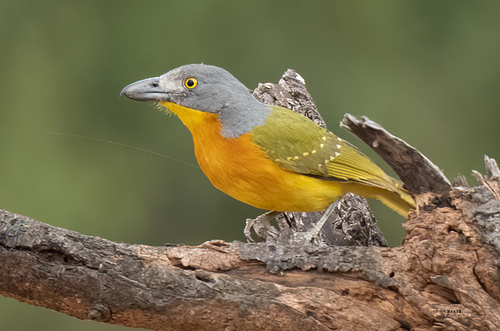
This species, Malaconotus blanchoti, has sexes that look identical, and adults measure 22.6 to 25.2 cm from bill to tail. Its distinctive face features a large, powerful black bill and a rich yellow iris. In related bushshrike species, white plumage on the lore extends past the whitish eye region, which is not the case for this species. Immature individuals of this species are generally paler overall than adults. Juveniles have pale yellow plumage on the chest, and brown barring or mottling across the crown; they can also be distinguished by their brown eyes and brownish horn-colored bills. This species lives in sympatry with the orange-breasted bushshrike, a similarly plumaged bird that is smaller and has more slender physical features. In subtropical regions, this species occurs at a density of 1 pair per 200 hectares, and a breeding pair holds a territory of around 50 hectares. In Zimbabwe, it is closely associated with miombo woodland, and occurs more sparsely in semi-arid savannah. It can also be found in riparian vegetation and associated tall Acacia, lowland evergreen thicket and forest, and the interior of riparian ground-water forest. It occurs at elevations from sea level to 1,500 metres, and up to 1,600 metres in Zimbabwe; in tropical areas, it can be found locally up to 3,000 metres. It avoids areas with annual rainfall below 500 mm. In southern Africa, it is absent from Kalahari woodlands, and it is largely replaced by the orange-breasted bushshrike in the Okavango Delta. It occurs in sympatry with the orange-breasted bushshrike across many areas, and may sometimes be found living in close proximity to several other bushshrike species. It is rarely found in non-native tree plantations, but occurs more commonly in gardens, where it would go unnoticed if it did not call frequently. Most of its diet consists of insects, but it also preys on mice (which it swallows whole), small birds, snakes, lizards, and chameleons.