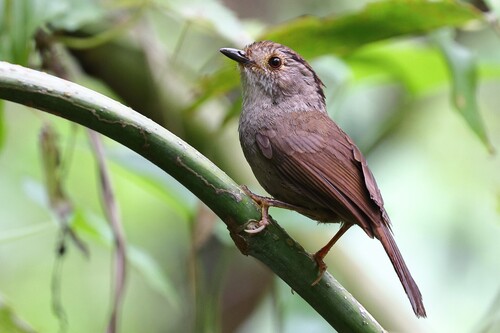
About Malacocincla abbotti Blyth, 1845
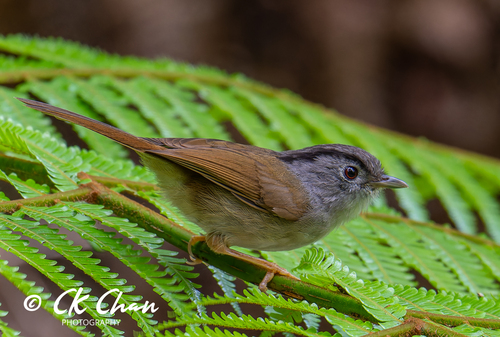
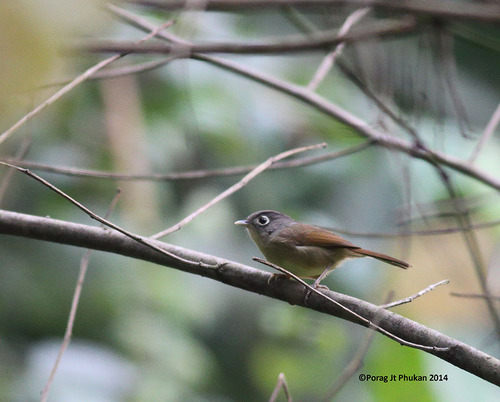
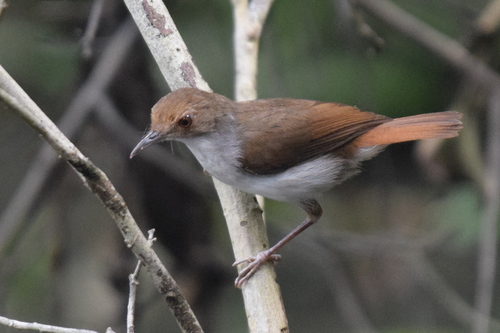
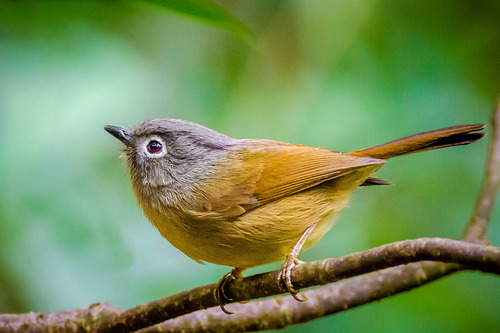
Adult Abbott's babbler (Malacocincla abbotti) is a nondescript, short-tailed brown babbler that moves through low vegetation, often near streams, around tree ferns and in tangled growth. Its throat is gray-white, the center of the belly is white, flanks are olive, and undertail coverts are rusty-colored. The sexes have identical plumage. It has a short tail, a heavy bill, and overall drab olive-brown plumage, with bright rusty lower flanks and vent, a grayish-white throat and breast, and variable pale gray supercilium and lores. Juvenile birds have dark rufescent-brown crowns and upperparts. The calls of this species are distinctive. The subspecies M. a. krishnarajui from the Eastern Ghats has a darker russet tail and rump than the nominate subspecies native to the Himalayas. Adult specimens measure 12–13 cm (4.7–5.1 in) in total length, with a head length of 39–44 mm (1.5–1.7 in) and a tail length of 55–61 mm (2.2–2.4 in).
In terms of distribution and habitat, Abbott's babbler is a resident bird in South Asia, ranging from Nepal to India's Arunachal Pradesh and Assam Valley, extending south through the South Assam hills including Meghalaya, and continues south through the Lushai Hills. It is also resident in eastern and southern Bangladesh (around Jessore and Khulna), and in the Eastern Ghats of northeastern Andhra Pradesh and Odisha. It occurs at elevations up to 600 m (2,000 ft) across its range, and up to 275 m (902 ft) in Nepal. It is also widely distributed across Southeast Asia, and is common across most of its large range. It inhabits the understory of broadleaved evergreen forest, forest edges, secondary growth, and scrub. In Singapore, populations have been recorded tolerating disturbance and adapting to live in secondary growth and disturbed forest.
For behavior and ecology, Abbott's babbler usually moves in pairs close to the ground. Its breeding season runs from April to July, during the summer monsoon. The nest is a bulky cup carefully placed low down in palms or other undergrowth; a study in Thailand found that most nests are built in spiny palms and rattans. The typical clutch is 3 to 5 eggs, which are bright salmon with dark blotches and red lines. When disturbed at the nest, the birds slip over the edge, fly with labored wing beats, then hop out of sight. A pair may raise more than one brood in a single breeding season. The species' distinctive calls are made up of three or four notes, with a pitch drop on the middle note. A male and female perform an antiphonal duet, with the male leading a call transcribed as "poor'ol bear", followed by the female's "dear dear". Call patterns can change over time. The birds tend to stay within a well-defined home range and do not wander widely. The song is a variable short series of around three to four rich, fluty, liquid, slurred, short whistled notes; it may be delivered either haltingly or rapidly. Evening group song includes a recurrent low, slurred sputtering "churrr" sound, ending with a sharp "chreep". Other calls include soft mewing notes, and a pulsing, purring trill produced when the bird is agitated.