About Malaclemys terrapin (Schoepff, 1793)
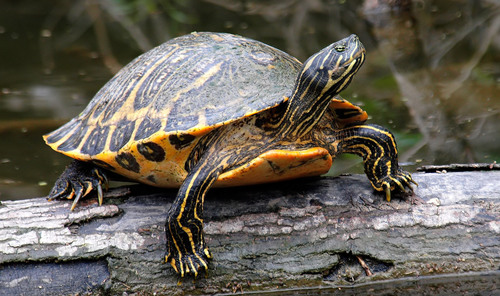
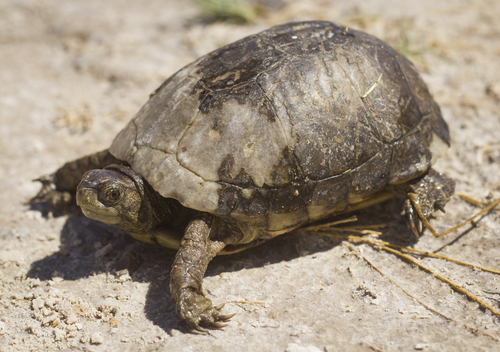
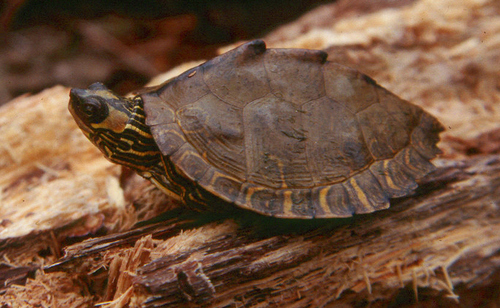
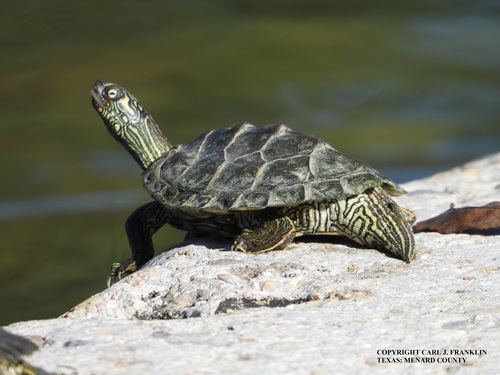
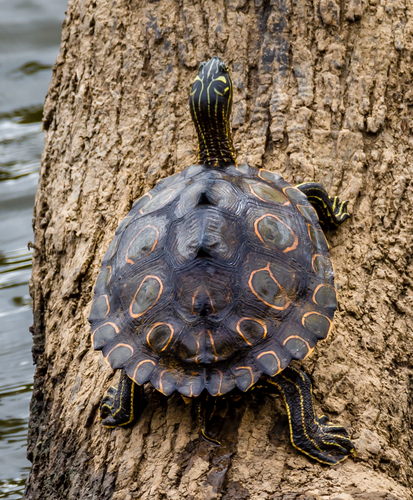
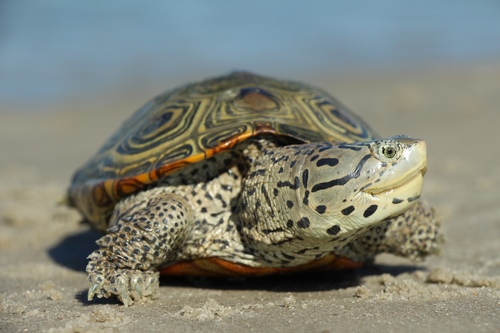
The common name of Malaclemys terrapin (Schoepff, 1793), the diamondback terrapin, comes from the diamond pattern on the top of its shell (called the carapace). Overall pattern and coloration vary so greatly between individuals that no two diamondback terrapins look exactly alike. Its shell is typically wider at the back than at the front, and appears wedge-shaped when viewed from above. Shell coloring ranges from brown to grey, while body color can be grey, brown, yellow, or white. All individuals have a unique pattern of wiggly black markings or spots across their body and head. This species has large webbed feet, and it is sexually dimorphic: males grow to a carapace length of approximately 13 cm (5 in), while females have an average carapace length of around 19 cm (7+1⁄2 in), and can grow larger. The largest recorded female had a carapace length just over 23 cm (9 in). Individuals from consistently warmer regions tend to be larger than those from cooler, more northern areas. On average, males weigh 300 g (11 oz) and females weigh around 500 g (18 oz); the largest females can weigh up to 1 kg (35 oz). Diamondback terrapins can live up to 40 years in captivity, while scientists estimate a typical wild lifespan of about 25 years.
Diamondback terrapins inhabit a narrow strip of coastal habitat along the Atlantic and Gulf Coasts of the United States, ranging from Cape Cod, Massachusetts in the north to the southern tip of Florida, and along the Gulf Coast to Texas. Across most of their range, they live in Spartina marshes that flood at high tide; in Florida, they also occupy mangrove swamps. This turtle can survive in both freshwater and full-strength ocean water, but adult individuals prefer habitats with intermediate salinities. Despite their preference for saltwater, they are not true sea turtles and are not fully marine. They face no competition from other native turtles, though common snapping turtles occasionally use salty marshes. It remains unclear why diamondback terrapins do not live in the upper reaches of rivers within their range, as they tolerate fresh water in captivity; their limited range there may be due to the distribution of their prey. Unlike sea turtles, which wander far out into open ocean, diamondback terrapins live quite close to shore. A self-established (not human-introduced) population of terrapins also exists on Bermuda. Diamondback terrapins tend to stay in the same general area for most or all of their lives, and do not make long-distance migrations.
While diamondback terrapins resemble their freshwater relatives, they are well adapted to near-shore marine environments, with several traits that let them survive across a wide range of salinities. They can live in full-strength salt water for extended periods, and their skin is largely impermeable to salt. Unlike their freshwater relatives, they have lachrymal salt glands that they use primarily when dehydrated. They can distinguish between drinking water of different salinities, and they exhibit unusual, sophisticated behavior to obtain fresh water: they drink the thin layer of freshwater that accumulates on top of salt water during rainfall, and they also raise their heads into the air with mouths open to catch falling raindrops. They are strong swimmers, with strongly webbed hind feet, but do not have flippers like sea turtles. Like their close relatives in the genus Graptemys, they have strong jaws for crushing the shells of prey such as clams and snails; this is especially pronounced in females, which have larger, more muscular jaws than males.
Adult diamondback terrapins mate in early spring, and females lay clutches of 4–22 eggs in sand dunes in early summer. Eggs hatch in late summer or early fall. Males reach sexual maturity at 2–3 years of age, when they reach a length of around 115 mm (4+1⁄2 in). Females take longer to mature: 6–7 years for most populations, and 8–10 years for northern diamondback terrapin populations, reaching maturity at a length of around 170 mm (6+3⁄4 in).
Like all reptiles, diamondback terrapins have internal fertilization. Courtship has been observed in May and June, and is similar to that of the closely related red-eared slider (Trachemys scripta). Females can mate with multiple males and store sperm for multiple years, which means a single clutch of eggs can have more than one father. Like many turtle species, diamondback terrapins have temperature-dependent sex determination, so the incubation temperature of eggs determines the sex of hatchlings. Females can lay up to three clutches of eggs per year in the wild, and up to five clutches per year in captivity. It is not known how often females may skip reproduction, so the true average clutch frequency is unknown. Females may travel considerable distances over land before selecting a nesting site. Nests are usually laid in sand dunes or scrub vegetation near the ocean in June and July, but nesting can start as early as late April in Florida. Females will quickly abandon a nesting attempt if disturbed during the process. Average clutch size varies with latitude, ranging from as low as 5.8 eggs per clutch in southern Florida to 10.9 eggs per clutch in New York. After covering their completed nest, females quickly return to the ocean and do not return to the nest except to lay new clutches later. Eggs usually take 60–85 days to hatch, depending on nest temperature and depth. Hatchlings most often emerge from the nest in August and September, but may overwinter inside the nest after hatching. Nest predation is a major threat to diamondback terrapins; a study of 3159 nests found that raccoons are the most significant nest predator, and completely emptied all predated nests of their eggs. Hatchlings sometimes stay on land in nesting areas during both fall and spring, and may remain on land for most or all of the winter in some locations. Hatchling terrapins are freeze tolerant, a trait that facilitates overwintering on land. Young terrapins (one- and two-year-old individuals) have lower salt tolerance than adults, and research has found strong evidence that juveniles use different habitats than older individuals. Growth rates, age of maturity, and maximum age are not well documented for wild terrapins, but males reach sexual maturity earlier than females due to their smaller adult size. For females at least, sexual maturity depends on size rather than age. Age estimations made by counting growth rings on the shell have not been validated, so there is currently no confirmed method to determine the age of wild diamondback terrapins.
The diamondback terrapin holds symbolic meaning in multiple contexts. Maryland named it the official state reptile in 1994. The University of Maryland, College Park has used the species as its team nickname (the Maryland Terrapins) and mascot (Testudo) since 1933; the school's newspaper has been named The Diamondback since 1921, and its athletic teams are often shortened to "Terps". In 1914 and 1915, the Baltimore baseball team that competed in the Federal League was called the Baltimore Terrapins. The species also became a symbol of the band the Grateful Dead after the release of their studio album *Terrapin Station*, leading to many images of a dancing terrapin with a tambourine appearing on Grateful Dead posters and t-shirts. Terrapin Beer Company took its name from the album, and uses a terrapin as its namesake and logo on product packaging.