About Malacanthus plumieri (Bloch, 1786)
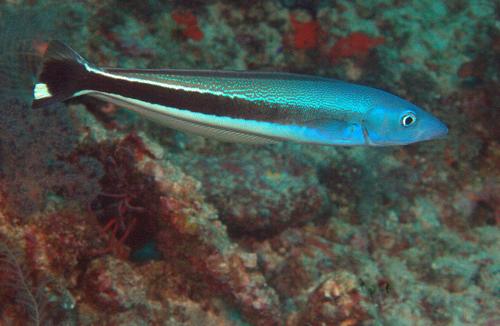
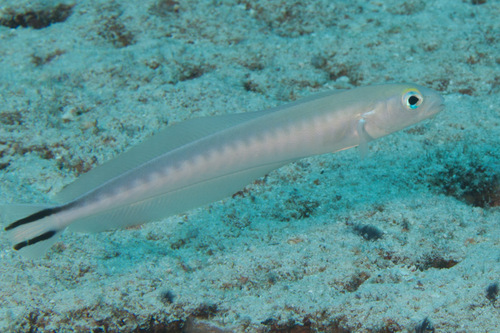
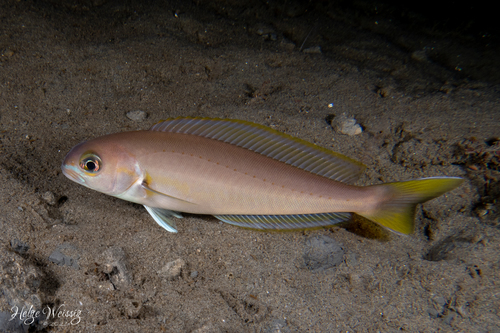
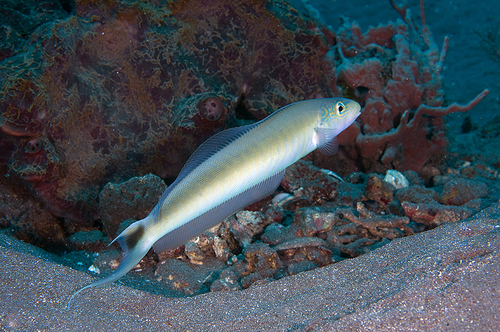
Malacanthus plumieri (Bloch, 1786) has a highly elongated, slightly compressed body with a slender, rounded head. There is a large, sharp spine at the corner of the gill cover. This species varies in colour from yellowish white to pale bluish gray, and its head has pale yellow and bluish markings. The dorsal and anal fins are long. The caudal fin is lunate, mainly yellow in colour with a dark blotch on the lower part of the upper lobe. This species has 4–5 spines and 53–57 soft rays in its dorsal fin, while the anal fin has 1 spine and 50–52 soft rays. The maximum recorded total length is 70 cm (28 in), although 50 cm (20 in) is more typical. Individuals can weigh up to 1 kg (2.2 lb).
Malacanthus plumieri is found in the western Atlantic Ocean. Its range extends from Cape Lookout in North Carolina and Bermuda in the north, southwards along the coast of the United States to the Bahamas, and into the Gulf of Mexico, where it has been recorded from the Florida Keys, along the shoreline of the Florida panhandle as far as eastern Louisiana, and the Flower Garden Banks and the surrounding area. It also occurs from Tuxpan along the Yucatan Peninsula, and around Cuba. It can be found widely in the Caribbean Sea, and on the coast of Brazil from the mouth of the Amazon River south to Uruguay. They are absent from the coasts between the mouth of the Orinoco River and the Amazon. It is also known from Trindade Island off Brazil and Ascension Island in the eastern Atlantic.
Malacanthus plumieri is found at depths between 3 and 153 m (10 and 502 ft). It is mainly a benthic inhabitant of shallow waters where the substrate is predominantly rubble or sand. Here it creates mounds of rubble or shell fragments in the vicinity of reefs and sea grass beds. When alarmed it dives head first into its mound. They feed mainly on stomatopods, fishes, polychaetes, chitons, sea urchins, starfish, amphipods and decapods, especially shrimp. It spends long periods hovering over its mound, undulating the long dorsal and anal fins. They are territorial, and the territories of males overlap with those of the females. They spawn as pairs: the male approaches the female in an undulating motion, the pair then rises up the water column in a crisscrossing pattern, ending with the pair swimming while quivering, and gametes are released at the zenith.