About Malacanthus latovittatus (Lacepède, 1801)
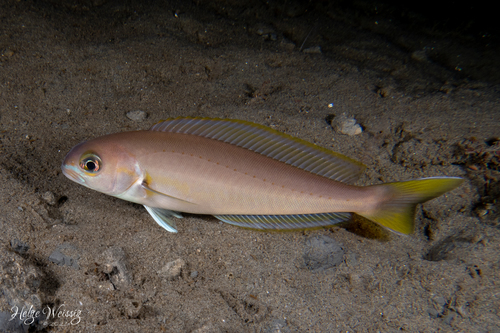
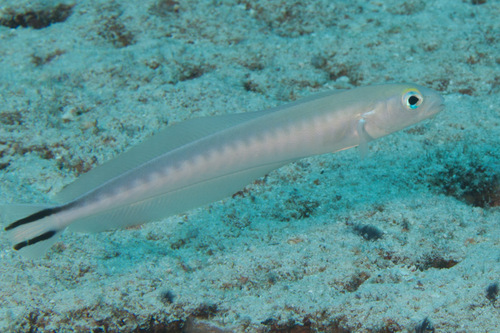
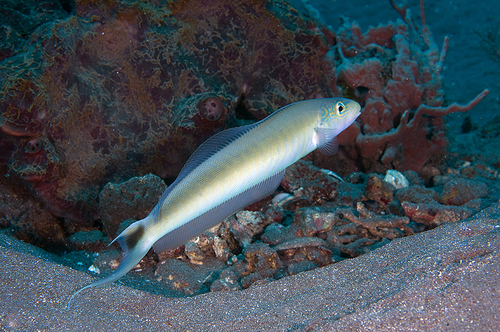
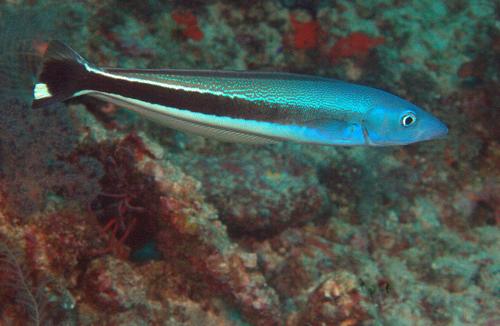
Malacanthus latovittatus, commonly known as the blue blanquillo, has an elongated body with a pointed snout; its mouth reaches as far as the forward nostril. The margin of its preoperculum is smooth, and its gill cover bears a sharp spine that is similar in size to the diameter of the pupil. The head and anterior part of the body are blue, and this color fades along the posterior portion of the body. Adults have a wide black lateral stripe that starts at the base of the pectoral fin, while in juveniles this stripe starts at the snout. Adults have fine lattice patterning on their upper back, and a white patch on the middle of the rear margin of the caudal fin. A pale line runs along the upper margin of the greyish dorsal fin; the anal and pelvic fins are white, and the pectoral fins are bluish. Juvenile blue blanquillo resemble juveniles of the ringed slender wrasse Hologymnosus annulatus. This species has 3–4 spines and 43–47 soft rays in its dorsal fin, and 1 spine and 37–40 soft rays in its anal fin. It reaches a maximum total length of 45 cm (18 in), with a more typical standard length of 35 cm (14 in).
The blue blanquillo has an Indo-Pacific distribution. It occurs in the Red Sea, along the eastern coast of Africa, across the entire Indian Ocean, and into the Pacific Ocean as far east as the Hawaiian Islands, Tabuaeran, and Samoa. Its range extends north to Japan and south to Australia. In Australia, it can be found from Dirk Hartog Island in Western Australia to Ashmore Reef in the Timor Sea, along the Great Barrier Reef off Queensland, and as far south as Seal Rocks. This species is also present at the Cocos (Keeling) Islands and Christmas Island.
Malacanthus latovittatus inhabits depths between 4 and 65 m (13 to 213 ft), and is most often found on the outer slopes of reefs. It has also been recorded in brackish water in the Goldie River of Papua New Guinea. Individuals are either solitary or live in pairs. While they are not known to clean other fish, they may mimic wrasse to deter predators from attacking them. Blue blanquillo typically swim high above the seabed substrate, and use their excellent eyesight to pick prey from the seabed. Adults mate in monogamous pairs. This is a wary species that swims away from threats instead of diving into its burrow. It lives in and around a burrow it constructs itself out of sand and rubble. The blue blanquillo feeds primarily on benthic invertebrates or zooplankton, and also eats crustaceans including crabs and shrimp, molluscs, worms, sea urchins, and small fish.