About Malacanthus brevirostris Guichenot, 1848
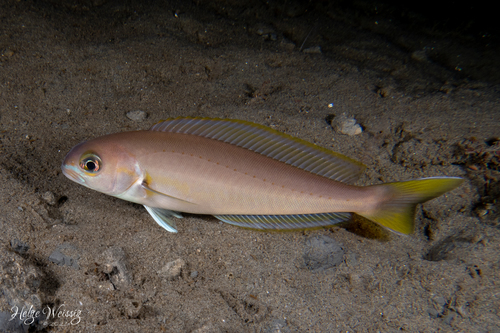
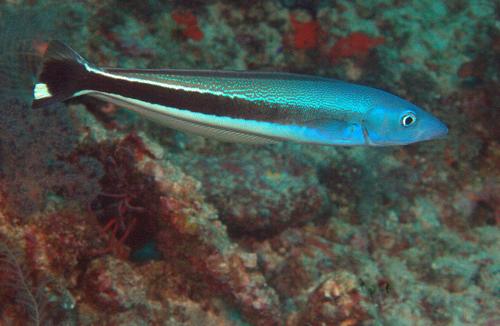
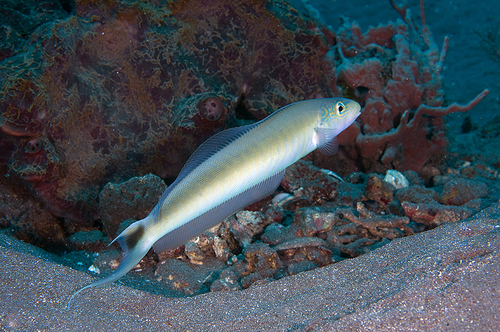
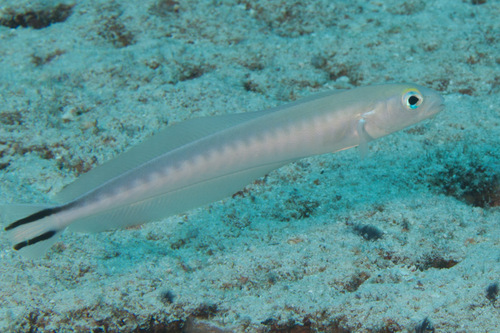
Malacanthus brevirostris Guichenot, 1848 is a species with a long, slender body, a rounded head, and a large, sharp spine at the center of its gill cover. Its base body color is greyish, with an added yellow hue on the head. The back has distinct chevron-shaped markings. Its caudal fin has two convergent black stripes, one on each of the upper and lower lobes. The dorsal fin has between 1 and 4 spines and 52 to 56 soft rays, while the anal fin contains one spine and 46 to 55 soft rays. This species reaches a maximum total length of 32 cm (13 in), with a more typical standard length of 25.6 cm (10.1 in). Malacanthus brevirostris has a wide distribution across the Indian and Pacific Oceans. Its range extends from the Red Sea and the eastern coast of Africa east to Hawaii, and continues to the western coasts of Panama and Colombia, reaching north to Japan and south to the Austral Islands and Lord Howe Island. In the eastern Pacific, it can also be found at Clipperton Island, a French territory, Colombia’s Malpelo Island, Ecuador’s Galápagos Islands, and Cocos Island, which belongs to Costa Rica. This species lives in association with reefs, found at depths ranging from 5 to 50 m (16 to 164 ft). It occurs most often in barren, open areas of outer reef slopes, where it is typically found in pairs that live in an excavated sand hole. When threatened, the fish retreat into their burrow for shelter. Its pelagic life stage continues until the fish reaches at least 5 cm (2.0 in) in length. Malacanthus brevirostris feeds on small fishes and invertebrates.