About Makaira nigricans Lacepède, 1802
Description: For Makaira nigricans (blue marlin), the largest females are more than four times as heavy as the largest males, which rarely weigh over 160 kg (350 lb). The longest females can reach a total length of 5 m (16 ft) including the bill, and the bill from eye to tip makes up around 20% of this total body length. Reported body masses of the largest verified female specimens range from 540 to 820 kg (1,190 to 1,810 lb) across different sources, as very few large specimens have been scientifically verified. The largest blue marlin caught under IGFA angling rules was caught off Vitoria, Brazil, and weighed 636 kg (1,402 lb). Fishermen commonly call individual blue marlin that reach or exceed 1,000 pounds "granders".
Both male and female blue marlin have 24 vertebrae: 11 precaudal and 13 caudal. This species has two dorsal fins and two anal fins, all supported by bony spines called rays. The first dorsal fin has 39 to 43 rays from front to back, while the second dorsal fin has 6 or 7 rays. The first anal fin, which matches the second dorsal fin in shape and size, has 13 to 16 rays, and the second anal fin has 6 or 7 rays. The long, narrow pectoral fins have 19 to 22 rays and can be retracted against the sides of the body. Pelvic fins are shorter than pectoral fins, have poorly developed membrane, and can be depressed into ventral grooves. The first anal fin, along with the pectoral and caudal fins, can be folded into grooves to streamline the fish and reduce drag.
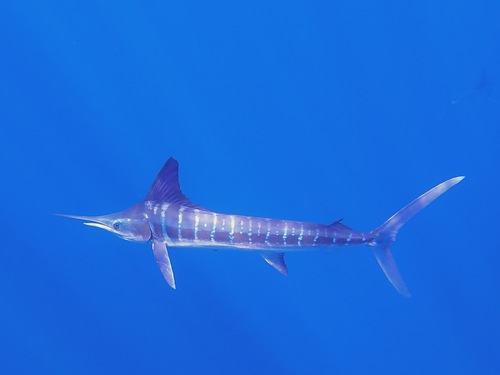
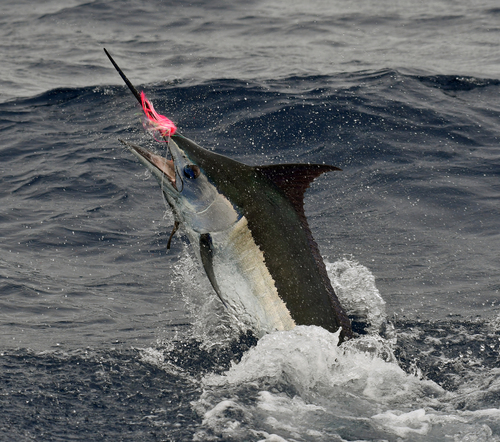
Like other billfish, blue marlin can change color rapidly, an effect produced by pigment-containing iridophores and light-reflecting skin cells. Most of the time, however, the upper body is blue-black, with a silvery white underside. Both sides of the body have around 15 rows of pale cobalt-colored stripes, each of which contains round dots, thin bars, or both. The membrane of the first dorsal fin is dark blue or nearly black, with no dots or markings. Other fins are typically brownish-black, sometimes with a faint dark blue tint. The bases of both the first and second anal fins have a faint silvery white hue. The body is covered with thick, bony, elongated scales that have 1, 2, or 3 posterior points; single-pointed scales are the most common form. The bill is long and stout. Small, file-like teeth cover both the jaws and the palatines, which form the roof of the mouth. The lateral line system is a collection of neuromasts rooted in lateral line canals that can detect weak water movements and large pressure changes, and has a net-like appearance. It is easily visible in immature blue marlin but becomes unclear in adults, as it gradually becomes embedded in the skin. The anus is located just in front of the origin of the first anal fin.
Range and migration: Blue marlin live year-round in tropical oceanic waters of the Atlantic. During warmer months, their range extends into temperate waters of both the Northern and Southern Hemispheres, and contracts toward the Equator during colder months. Warm currents such as the Gulf Stream in the western Atlantic have a major influence on their seasonal distribution. As the most tropical of all billfishes, blue marlin spend much of their time in the water column between the surface and a depth of 100 meters. They spend most nights near the surface, and dive to deeper depths during the day. They cannot go deeper than this range due to limiting water temperature and oxygen levels. The species' latitudinal range extends from roughly 45°N to roughly 35°S. It is less abundant in the eastern Atlantic, where it occurs mostly off Africa between 25°N and 25°S. The highest population densities are usually found in waters warmer than 24 °C (75 °F), but blue marlin have been recorded in surface waters with temperatures as high as 30.5 °C (86.9 °F) and as low as 21.7 °C (71.1 °F).
Tagging studies, using conventional "spaghetti" tags and more recently pop-up satellite tags, have allowed researchers to study blue marlin migration patterns and habits. Recaptures of tagged fish have documented multiple movements between the Caribbean Islands, Venezuela, and the Bahamas, as well as between the Caribbean's Saint Thomas (U.S. Virgin Islands) and West Africa, including interocean travel. Most notably, a blue marlin tagged off the coast of Delaware was recovered near the island of Mauritius off the southeast coast of Africa in the Indian Ocean, after traveling 9,254 miles. Multiple fish have been recaptured in the same general area where they were originally tagged, which suggests reverse migration over several years, but existing data is not sufficient to accurately determine seasonal movement patterns.