About Magnolia tripetala (L.) L.
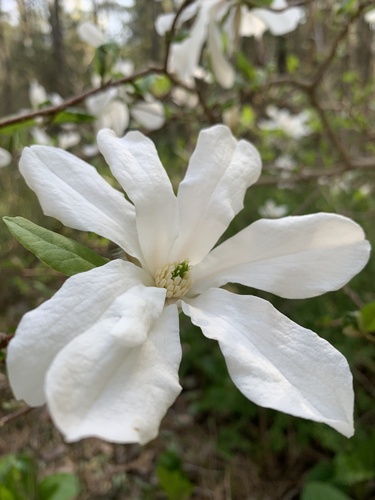
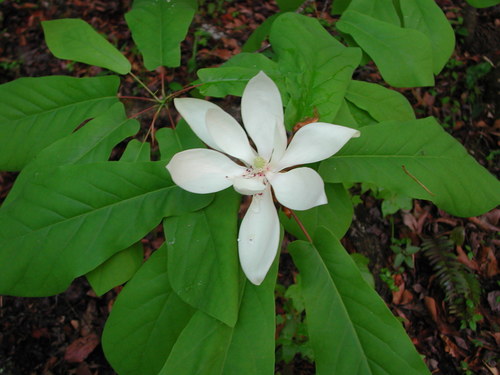
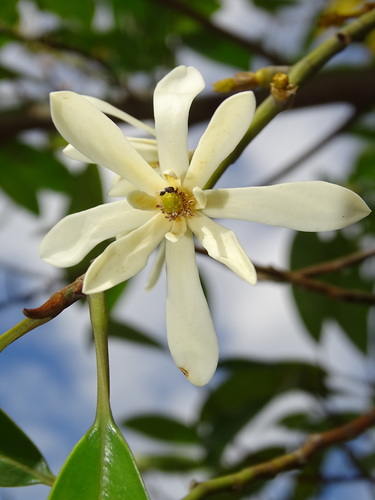
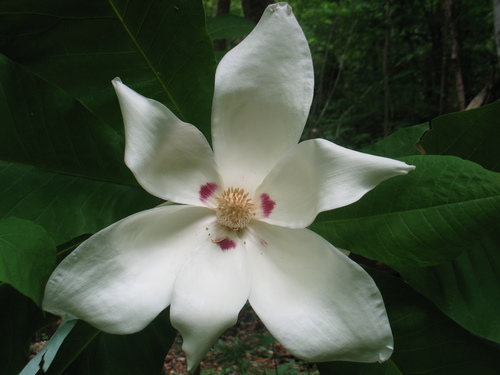
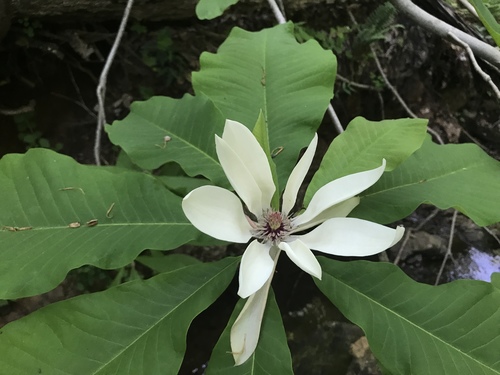
Magnolia tripetala (L.) L., commonly called umbrella magnolia, gets its common name from the fact that its leaves are clustered at the ends of branches, giving them the appearance of an umbrella. Its leaves are large, shiny, dark green on top and pale green underneath, 30–50 cm long, alternate, simple, and oblong. Leaves are clustered at the tip of the stem with very short internodes, and their size and arrangement resemble those of the related species Magnolia macrophylla. In autumn, the leaves turn yellow. Umbrella magnolia grows from stout stems; most trees grow from single stems, though multiple stems are not uncommon. In natural settings, the species can reach 15 m in height. Its bark is thin, gray, mostly smooth, and may have raised lenticels. This tree is moderate growing during the spring season, is shade tolerant, and has shallow spreading roots. It is pollinated primarily by beetles. Its large flowers bloom in spring, are 15–25 cm in diameter, have six to nine creamy-white tepals and a large red style, and are noted to have an unpleasant, malodorous scent. While the flowers have an unpleasant smell, they are not toxic to organisms. After flowering, the red style develops into a 10 cm long red aril fruit; the species also produces reddish cone-shaped fruit, which holds several red seeds. This tree naturally grows in rich, moist woods, along slopes, streams, and ravines. Its native range extends from New York state south to southern Florida, and west to Arkansas and parts of Oklahoma, and it occurs naturally in the deciduous forests of the Appalachian Mountains. Research indicates that the species is not native to northern states such as Pennsylvania, and is only a recent arrival there. It has been cultivated outside its natural range, and has spread from cultivation into nearby woodlands; single individuals and small populations have been observed growing outside its native range near cultivated sites. It holds the FACU wetland status, prefers average to dry soil, and has low tolerance to drought and fire. It most commonly grows in slope forests on north-facing slopes, and also grows along streambanks and in ravines. In reproduction, cultivated Magnolia tripetala can produce pollen with low viability, ranging from 9.4% to 31.7%. Actual seed productivity of this species is lower than its potential productivity, but it is characterized by high seed germination rates that can reach up to 94%. Optimal conditions for seed germination are in protected ground or a greenhouse, with stratification at 4 °C for 30 days. Male reproductive parts of the flower mature first. Beetles are the primary pollinators; beetles enter flower buds to feed on pollen, moving pollen from the male parts of the flower to the female parts. Birds and squirrels disperse the species' seeds. Flowers bloom in spring, and seeds mature and disperse throughout the summer. The species spreads slowly, but its seedlings are resilient. Its branches contain ethyl acetate, a substance that shows nematicidal activity, and can specifically resist the nematodes Bursaphelenchus xylophilus, Panagrellus redivivus, and Caenorhabditis elegans. It has been used as a parent with Magnolia obovata (Japanese cucumber tree) to produce the hybrid Magnolia x pruhoniciana, an ornamental plant named for Prühonice Park in the Czech Republic, where it was first discovered. This hybrid has produced multiple variants, including the named 'Silk Road' and 'Silver Parasol' cultivars. These hybrid variants are deciduous medium trees with elliptic to ovate leaves that measure 20-45 cm by 10-22 cm. Their white flowers, 16-25 cm across, grow at the end of branches. Fruit traits such as number of follicles and stamen scars in the cultivars are intermediate between the two parent species. Umbrella magnolia leaves are eaten by a variety of animals. These trees often grow under the canopy of larger trees and support biodiversity in forested areas. They are attractive and easy to grow, and are notably used as specimen trees for their unique foliage. The species is grown as an ornamental in urban areas, and used as a focal tree in garden settings.